
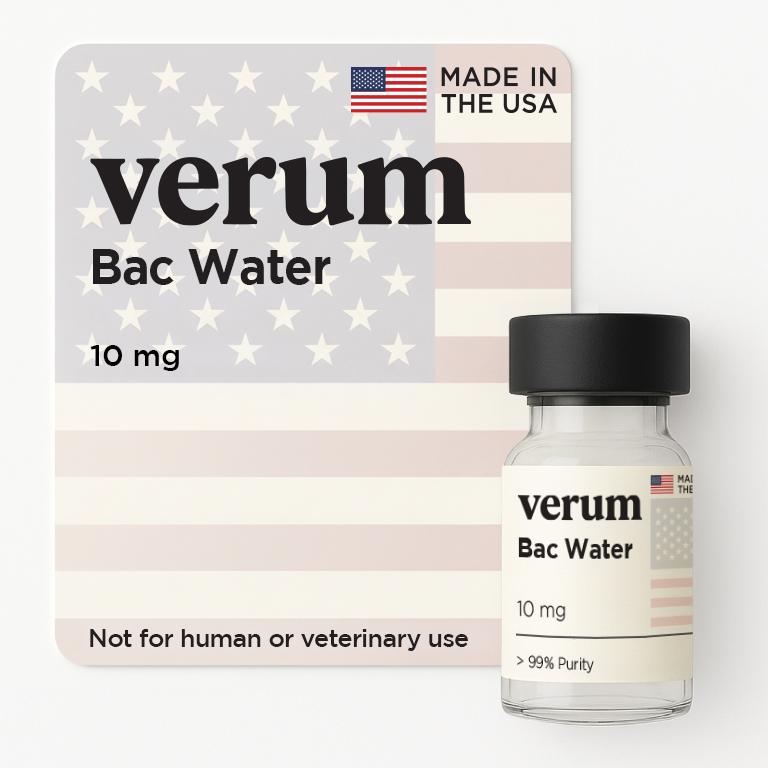
 NFC-verified COA on this vial
Bacteriostatic Water
In stock · same-day dispatch, 2-day US shipping
- ✓ Third-party HPLC + MS tested
- ✓ NFC-verified COA on the vial
- ✓ Made in the USA
- ✓ Plain, discreet packaging
Identification
| Product type | Aqueous laboratory diluent containing an antimicrobial preservative |
| Principal component | Water · H2O · 18.02 g/mol · CAS 7732-18-5 |
| Preservative | Benzyl alcohol · C7H8O · 108.14 g/mol · CAS 100-51-6 |
| Preservative concentration | As stated on the container label. We do not publish a figure we have not independently verified. |
| Appearance | Clear, colourless solution |
| Volumes supplied | 3 mL and 10 mL |
02
Documentation
Lot record
No certificate of analysis
Every other item in this catalogue carries a scannable code linking to a lot-specific certificate from an independent laboratory. This one does not, and we state that here rather than leave it to be discovered after purchase.
We do not commission independent lot testing on this item and we do not publish specifications for it that we have not verified. Accordingly this page states no grade designation, no preservative concentration and no sterility claim. What appears on the container label is what we are able to tell you about the contents.
Where documented composition, purity or sterility is material to intended laboratory work, source a diluent released against those specifications rather than relying on this item.
03
Testing scope
|
Performed by Verum
|
Not performed
|
This is the only item in the catalogue with an empty performed column. It is listed this way deliberately.
04
What the preservative does, and does not do
Benzyl alcohol is bacteriostatic rather than bactericidal. It does not sterilise a solution, and it does not reverse contamination that has already occurred. What it does is inhibit the multiplication of organisms introduced during handling, which is why a preserved diluent tolerates being accessed more than once where an unpreserved one does not.
That is the entire functional difference between this and plain sterile water. It is a handling property, not a quality advantage, and it carries consequences for downstream work that are set out below.
05
When this is the wrong diluent
Benzyl alcohol is cytotoxic to cultured cells at concentrations below those present in a preserved diluent. Reconstituting a compound in this material and introducing it to a cell-based assay adds a second active component to every well, and any effect observed carries the preservative's contribution alongside the compound's. For cell work, sterile water or a defined buffer is the correct choice and this is not.
The same logic applies wherever an organic co-solvent could interfere: enzyme kinetics, binding assays with sensitive readouts, and anything downstream of mass spectrometry where an additional component complicates the background.
A preserved diluent earns its place where a stock solution must be accessed repeatedly over time and the preservative is inert to the measurement. Compatibility with any particular compound is not guaranteed. Establishing whether a preserved diluent is suitable for a given material is part of the experimental design and rests with the receiving laboratory.
06
Choosing a volume
| 3 mL | Suited to a single unit of lyophilized material where the stock will be consumed within a short window |
| 10 mL | Suited to several preparations, or to work at lower working concentrations |
The larger volume is not automatically better value. A preserved diluent accumulates handling risk with every access, and a container that outlives the work it was opened for has spent that time standing rather than waiting. Select the volume that matches what will actually be consumed.
07
Storage and laboratory handling
| Storage | Controlled room temperature, away from direct light and heat |
| Refrigeration | Not required. Freezing is not recommended. |
| Inspection | Examine before use. Discard any container that is discoloured, cloudy or shows visible particulates. |
| Technique | Aseptic technique at every access. The preservative slows microbial multiplication; it does not prevent contamination. |
| After opening | Discard once the work it was opened for is complete rather than retaining it indefinitely. |
| Personal protection | Handle under standard laboratory conditions with gloves, eye protection and a laboratory coat. |
Preparation conditions are the responsibility of the receiving laboratory. Verum provides no protocol, no preparation instruction, and no guidance on use.
08
Regulatory status
| This item | A laboratory diluent. Not a drug, not a medical device, not approved or registered by any regulatory authority for any purpose. |
| Distinct product | Bacteriostatic Water for Injection USP is a separate FDA-approved prescription drug product manufactured under an approved application and dispensed under the supervision of a licensed prescriber. This item is not that product and is not equivalent to it. |
| Status date | Accurate as of August 2026. |
09
Purchase eligibility
By placing an order you confirm each of the following:
| ✓ | You are at least 21 years of age. |
| ✓ | You are a qualified researcher, or are purchasing on behalf of a research institution or commercial laboratory. |
| ✓ | The material will be used solely for in vitro laboratory research. |
| ✓ | The material will not be administered to humans or to animals, and will not be resold or transferred for any such purpose. |
| ✓ | You are responsible for compliance with all federal, state and local law governing receipt, handling, storage and use. |
Confirmation is recorded at checkout against your order. Verum reserves the right to decline or cancel any order.
10
Supply
Orders placed before the daily cutoff are dispatched the same day from our United States warehouse. Domestic orders typically arrive within two business days. A tracking reference is issued by email once the consignment leaves the facility.
Not for human or veterinary use. Not for use in diagnostic or therapeutic procedures. This product is a laboratory diluent. Nothing on this page constitutes medical advice, a recommendation for personal use, or a representation that this material is safe or effective for any purpose. No statement here has been evaluated by the U.S. Food and Drug Administration.