
 Bestseller
Verified COA
Bestseller
Verified COA
 NFC-verified COA on this vial
Blends
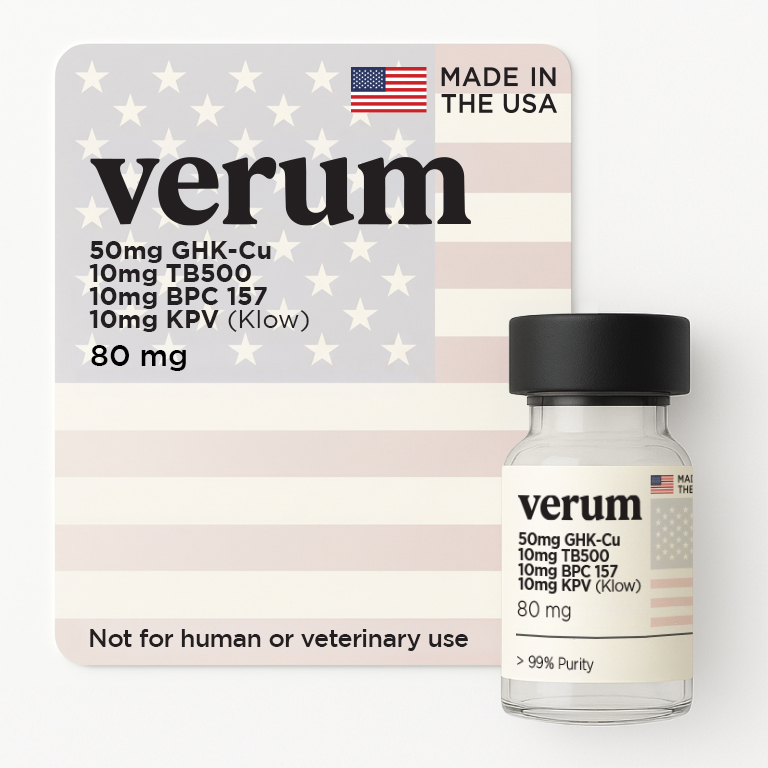
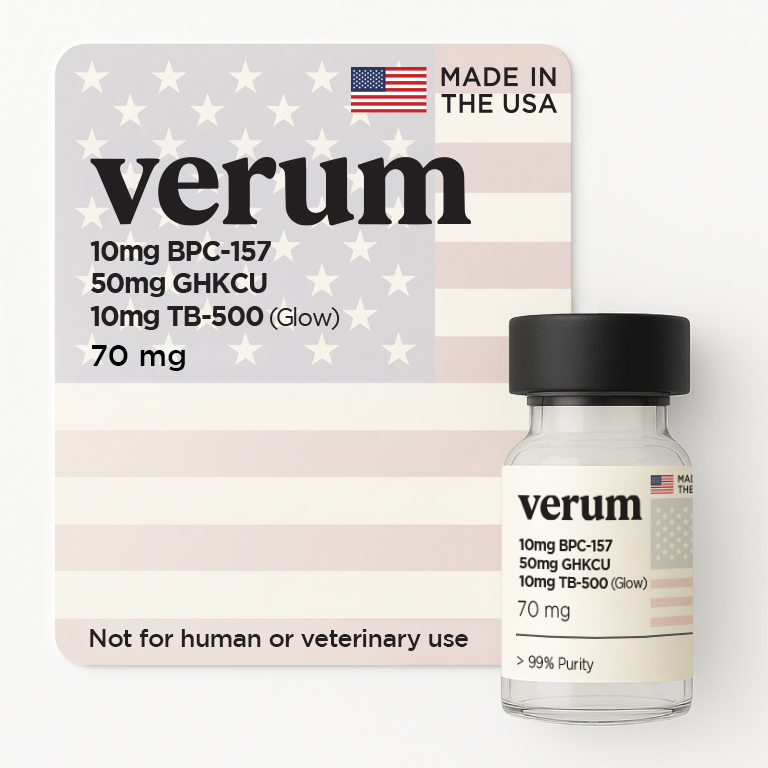
GLOW Blend
BPC-157, GHK-Cu, TB-500
$120 $140
In stock · same-day dispatch, 2-day US shipping
- ✓ Third-party HPLC + MS tested
- ✓ NFC-verified COA on the vial
- ✓ Made in the USA
- ✓ Plain, discreet packaging
Research use only. Not for human or veterinary use, or for diagnostic or therapeutic procedures.
Live certificate of analysis
This is the same live record the NFC tag on the vial opens. Match the lot number on the certificate against the one printed on your vial.
Composition
| Component 1 | GHK-Cu, 50 mg nominal. Glycyl-L-histidyl-L-lysine copper(II) complex. C14H22CuN6O4, 401.9 g/mol, CAS 89030-95-5. |
| Component 2 | Thymosin beta-4, 10 mg nominal. Full-length 43-residue protein, approximately 4,963 g/mol, CAS 77591-33-4. Contains methionine at position 6. |
| Component 3 | BPC-157, 10 mg nominal. Gly-Glu-Pro-Pro-Pro-Gly-Lys-Pro-Ala-Asp-Asp-Ala-Gly-Leu-Val. C62H98N16O22, 1419.5 g/mol, CAS 137525-51-0. No oxidation-sensitive residues. |
| Physical form | Blue co-lyophilized powder. The colour is intrinsic to the copper complex and saturates the whole unit. |
| Country of manufacture | United States |
Note on the second component
This blend is commonly listed with TB-500 as its second component. TB-500 is a trade designation applied to two chemically distinct materials: an acetylated seven-residue fragment of approximately 888 g/mol, and the full-length 43-residue protein of approximately 4,963 g/mol. They differ in mass by more than fivefold and only the full-length protein contains a methionine.
The component in this blend is the full-length protein, and the certificate below names and confirms it as such. Our standalone TB-500 listing is the fragment. The two products are not interchangeable, and results obtained with one should not be compared against the other.
Relationship to KLOW. One component. GLOW and KLOW carry the same three compounds at the same nominal amounts; KLOW adds 10 mg of KPV. Nothing else differs and there is no reformulation between them. We state that rather than let two product names imply a distinction that does not exist.
02
Certificate of analysis - current lot
The interactive verification record is shown below, followed by the same information reproduced as text on this page and the full certificate as a document. The record does not depend on the embed loading.
Certificate of analysis - lot GLOW-062026-4
Lot record
GLOW-062026-4
| Testing laboratory | Freedom Diagnostics, United States. Independent third party, not owned by or affiliated with Verum. |
| Sample received | 3 June 2026 |
| Results reported | 7 June 2026 |
| Accession reference | 2606030675 |
| Analytical methods | HPLC-UV coupled to mass spectrometry (LC-MS). Bacterial endotoxin by limulus amebocyte lysate assay in accordance with USP . Microbial detection by validated PCR assay. |
| Sampling | Two units drawn from the lot and analysed individually rather than pooled |
Content by unit, lot GLOW-062026-4
| Unit 1 | Unit 2 | Mean | |
| GHK-Cu | 58.75 mg | 61.09 mg | 59.92 mg |
| Thymosin beta-4 | 11.50 mg | 11.92 mg | 11.71 mg |
| BPC-157 | 10.74 mg | 10.98 mg | 10.86 mg |
| Purity, HPLC-UV | 99.60 % | 99.75 % | 99.68 % |
Other results, this lot
| Identity, LC-MS | All three components resolved and confirmed: GHK-Cu, thymosin beta-4, BPC-157 |
| Mass confirmation | Thymosin beta-4 observed as a 4+ to 7+ charge ladder, consistent with the full-length protein. BPC-157 at m/z 710.4 [M+2H]2+. GHK-Cu observed as the ligand near m/z 341. |
| Appearance | Blue lyophilized powder |
| Bacterial endotoxin | Pass, duplicate replicates. Assay sensitivity ≤0.05 EU/mL |
| Microbial analysis | No detectable microbial DNA. Pass. |
Two units were drawn from this lot and analysed individually rather than pooled, which reports the consistency of the filling operation across the batch instead of the composition of a single sampled unit. On a co-lyophilized three-component product that is a materially stronger statement than a single set of figures. All values are specific to lot GLOW-062026-4 and are not specifications carried across other lots.
03
There is a redox-active metal in this unit
GHK-Cu is not a peptide with copper attached as a decoration. It is a copper(II) coordination complex in which the metal is held by the glycine amino terminus, the histidine imidazole and the peptide backbone. Copper(II) is redox-active: in solution it participates in Fenton-type chemistry and catalyses oxidation of susceptible amino acid side chains. Co-lyophilizing it with other compounds is a formulation decision with chemical consequences.
The residues most vulnerable to metal-catalysed oxidation are methionine, cysteine, tryptophan and tyrosine. BPC-157 contains none of them and is well suited to sharing a unit with a copper complex.
Thymosin beta-4 is the exception, and on this product it is not a hypothetical one. The full-length protein carries a methionine at position 6, and methionine is the classic target for copper-catalysed oxidation. The sulfoxide product is a species with the correct sequence, a mass sixteen daltons higher, and altered behaviour, and a coarse chromatographic method will not separate it from the parent. Where the seven-residue fragment is used in a blend of this kind the question does not arise; here it does.
Two consequences follow for anyone working with this material. Keep reducing agents and thiol-containing buffer components out of any working solution, because free thiols and copper together accelerate exactly this chemistry. And prepare close to the time of use rather than holding reconstituted stock, since the oxidation in question proceeds in solution rather than in the dry powder.
A third consequence is about inspection rather than chemistry. The deep blue of the copper complex saturates the whole unit, so visual appearance tells you nothing about the condition of the other two components. On a single-component product cake appearance is a useful first-pass check. Here it is not available.
04
Mass proportions and molar proportions are not the same
The three components differ in molecular weight by more than twelvefold, from 402 for the copper complex to 4,963 for the protein. Mass proportions on a label therefore bear little relation to the proportions a receptor or an enzyme encounters.
| By mass | Micromoles | Share of molecules | |
| GHK-Cu | 59.9 mg | 149 | 94 % |
| BPC-157 | 10.9 mg | 7.7 | 5 % |
| Thymosin beta-4 | 11.7 mg | 2.4 | 1.5 % |
Calculated from the mean content figures for this lot. By mass the ratio reads roughly five to one to one. In molecules it is closer to sixty-two to three to one, and the copper complex accounts for about ninety-four percent of what is present. The component named second on most listings of this blend is the smallest by a wide margin in molar terms. Anyone reading this as a balanced three-way combination is working from the wrong figures; do the conversion before designing around it.
05
What a fixed three-component unit means for experimental data
Nothing can be varied. With three compounds fixed in one powder there is no way to change one input while holding the others constant, and no way to run a single-component control. Any observation from this material is an observation about this mixture at this proportion. It cannot be attributed to any component and cannot be compared against published work on any component individually.
Three components need three sets of figures, plus a metal assay. A single purity percentage describes a single-component product. The certificate above reports identity and quantified content for each of the three separately, which is the meaningful specification here. It does not report copper content, which chromatography with ultraviolet detection does not measure and which requires an elemental method.
Three components do not degrade on one schedule. BPC-157 has no oxidation liability. Thymosin beta-4 carries a methionine sharing a container with a redox-active metal. GHK-Cu is a coordination complex whose behaviour in solution is governed by copper speciation rather than by peptide chemistry. These three do not share a shelf life, and the proportions reported above describe the lot at the time of testing.
06
Testing scope
|
Performed
|
Not performed
|
Endotoxin and microbial detection answer different questions and both appear on this lot. A microbial assay asks whether organisms are present; endotoxin is a bacterial membrane fragment that persists after the organism producing it is gone. Material can pass one and not the other. The second entry in the right-hand column is the one specific to this formulation; see section 03. Where a parameter is material to intended laboratory work, purchasers should verify it independently.
07
Storage and laboratory handling
| Lyophilized powder, transit | Stable at ambient temperature during shipping and short-term handling. Cold-chain transport is not required. |
| Lyophilized powder, storage | −20 °C, protected from light, container tightly closed |
| Solubility | Sterile laboratory-grade water or a defined aqueous buffer appropriate to the assay |
| Solution, storage | 2 °C to 8 °C, protected from light. Prepare close to the time of use rather than holding stock; see section 03. |
| Free thiols | Keep reducing agents and thiol-containing buffer components out of any working solution. Free thiols and copper together accelerate oxidative chemistry. This applies to other items in this catalogue, glutathione among them. |
| Chelating agents | Avoid EDTA and other chelators in the same buffer. They strip copper from the complex and change the material being worked with. |
| Visual inspection | Not a usable quality check on this product. The copper complex colours the whole unit blue and masks anything the other components might otherwise show. |
| Freeze-thaw | Avoid repeated cycles. |
| Personal protection | Handle under standard laboratory conditions with gloves, eye protection and a laboratory coat. |
Preparation conditions are the responsibility of the receiving laboratory. Verum provides no protocol, no preparation instruction, and no guidance on use.
08
Published literature and regulatory status
There is no literature on this combination. No published study has examined these three compounds together, in any system, at any proportion. Each has a separate record, none of which transfers to a mixture, and any inference drawn from single-component work about this material is an inference rather than a finding.
| United States | None of the three components is approved by the FDA for any indication. None is on the section 503A bulk drug substances list. |
| Advisory committee | On 23 July 2026 the Pharmacy Compounding Advisory Committee voted to recommend BPC-157 and TB-500 for inclusion on the 503A list, each by eight votes to six with one abstention, over the recommendation of the agency's own reviewers. GHK-Cu was not on that docket and is scheduled for a later meeting announced for before the end of February 2027. |
| What that does not do | A committee recommendation is advisory and non-binding. Inclusion requires separate notice-and-comment rulemaking, which has historically taken a year or more and has not always followed a favourable vote. Glutathione cleared the same committee in June 2022 and is still not on the codified list. None of these compounds is lawfully compoundable, none is approved, and the vote does not make any of them a medicine. |
| Athletic competition | BPC-157 and thymosin beta-4 are prohibited under World Anti-Doping Agency rules. |
| Status date | Accurate as of August 2026. Verify the current position independently. |
09
Purchase eligibility
By placing an order you confirm each of the following:
| ✓ | You are at least 21 years of age. |
| ✓ | You are a qualified researcher, or are purchasing on behalf of a research institution or commercial laboratory. |
| ✓ | The material will be used solely for in vitro laboratory research. |
| ✓ | The material will not be administered to humans or to animals, and will not be resold or transferred for any such purpose. |
| ✓ | You are responsible for compliance with all federal, state and local law governing receipt, handling, storage and use. |
Confirmation is recorded at checkout against your order. Verum reserves the right to decline or cancel any order.
10
Supply
Orders placed before the daily cutoff are dispatched the same day from our United States warehouse. Domestic orders typically arrive within two business days. A tracking reference is issued by email once the consignment leaves the facility. Each unit carries a scannable code linking to the certificate for its own lot.
Not for human or veterinary use. Not for use in diagnostic or therapeutic procedures. This product is a laboratory reagent. Nothing on this page constitutes medical advice, a recommendation for personal use, or a representation that this material is safe or effective for any purpose. No statement here has been evaluated by the U.S. Food and Drug Administration.
Related research compounds
Bestseller
Verified COA
 Bestseller
Verified COA
Bestseller
Verified COA