 Verified COA
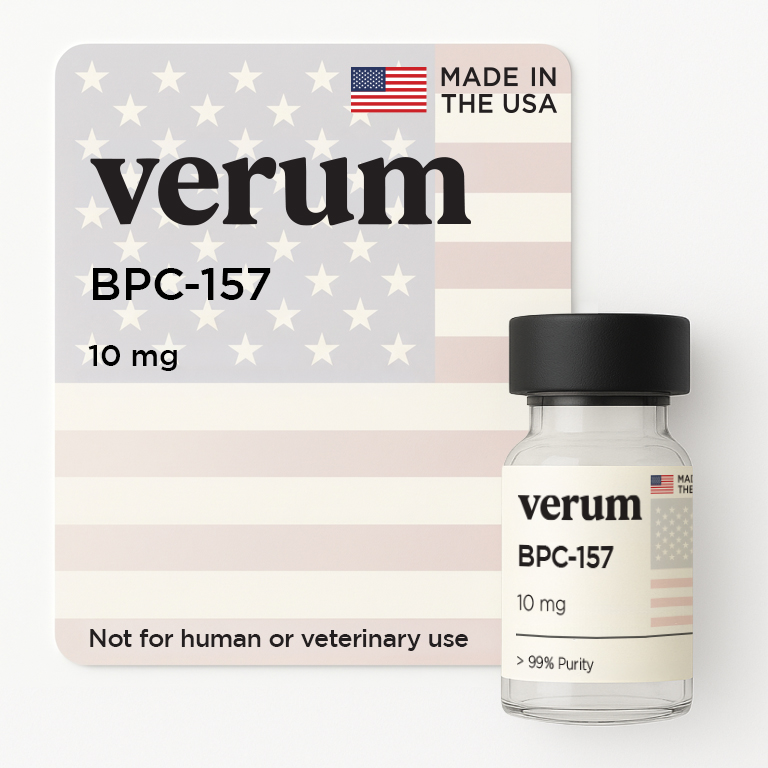 NFC-verified COA on this vial
Peptides
BPC-157
$59 $79
In stock · same-day dispatch, 2-day US shipping
- ✓ Third-party HPLC + MS tested
- ✓ NFC-verified COA on the vial
- ✓ Made in the USA
- ✓ Plain, discreet packaging
Research use only. Not for human or veterinary use, or for diagnostic or therapeutic procedures.
Live certificate of analysis
This is the same live record the NFC tag on the vial opens. Match the lot number on the certificate against the one printed on your vial.
Identification
| Chemical name | Synthetic 15-residue polypeptide corresponding to a partial sequence identified in gastric juice |
| Common designation | BPC-157; body protective compound 157; pentadecapeptide BPC 157 |
| Sequence | Gly-Glu-Pro-Pro-Pro-Gly-Lys-Pro-Ala-Asp-Asp-Ala-Gly-Leu-Val |
| One-letter | GEPPPGKPADDAGLV |
| Length | 15 amino acids, linear, free termini |
| Molecular formula | C62H98N16O22 |
| Molecular weight | 1419.5 g/mol |
| CAS number | 137525-51-0 |
| Oxidation-sensitive residues | None. The sequence contains no methionine, cysteine, tryptophan or tyrosine. |
| Physical form | White lyophilized powder |
| Quantity supplied | 10 mg nominal per unit |
| Country of manufacture | United States |
02
Certificate of analysis - current lot
The interactive verification record for this product is shown below, followed by the same information reproduced as text on this page and the full certificate as a document. The record does not depend on the embed loading.
Certificate of analysis - lot 2FRBRG
Lot record
2FRBRG
| Testing laboratory | Freedom Diagnostics, United States |
| Laboratory relationship | Independent third party. Not owned by, affiliated with, or operated by Verum. |
| Sample received | 27 May 2026 |
| Results reported | 29 May 2026 |
| Accession reference | 2605270306 |
| Analytical method | High-performance liquid chromatography with ultraviolet detection coupled to mass spectrometry (HPLC-UV / LC-MS) |
Results, this lot
| Identity, LC-MS | Confirmed as BPC-157 |
| Purity, HPLC-UV | 99.51 % |
| Net peptide content | 10.68 mg per unit |
| Appearance | White lyophilized powder |
| Mass confirmation | Ion observed at m/z 710.4 [M+2H]2+, consistent with a molecular weight of 1419.5 |
Purity and content figures above are specific to lot 2FRBRG and are not a specification carried across other lots. Each lot is tested individually and reports its own results. The certificate supplied with your unit records the results for that lot.
03
Testing scope
Panels differ between products and between lots. What follows is the scope of testing performed on this lot. Nothing is claimed unless it appears on the certificate for the lot supplied.
|
Performed
|
Not performed
|
Where a parameter is material to intended laboratory work, purchasers should verify it independently or source material released against that specification.
04
Storage and laboratory handling
| Lyophilized powder, transit | Stable at ambient temperature during shipping and short-term handling. Cold-chain transport is not required. |
| Lyophilized powder, storage | −20 °C, protected from light, container tightly closed |
| Solubility | Sterile laboratory-grade water or a defined aqueous buffer appropriate to the assay |
| Solution, storage | 2 °C to 8 °C, protected from light. Materially less stable than the dry powder. |
| Freeze-thaw | Avoid repeated cycles. Aliquot at first preparation where the protocol allows. |
| Sequence-specific note | The sequence carries no methionine, cysteine, tryptophan or tyrosine, so it has none of the oxidation liabilities that govern handling for many peptides. This is not an argument for indefinite stability in solution; ordinary aqueous hydrolysis applies. |
| Personal protection | Handle under standard laboratory conditions with gloves, eye protection and a laboratory coat. |
Preparation conditions are the responsibility of the receiving laboratory. Verum provides no protocol, no preparation instruction, and no guidance on use.
05
Published literature
References are listed for bibliographic purposes and are indexed by the experimental system used. Each description states what the study measured, not what it concluded. Every primary study listed was conducted in cultured cells or in animals. Verum has no involvement in any of this work and makes no representation as to its applicability.
| Rodent tendon explant 2011 |
Fibroblast outgrowth, survival and migration in rodent tendon explant culture Chang CH, Tsai WC, Lin MS, Hsu YH, Pang JH · Journal of Applied Physiology 110(3):774–780 Measured fibroblast outgrowth from rodent Achilles tendon explants, cell survival under hydrogen peroxide stress, and migration by transwell assay. Examined phosphorylation of focal adhesion kinase and paxillin by Western blot. |
| Fibroblast culture 2014 |
Growth hormone receptor transcript and protein levels in cultured tendon fibroblasts Chang CH, Tsai WC, Hsu YH, Pang JH · Molecules 19(11):19066–19077 Screened gene expression changes in rodent tendon fibroblasts by cDNA microarray, then quantified the growth hormone receptor at messenger RNA and protein level using real-time PCR and Western blot. |
| Chick CAM, endothelial 2017 |
VEGFR2 expression, internalisation and downstream phosphorylation in endothelial and membrane assays Hsieh MJ, Liu HT, Wang CN, et al. · Journal of Molecular Medicine 95(3):323–333 Measured vessel density by chorioallantoic membrane assay and endothelial tube formation in culture. Assessed VEGFR2 expression and internalisation and phosphorylation along the VEGFR2–Akt–eNOS axis, with endocytosis blocked by dynasore as a control. |
| Rodent and canine 2022 |
Pharmacokinetics, distribution, metabolism and excretion in rodent and canine models He L, Feng D, Guo H, et al. · Frontiers in Pharmacology 13:1026182 Characterised elimination half-life, linearity across an ascending range, and absolute bioavailability. Used tritium labelling to trace tissue distribution, metabolite formation and excretion routes. The most detailed disposition study available on this compound. |
| Systematic review 2025 |
Systematic review of the preclinical evidence base and its regulatory position Vasireddi N, Hahamyan H, Salata MJ, et al. · HSS Journal Aggregates the preclinical literature and assesses the breadth and quality of the evidence. Covers regulatory status, including the absence of approval and the prohibition applying in sanctioned athletic competition. The most useful single entry point into a scattered literature. |
| Narrative review 2025 |
Narrative review of reported signalling pathways and open safety questions Current Reviews in Musculoskeletal Medicine Maps the overlapping signalling routes reported across the animal literature, including the VEGFR2 and Src–caveolin-1 routes to nitric oxide, and sets them against what remains unestablished. A balanced treatment of the evidence and its limits. |
Work conducted in cultured cells and animals does not establish an effect in any other system. Nothing in the above is offered as a representation about this material.
06
Regulatory status
| United States | Not approved by the FDA for any indication. Not on the section 503A bulk drug substances list. |
| Advisory committee | The Pharmacy Compounding Advisory Committee reviewed this substance on 23 July 2026 and voted to recommend it for inclusion on the 503A list, by eight votes to six with one abstention, over the recommendation of the agency's own reviewers. A committee recommendation is advisory and non-binding. Inclusion requires separate notice-and-comment rulemaking, which has historically taken a year or more and has not always followed a favourable vote. |
| Other jurisdictions | No marketing authorisation is held anywhere. |
| Athletic competition | Prohibited under World Anti-Doping Agency rules. |
| Status date | Accurate as of August 2026. Verify the current position independently. |
07
Purchase eligibility
By placing an order you confirm each of the following:
| ✓ | You are at least 21 years of age. |
| ✓ | You are a qualified researcher, or are purchasing on behalf of a research institution or commercial laboratory. |
| ✓ | The material will be used solely for in vitro laboratory research. |
| ✓ | The material will not be administered to humans or to animals, and will not be resold or transferred for any such purpose. |
| ✓ | You are responsible for compliance with all federal, state and local law governing receipt, handling, storage and use. |
Confirmation is recorded at checkout against your order. Verum reserves the right to decline or cancel any order.
08
Supply
Orders placed before the daily cutoff are dispatched the same day from our United States warehouse. Domestic orders typically arrive within two business days. A tracking reference is issued by email once the consignment leaves the facility. Each unit carries a scannable code linking to the certificate for its own lot.
Not for human or veterinary use. Not for use in diagnostic or therapeutic procedures. This product is a laboratory reagent. Nothing on this page constitutes medical advice, a recommendation for personal use, or a representation that this material is safe or effective for any purpose. No statement here has been evaluated by the U.S. Food and Drug Administration.