 Verified COA
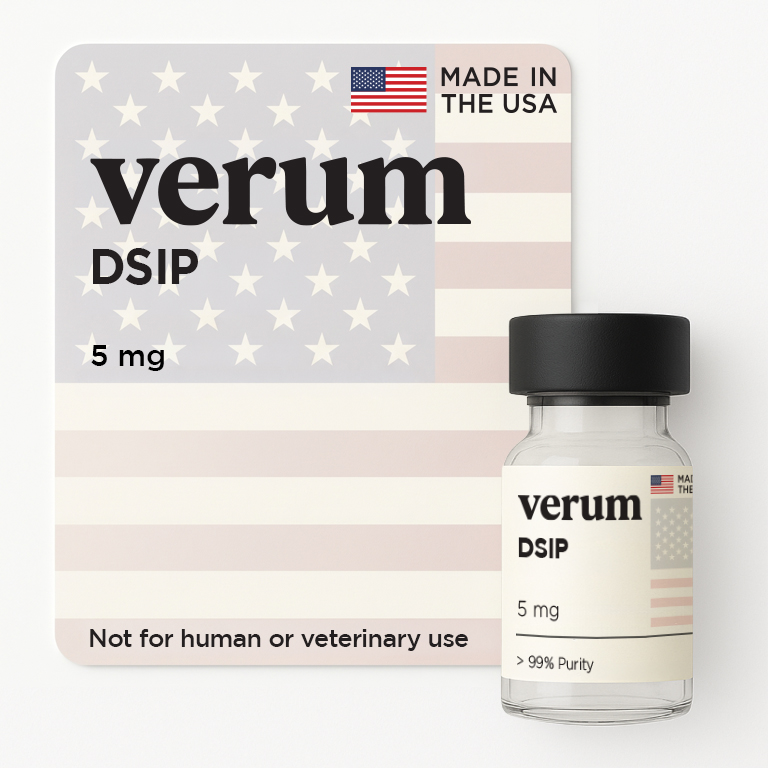 NFC-verified COA on this vial
Peptides
DSIP
$59 $79
In stock · same-day dispatch, 2-day US shipping
- ✓ Third-party HPLC + MS tested
- ✓ NFC-verified COA on the vial
- ✓ Made in the USA
- ✓ Plain, discreet packaging
Research use only. Not for human or veterinary use, or for diagnostic or therapeutic procedures.
Live certificate of analysis
This is the same live record the NFC tag on the vial opens. Match the lot number on the certificate against the one printed on your vial.
Identification
| Chemical name | Linear nonapeptide, sequence Trp-Ala-Gly-Gly-Asp-Ala-Ser-Gly-Glu |
| Common designation | DSIP. The full historical name records the conditions under which the peptide was isolated in 1977 and is not a statement of established activity. |
| Sequence | Trp-Ala-Gly-Gly-Asp-Ala-Ser-Gly-Glu |
| One-letter | WAGGDASGE |
| Length | 9 amino acids, linear, free termini |
| Molecular formula | C35H48N10O15 |
| Molecular weight | 848.8 g/mol |
| CAS number | 62568-57-4 |
| First isolated | 1977, from rabbit cerebral venous blood |
| Identified receptor | None. No receptor, encoding gene or precursor protein has been identified. |
| Oxidation-sensitive residues | Tryptophan at position 1, vulnerable to both oxidation and photodegradation |
| Physical form | White lyophilized powder |
| Quantity supplied | 5 mg nominal per unit |
| Country of manufacture | United States |
Note on what is and is not established
The name attached to this peptide in 1977 describes what its discoverers were investigating, not a settled finding. Nearly fifty years later no receptor has been identified for it, no encoding gene has been found, and its precursor protein remains unknown.
Results across the literature are inconsistent enough that a 2006 review in the Journal of Neurochemistry characterised the field as an unresolved riddle and argued the original hypothesis is poorly documented. That review is listed first in the references below rather than buried. Anyone evaluating this compound should read the critical literature before the enthusiastic literature.
02
Certificate of analysis - current lot
The interactive verification record for this product is shown below, followed by the same information reproduced as text on this page and the full certificate as a document. The record does not depend on the embed loading.
Certificate of analysis - lot DSIP12302025-J
Lot record
DSIP12302025-J
| Testing laboratory | Freedom Diagnostics, United States |
| Laboratory relationship | Independent third party. Not owned by, affiliated with, or operated by Verum. |
| Sample received | 31 December 2025 |
| Results reported | 1 January 2026 |
| Accession reference | 2512310095 |
| Analytical method | High-performance liquid chromatography with ultraviolet detection coupled to mass spectrometry (HPLC-UV / LC-MS) |
Results, this lot
| Identity, LC-MS | Confirmed as DSIP |
| Purity, HPLC-UV | 99.547 % |
| Net peptide content | 5.85 mg per unit |
| Appearance | White lyophilized powder |
| Mass confirmation | Ion observed at m/z 849.03 [M+H]+, consistent with a molecular weight of 848.8 |
Purity and content figures above are specific to lot DSIP12302025-J and are not a specification carried across other lots. Each lot is tested individually and reports its own results. The certificate supplied with your unit records the results for that lot.
03
Testing scope
Panels differ between products and between lots. What follows is the scope of testing performed on this lot. Nothing is claimed unless it appears on the certificate for the lot supplied.
|
Performed
|
Not performed
|
Identity confirmation carries particular weight on this sequence. Removal of the N-terminal tryptophan is reported to collapse the folded conformation, so a sequence that is nearly right is not a near-equivalent compound. Where a parameter is material to intended laboratory work, purchasers should verify it independently or source material released against that specification.
04
Storage and laboratory handling
| Lyophilized powder, transit | Stable at ambient temperature during shipping and short-term handling. Cold-chain transport is not required. |
| Lyophilized powder, storage | −20 °C, protected from light, container tightly closed |
| Solubility | Readily soluble in sterile laboratory-grade water or a defined aqueous buffer appropriate to the assay |
| Solution, storage | 2 °C to 8 °C, protected from light. Materially less stable than the dry powder. |
| Freeze-thaw | Avoid repeated cycles. Aliquot at first preparation where the protocol allows. |
| Sequence-specific note | The N-terminal tryptophan is vulnerable to both oxidation and photodegradation, so light protection matters more here than for many short peptides. Keep solutions in the dark rather than merely out of direct sun, minimise headspace and air contact, and prepare close to the time of use. |
| Personal protection | Handle under standard laboratory conditions with gloves, eye protection and a laboratory coat. |
Preparation conditions are the responsibility of the receiving laboratory. Verum provides no protocol, no preparation instruction, and no guidance on use.
05
Published literature
References are listed for bibliographic purposes and are indexed by the experimental system used. Each description states what the study measured, not what it concluded. The critical review is listed first rather than buried, because it is the honest starting point. Studies conducted in human participants are excluded. Verum has no involvement in any of this work and makes no representation as to its applicability.
| Critical review 2006 |
Critical review of three decades of work, and of the gaps in it Kovalzon VM, Strekalova TV · Journal of Neurochemistry 97(2):303–309 Argues that the original hypothesis is poorly documented, that results across the field are inconsistent, and that the absence of an identified receptor, gene or precursor protein has blocked mechanistic understanding. Read this one first. |
| Review
1984 |
Foundational review of the isolation and characterisation work Graf MV, Kastin AJ · Neuroscience & Biobehavioral Reviews 8(1):83–93 Covers the isolation and characterisation work from 1963 to 1977 and catalogues the early animal findings, including electrophysiological, circadian, locomotor, thermoregulatory and hormonal measurements. |
| Canine
1982 |
Blood-brain barrier passage and its relationship to plasma protein binding Banks WA, et al. · Pharmacology Biochemistry and Behavior 17(5):1009–1014 Measured passage across the blood-brain barrier and its correlation with plasma protein binding. One of few papers addressing whether the peptide reaches the compartment in which activity has been proposed. |
| Rodent · analogue 1989 |
Electroencephalographic recording in unrestrained rodents following a phosphorylated analogue Kimura M, Inoué S · Psychopharmacology 97(1):35–39 Recorded electroencephalographic architecture in unrestrained rodents. The compound under test is a phosphorylated analogue rather than the parent peptide, a distinction the secondary literature frequently loses. |
| Isolated mitochondria 2003 |
Respiratory chain activity in isolated mitochondria under experimental hypoxia Khvatova EM, et al. · Peptides 24(2):307–311 Measured respiratory chain activity in isolated mitochondria under experimental hypoxia. A biochemical readout entirely separate from the electrophysiological work, useful as an orthogonal assay. |
| Rodent · analogue 2021 |
Infarct volume measurement in rodent ischaemia-reperfusion models using a DSIP-like analogue Tukhovskaya EA, et al. · Biomedicines 9(4):407 Measured infarct volume in two rodent ischaemia-reperfusion models. The compound tested is a DSIP-like analogue rather than DSIP itself, stated here because the distinction is routinely dropped when this paper is cited elsewhere. |
Two of the entries above test analogues rather than the parent peptide. Work conducted in cultured systems and animals does not establish an effect in any other system. Nothing in the above is offered as a representation about this material.
06
Regulatory status
| United States | Not approved by the FDA for any indication. Not on the section 503A bulk drug substances list. |
| Advisory committee | The Pharmacy Compounding Advisory Committee reviewed this substance on 24 July 2026 and voted against adding it to the 503A list, by six votes to seven. Of the substances considered across that two-day docket, this was the only one to receive an unfavourable vote. |
| Other jurisdictions | No marketing authorisation is held anywhere. |
| Status date | Accurate as of August 2026. Verify the current position independently. |
07
Purchase eligibility
By placing an order you confirm each of the following:
| ✓ | You are at least 21 years of age. |
| ✓ | You are a qualified researcher, or are purchasing on behalf of a research institution or commercial laboratory. |
| ✓ | The material will be used solely for in vitro laboratory research. |
| ✓ | The material will not be administered to humans or to animals, and will not be resold or transferred for any such purpose. |
| ✓ | You are responsible for compliance with all federal, state and local law governing receipt, handling, storage and use. |
Confirmation is recorded at checkout against your order. Verum reserves the right to decline or cancel any order.
08
Supply
Orders placed before the daily cutoff are dispatched the same day from our United States warehouse. Domestic orders typically arrive within two business days. A tracking reference is issued by email once the consignment leaves the facility. Each unit carries a scannable code linking to the certificate for its own lot.
Not for human or veterinary use. Not for use in diagnostic or therapeutic procedures. This product is a laboratory reagent. Nothing on this page constitutes medical advice, a recommendation for personal use, or a representation that this material is safe or effective for any purpose. No statement here has been evaluated by the U.S. Food and Drug Administration.