 Verified COA
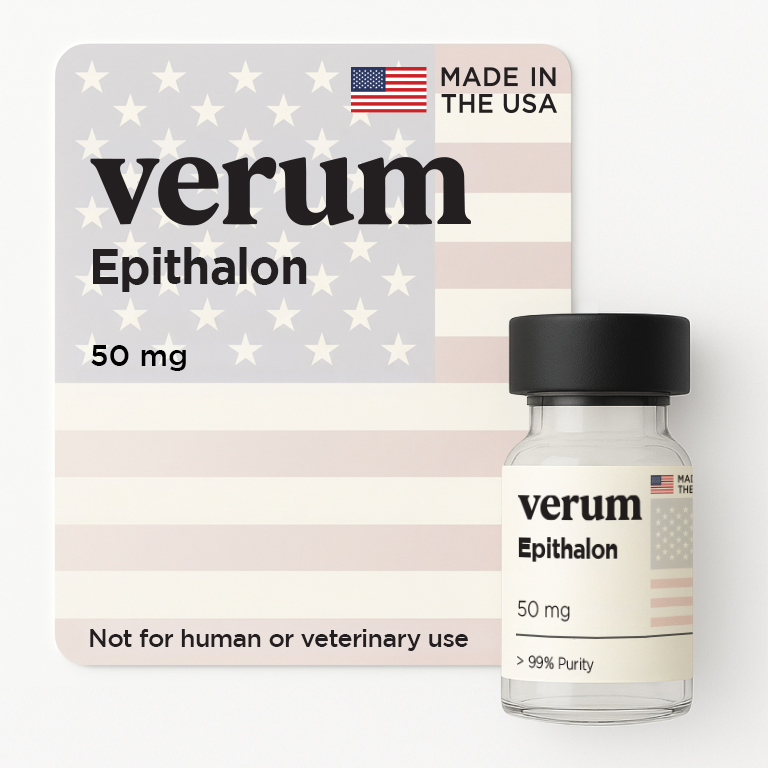 NFC-verified COA on this vial
Peptides
Epithalon
$98 $112
In stock · same-day dispatch, 2-day US shipping
- ✓ Third-party HPLC + MS tested
- ✓ NFC-verified COA on the vial
- ✓ Made in the USA
- ✓ Plain, discreet packaging
Research use only. Not for human or veterinary use, or for diagnostic or therapeutic procedures.
Live certificate of analysis
This is the same live record the NFC tag on the vial opens. Match the lot number on the certificate against the one printed on your vial.
Identification
| Chemical name | L-alanyl-L-glutamyl-L-aspartyl-glycine |
| Common designations | Epithalon; Epitalon; Epithalone; AEDG peptide. Both principal spellings appear in the literature and on certificates; they refer to the same compound. |
| Sequence | Ala-Glu-Asp-Gly |
| One-letter | AEDG |
| Length | 4 amino acids, linear, free termini |
| Molecular formula | C14H22N4O9 |
| Molecular weight | 390.35 g/mol |
| CAS number | 307297-39-8 |
| Sequence origin | Modelled on a fraction of epithalamin, a pineal gland extract |
| Charge profile | Two acidic residues, no basic residues. Strongly acidic and highly water-soluble. |
| Oxidation-sensitive residues | None. The sequence contains no methionine, cysteine, tryptophan or tyrosine. |
| Physical form | White lyophilized powder |
| Quantity supplied | 50 mg nominal per unit |
| Country of manufacture | United States |
Note on where the literature comes from
Almost the entire published record on this peptide traces to one research group, led by Vladimir Khavinson at the St. Petersburg Institute of Bioregulation and Gerontology, and a large share of it appeared in a single journal across two decades. Concentration in one laboratory is not evidence of error, but it does mean the ordinary check of independent replication was largely absent from the field.
That changed in 2025, when a group at Brunel University London published an independent examination across several human cell lines. Both the 2003 original and the 2025 independent work are listed below so the two can be compared directly rather than either taken on trust.
02
Certificate of analysis - current lot
The interactive verification record for this product is shown below, followed by the same information reproduced as text on this page and the full certificate as a document. The record does not depend on the embed loading.
Certificate of analysis - lot EPIT50-02112026-J
Lot record
EPIT50-02112026-J
| Testing laboratory | Freedom Diagnostics, United States |
| Laboratory relationship | Independent third party. Not owned by, affiliated with, or operated by Verum. |
| Sample received | 17 February 2026 |
| Results reported | 18 February 2026 |
| Accession reference | 2602170215 |
| Analytical method | High-performance liquid chromatography with ultraviolet detection coupled to mass spectrometry (HPLC-UV / LC-MS) |
Results, this lot
| Identity, LC-MS | Confirmed. Recorded on the certificate as Epitalon. |
| Purity, HPLC-UV | 99.753 % |
| Net peptide content | 61.76 mg per unit |
| Appearance | White lyophilized powder |
| Mass confirmation | Ion observed at m/z 390.93 [M+H]+, consistent with a molecular weight of 390.35 |
Purity and content figures above are specific to lot EPIT50-02112026-J and are not a specification carried across other lots. Content measurement carries unusual weight at a 50 mg fill, where a shortfall that would be marginal in a 5 mg unit becomes a material difference in the quantity received. Each lot is tested individually and reports its own results.
03
Testing scope
Panels differ between products and between lots. What follows is the scope of testing performed on this lot. Nothing is claimed unless it appears on the certificate for the lot supplied.
|
Performed
|
Not performed
|
Identity confirmation is less discriminating on a four-residue molecule than on a longer chain, since a tetrapeptide is too small to carry a multi-state charge series and elutes early on a reversed-phase column. Where certainty at this size is material, amino acid analysis or a second orthogonal method is the appropriate check. Where a parameter is material to intended laboratory work, purchasers should verify it independently or source material released against that specification.
04
Storage and laboratory handling
| Lyophilized powder, transit | Stable at ambient temperature during shipping and short-term handling. Cold-chain transport is not required. |
| Lyophilized powder, storage | −20 °C, protected from light, container tightly closed |
| Solubility | Highly soluble in sterile laboratory-grade water or a defined aqueous buffer appropriate to the assay |
| Solution, storage | 2 °C to 8 °C, protected from light. Materially less stable than the dry powder. |
| Freeze-thaw | Avoid repeated cycles. Aliquot at first preparation where the protocol allows. |
| Sequence-specific note | No oxidation-sensitive residues, so this sequence carries none of the liabilities that govern handling for many peptides. With two acidic residues and no basic residue it is strongly acidic in solution, so hold buffer conditions constant across an experiment rather than varying them between preparations. It is hygroscopic; allow the container to reach room temperature before opening. |
| Personal protection | Handle under standard laboratory conditions with gloves, eye protection and a laboratory coat. |
Preparation conditions are the responsibility of the receiving laboratory. Verum provides no protocol, no preparation instruction, and no guidance on use.
05
Published literature
References are listed for bibliographic purposes and are indexed by the experimental system used. Each description states what the study measured, not what it concluded, and the originating group is named so the concentration of the literature is visible rather than obscured. Every entry was conducted in cell culture. Studies conducted in human participants are excluded. Verum has no involvement in any of this work and makes no representation as to its applicability.
| Fibroblast culture 2003 |
Telomerase subunit expression, enzymatic activity and telomere length in telomerase-negative fibroblast culture Khavinson VKh, Bondarev IE, Butyugov AA · Bulletin of Experimental Biology and Medicine 135(6):590–592 · St. Petersburg Institute of Bioregulation and Gerontology Measured expression of the telomerase catalytic subunit, enzymatic activity, and telomere length in telomerase-negative human fetal fibroblast culture. The founding paper for this field and the one every subsequent statement about this peptide traces back to. |
| Multiple cell lines 2025 |
Independent examination of telomere length, hTERT expression and alternative lengthening across several cell lines Al-Dulaimi S, Thomas R, Matta S, Roberts T · Biogerontology 26:178 · Brunel University London Quantified telomere length, hTERT messenger RNA, telomerase activity and alternative lengthening of telomeres across several cell lines using qPCR and immunofluorescence. The first substantial independent examination and the most methodologically detailed paper available. A figure correction was issued in November 2025; read the corrected version. |
| Fibroblast culture 2004 |
Proliferative potential through serial passage in primary pulmonary fibroblasts Khavinson VKh, Bondarev IE, Butyugov AA, Smirnova TD · Bulletin of Experimental Biology and Medicine 137(5):503–506 Followed proliferative potential in primary pulmonary fibroblasts through serial passage, tracking the passage number at which the culture lost capacity to divide. A direct extension of the 2003 work by the same group. |
| Stem cell culture 2020 |
Transcript and protein levels of differentiation markers in stem cell culture, with a proposed epigenetic mechanism Khavinson V, Diomede F, Mironova E, et al. · Molecules 25(3):609 Measured transcript and protein levels of neuronal differentiation markers in human stem cell culture and proposed a mechanism involving direct interaction with DNA. Notable as a collaboration between the St. Petersburg group and an Italian university rather than a single-laboratory output. |
| Stem cell culture 2020 |
Senescence markers and proliferative capacity across passages in gingival mesenchymal stem cell culture Sinjari B, Diomede F, Khavinson V, et al. · Stem Cell Reviews and Reports 16(1):159–166 Assessed senescence markers and proliferative capacity in human gingival mesenchymal stem cell culture across passages. Uses a cell type entirely separate from the fibroblast work, which makes it a useful orthogonal check on the same readouts. |
Findings in cultured cells do not establish an effect in any whole organism. Nothing in the above is offered as a representation about this material.
06
Regulatory status
| United States | Not approved by the FDA for any indication. Not on the section 503A bulk drug substances list. |
| Advisory committee | The Pharmacy Compounding Advisory Committee reviewed this substance on 24 July 2026 and voted to recommend it for inclusion on the 503A list, by seven votes to four. |
| What that vote does not do | A committee recommendation is advisory and non-binding. Inclusion requires separate notice-and-comment rulemaking, which has historically taken a year or more and has not always followed a favourable vote. Glutathione cleared the same committee in June 2022 by a comparable margin and is still not on the codified list four years later. This substance is not approved, is not lawfully compoundable, and the vote does not make it a medicine. |
| Other jurisdictions | No marketing authorisation is held anywhere. |
| Status date | Accurate as of August 2026. Verify the current position independently. |
07
Purchase eligibility
By placing an order you confirm each of the following:
| ✓ | You are at least 21 years of age. |
| ✓ | You are a qualified researcher, or are purchasing on behalf of a research institution or commercial laboratory. |
| ✓ | The material will be used solely for in vitro laboratory research. |
| ✓ | The material will not be administered to humans or to animals, and will not be resold or transferred for any such purpose. |
| ✓ | You are responsible for compliance with all federal, state and local law governing receipt, handling, storage and use. |
Confirmation is recorded at checkout against your order. Verum reserves the right to decline or cancel any order.
08
Supply
Orders placed before the daily cutoff are dispatched the same day from our United States warehouse. Domestic orders typically arrive within two business days. A tracking reference is issued by email once the consignment leaves the facility. Each unit carries a scannable code linking to the certificate for its own lot.
Not for human or veterinary use. Not for use in diagnostic or therapeutic procedures. This product is a laboratory reagent. Nothing on this page constitutes medical advice, a recommendation for personal use, or a representation that this material is safe or effective for any purpose. No statement here has been evaluated by the U.S. Food and Drug Administration.