 Verified COA
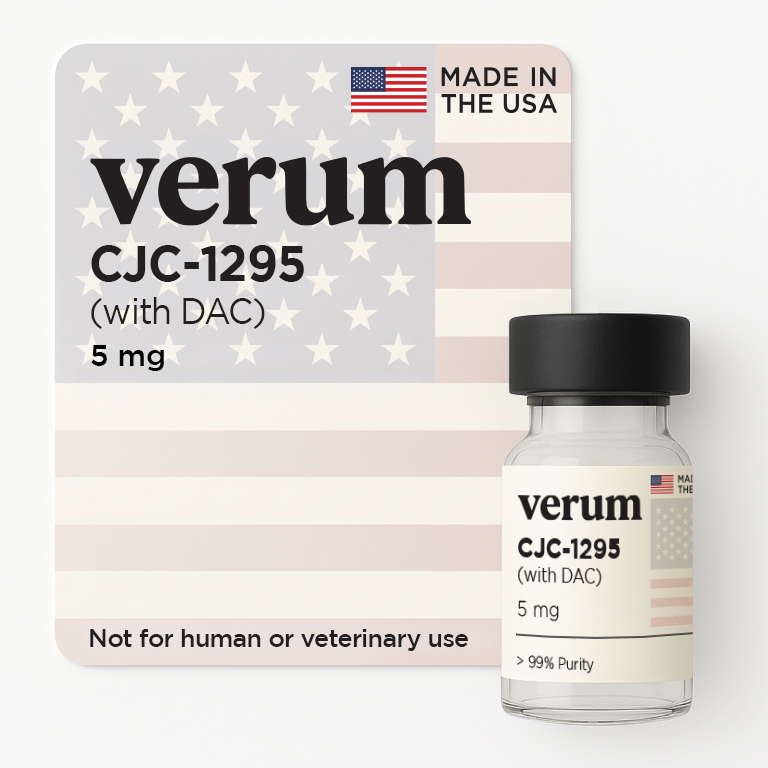 NFC-verified COA on this vial
Peptides
CJC-1295
From $54
In stock · same-day dispatch, 2-day US shipping
- ✓ Third-party HPLC + MS tested
- ✓ NFC-verified COA on the vial
- ✓ Made in the USA
- ✓ Plain, discreet packaging
Research use only. Not for human or veterinary use, or for diagnostic or therapeutic procedures.
Live certificate of analysis
This is the same live record the NFC tag on the vial opens. Match the lot number on the certificate against the one printed on your vial.
The two options are different compounds
This is the most consequential thing to understand about this listing, and almost nobody selling it states it.
CJC-1295 is a tetrasubstituted analogue of GRF(1-29) carrying a Drug Affinity Complex: a maleimidopropionamide group on an added lysine, which forms a covalent bond with circulating albumin. That group is not an accessory. It is the defining feature of the molecule and the reason the compound carries the name it does.
Remove it and the result is not a shorter-acting CJC-1295. It is a separate compound properly designated Modified GRF (1-29), also written mod GRF (1-29) or tetrasubstituted GRF(1-29): the same four backbone substitutions, no linker, a different molecular formula and a mass roughly 280 daltons lighter. The market began calling it "CJC-1295 without DAC" and the designation stuck. We use it in the option selector because that is what people search for, and we state here what the compound actually is.
How to verify which compound you have
Registry numbers cannot be relied upon to distinguish these two products across suppliers; both are widely listed under a single CAS number. Our own certificates illustrate the problem: the identity field on the non-DAC certificate reads simply "CJC-1295," which is the trade designation rather than the compound's proper name.
The mass settles it. Reconstruct the molecular weight from the charge series on the certificate for your lot. The DAC compound lands near 3647; Modified GRF (1-29) lands near 3368. A 280 dalton gap is unmistakable on any competent trace, and it is the check to run before anything else.
02
Selecting between them is a pharmacology decision
Both options share four substitutions to the GRF(1-29) backbone: D-alanine at position 2, glutamine at 8, alanine at 15 and leucine at 27. Between them these resist dipeptidyl peptidase-4 cleavage, deamidation and oxidation, which are the liabilities of the native sequence.
Reported clearance separates them by roughly three orders of magnitude. Modified GRF (1-29) is cleared on the order of thirty minutes. With the DAC bound to albumin, reported duration extends into days.
That difference is mechanistic rather than one of convenience, and it should determine which option a protocol requires. GHRH signalling is physiologically pulsatile. A compound cleared in half an hour produces a discrete pulse. A compound tethered to albumin across days produces continuous receptor occupancy, which is a different stimulus pattern that no model of endogenous GHRH signalling will reproduce. A design depending on pulsatility will be confounded by the DAC option; a design requiring sustained occupancy cannot be served by the non-DAC option.
03
Certificates of analysis - current lots
Each option is tested and released separately and carries its own certificate. Both are set out below: the interactive verification record, the certificate document, and the same information reproduced as text on this page. The record does not depend on the embeds loading.
Option A - with DAC
Certificate of analysis - lot K68WPF, with DAC
Lot record - with DAC
K68WPF
| Testing laboratory | Freedom Diagnostics, United States. Independent third party, not owned by or affiliated with Verum. |
| Sample received | 11 May 2026 |
| Results reported | 12 May 2026 |
| Accession reference | 2605110188 |
| Analytical method | HPLC-UV coupled to mass spectrometry (LC-MS) |
Results, lot K68WPF
| Identity, LC-MS | Confirmed as CJC-1295 with DAC |
| Purity, HPLC-UV | 99.46 % |
| Net peptide content | 5.28 mg per unit |
| Appearance | White lyophilized powder |
| Mass confirmation | Ions at m/z 729.7 [M+5H]5+ and 912.8 [M+4H]4+, reconstructing to approximately 3647 |
Option B - without DAC, Modified GRF (1-29)
Certificate of analysis - lot J3SPEC, without DAC
Lot record - without DAC
J3SPEC
| Testing laboratory | Freedom Diagnostics, United States. Independent third party, not owned by or affiliated with Verum. |
| Sample received | 11 May 2026 |
| Results reported | 12 May 2026 |
| Accession reference | 2605110189 |
| Analytical method | HPLC-UV coupled to mass spectrometry (LC-MS) |
Results, lot J3SPEC
| Identity, LC-MS | Confirmed. Recorded on the certificate under the trade designation CJC-1295; the mass identifies the compound as Modified GRF (1-29). |
| Purity, HPLC-UV | 99.72 % |
| Net peptide content | 4.91 mg per unit |
| Appearance | White lyophilized powder |
| Mass confirmation | Ions at m/z 674.0 [M+5H]5+, 842.5 [M+4H]4+ and 1123.6 [M+3H]3+, all reconstructing to approximately 3368 |
Purity and content figures above are specific to lots K68WPF and J3SPEC and are not specifications carried across other lots. Each lot is tested individually and reports its own results. The certificate supplied with your unit records the results for that lot.
04
Identification
Option A - with DAC
| Chemical name | Tetrasubstituted GRF(1-29) bearing a maleimidopropionamide group on an added lysine |
| Common designation | CJC-1295; DAC:GRF |
| Backbone substitutions | D-Ala2, Gln8, Ala15, Leu27 |
| DAC moiety | Maleimidopropionamide; conjugates covalently to serum albumin |
| Molecular formula | C165H269N47O46 |
| Molecular weight | Approximately 3647 g/mol |
| Expected ions | [M+5H]5+ near 730; [M+4H]4+ near 913 |
| Quantity supplied | 5 mg nominal per unit |
Option B - without DAC
| Chemical name | Modified GRF (1-29); tetrasubstituted GRF(1-29) |
| Trade designation | Sold across this market as "CJC-1295 without DAC" |
| Sequence | Tyr-D-Ala-Asp-Ala-Ile-Phe-Thr-Gln-Ser-Tyr-Arg-Lys-Val-Leu-Ala-Gln-Leu-Ser-Ala-Arg-Lys-Leu-Leu-Gln-Asp-Ile-Leu-Ser-Arg |
| Length | 29 amino acids, C-terminal amide |
| Molecular formula | C152H252N44O42 |
| Molecular weight | 3367.9 g/mol |
| Expected ions | [M+5H]5+ near 674; [M+4H]4+ near 843; [M+3H]3+ near 1124 |
| CAS number | 863288-34-0 (registry assignment is inconsistent across suppliers; verify against formula and mass) |
| Quantity supplied | 5 mg nominal per unit |
| Shared molecular target | GHRH receptor, anterior pituitary somatotrophs |
| Physical form, both options | White lyophilized powder |
| Country of manufacture | United States |
05
Testing scope
Panels differ between products and between lots. The scope below applies to both current lots. Nothing is claimed unless it appears on the certificate for the lot supplied.
|
Performed
|
Not performed
|
The last entry matters on the DAC option specifically. The maleimide group is the reactive handle that makes albumin conjugation possible, and it is also the most fragile part of the molecule. Its integrity is not quantified as a separate parameter on this certificate. Where a parameter is material to intended laboratory work, purchasers should verify it independently or source material released against that specification.
06
Storage and laboratory handling
| Lyophilized powder, transit | Stable at ambient temperature during shipping and short-term handling. Cold-chain transport is not required. |
| Lyophilized powder, storage | −20 °C, protected from light, container tightly closed |
| Solubility | Sterile laboratory-grade water or a defined aqueous buffer appropriate to the assay |
| Solution, storage | 2 °C to 8 °C, protected from light. Materially less stable than the dry powder. |
| Freeze-thaw | Avoid repeated cycles. Aliquot at first preparation where the protocol allows. |
| DAC option, specific caution | The maleimide group is a thiol-reactive electrophile and the most fragile part of the molecule. It hydrolyses in aqueous solution, faster as pH rises, and will react with any free thiol it encounters. Keep reducing agents and thiol-containing buffer components out of working solutions, avoid alkaline buffers, and prepare close to the time of use. Material that has stood in neutral or basic buffer may retain the correct peptide backbone while having lost the property distinguishing this option from the other. |
| Personal protection | Handle under standard laboratory conditions with gloves, eye protection and a laboratory coat. |
Preparation conditions are the responsibility of the receiving laboratory. Verum provides no protocol, no preparation instruction, and no guidance on use.
07
Published literature
The entry below is listed for bibliographic purposes and is indexed by the experimental system used. The description states what the study measured, not what it concluded. Studies conducted in human participants are excluded. Note also that the published record concerns the DAC compound; work on it should not be assumed to transfer to the non-DAC option, which has very little literature of its own. Verum has no involvement in this work and makes no representation as to its applicability.
| Rodent · bioconjugate 2005 |
Albumin bioconjugation of hGRF(1-29) analogues and receptor activation in a rodent model Jetté L, Léger R, Thibaudeau K, et al. · Endocrinology 146(7):3052–3058 Characterised albumin bioconjugation across a series of candidate constructs, measured receptor activation at the anterior pituitary, and compared duration between them. This is the study that identified and named CJC-1295 and the origin of the DAC design. |
Work conducted in animals does not establish an effect in any other system. Nothing in the above is offered as a representation about this material.
08
Regulatory status
| United States | Not approved by the FDA for any indication. Not on the section 503A bulk drug substances list. |
| Advisory committee | The Pharmacy Compounding Advisory Committee reviewed CJC-1295 on 4 December 2024 and voted against adding it to the 503A list. |
| Development history | Developed commercially in the mid-2000s. That programme did not result in an approved product in any jurisdiction. |
| Athletic competition | Prohibited under World Anti-Doping Agency rules. |
| Status date | Accurate as of August 2026. Verify the current position independently. |
09
Purchase eligibility
By placing an order you confirm each of the following:
| ✓ | You are at least 21 years of age. |
| ✓ | You are a qualified researcher, or are purchasing on behalf of a research institution or commercial laboratory. |
| ✓ | The material will be used solely for in vitro laboratory research. |
| ✓ | The material will not be administered to humans or to animals, and will not be resold or transferred for any such purpose. |
| ✓ | You are responsible for compliance with all federal, state and local law governing receipt, handling, storage and use. |
Confirmation is recorded at checkout against your order. Verum reserves the right to decline or cancel any order.
10
Supply
Orders placed before the daily cutoff are dispatched the same day from our United States warehouse. Domestic orders typically arrive within two business days. A tracking reference is issued by email once the consignment leaves the facility. Each unit carries a scannable code linking to the certificate for its own lot.
Not for human or veterinary use. Not for use in diagnostic or therapeutic procedures. This product is a laboratory reagent. Nothing on this page constitutes medical advice, a recommendation for personal use, or a representation that this material is safe or effective for any purpose. No statement here has been evaluated by the U.S. Food and Drug Administration.