 Verified COA
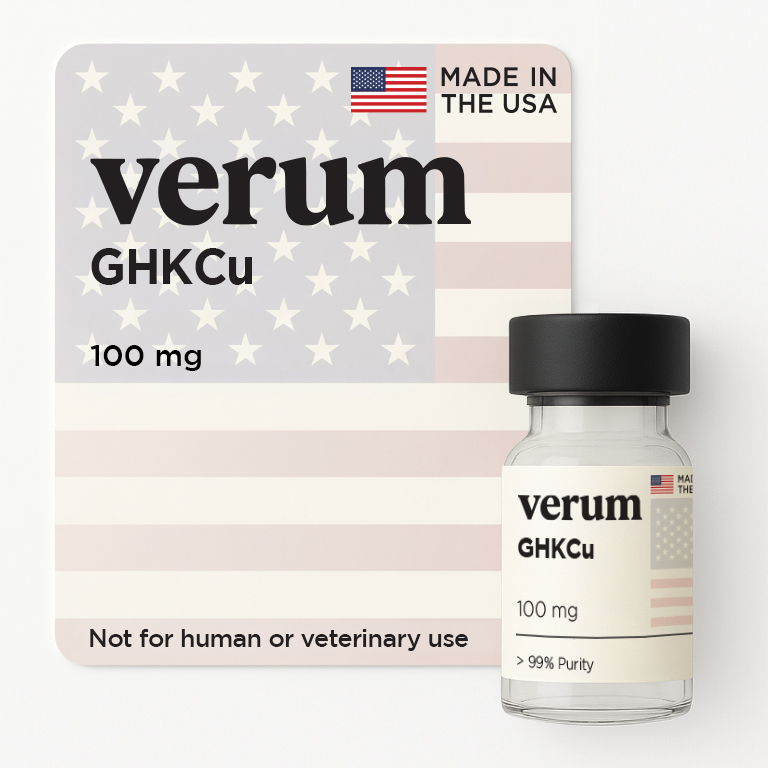 NFC-verified COA on this vial
Peptides
GHK-Cu
From $59
In stock · same-day dispatch, 2-day US shipping
- ✓ Third-party HPLC + MS tested
- ✓ NFC-verified COA on the vial
- ✓ Made in the USA
- ✓ Plain, discreet packaging
Research use only. Not for human or veterinary use, or for diagnostic or therapeutic procedures.
Live certificate of analysis
This is the same live record the NFC tag on the vial opens. Match the lot number on the certificate against the one printed on your vial.
Identification
| Chemical name | Glycyl-L-histidyl-L-lysine copper(II) complex |
| Common designation | GHK-Cu; copper tripeptide-1 |
| Compound class | Metal coordination complex, not a plain peptide |
| Ligand sequence | Gly-His-Lys |
| Coordination sites | Glycine amino terminus, histidine imidazole, peptide backbone nitrogens |
| Molecular formula, complex | C14H22CuN6O4 |
| Molecular weight, complex | 401.9 g/mol |
| Molecular weight, ligand alone | 340.4 g/mol. The ligand accounts for approximately 85 % of the complex by mass. |
| CAS number, complex | 89030-95-5 |
| CAS number, free ligand | 49557-75-7 - GHK without copper, a different product |
| Physical form | Blue lyophilized powder. The colour arises from d-orbital transitions in coordinated copper(II); a copper-free preparation of the same ligand is white. |
| Quantities supplied | 50 mg and 100 mg nominal per unit |
| Country of manufacture | United States |
Note on the quantity basis
A milligram figure on a coordination complex is ambiguous unless the basis is stated. The ligand is 340.4 g/mol and the complex is 401.9 g/mol, so the peptide accounts for roughly eighty-five percent of the complex by mass and the copper with its coordination for the remaining fifteen.
100 mg of the complex therefore contains approximately 85 mg of the GHK ligand. Read the content figure on the certificate for your lot, and where the basis is not stated, establish it before calculating a molarity. A fifteen percent difference in a stock concentration is not a rounding matter.
02
Certificates of analysis - current lots
Each size is tested and released separately and carries its own certificate. Both are set out below: the interactive verification record, the certificate document, and the same information reproduced as text on this page. The record does not depend on the embeds loading. The panels differ between the two current lots, which is why they are presented separately rather than combined.
50 mg
Certificate of analysis - lot 8ZVN1B, 50 mg
Lot record - 50 mg
8ZVN1B
| Testing laboratory | Freedom Diagnostics, United States. Independent third party, not owned by or affiliated with Verum. |
| Sample received | 22 June 2026 |
| Results reported | 24 June 2026 |
| Accession reference | 2606220279 |
| Analytical method | HPLC-UV coupled to mass spectrometry (LC-MS) |
Results, lot 8ZVN1B
| Identity, LC-MS | Confirmed as GHK-Cu |
| Purity, HPLC-UV | 99.95 % |
| Net content | 65.80 mg per unit |
| Appearance | Blue lyophilized powder |
| Mass confirmation | Ions at m/z 171, 341 and 363, corresponding to the doubly protonated ligand, the protonated ligand and its sodium adduct |
| Bacterial endotoxin | Not tested on this lot |
100 mg
Certificate of analysis - lot GHK100-052026-4, 100 mg
Lot record - 100 mg
GHK100-052026-4
| Testing laboratory | Freedom Diagnostics, United States. Independent third party, not owned by or affiliated with Verum. |
| Sample received | 12 May 2026 |
| Results reported | 14 May 2026 |
| Accession reference | 2605120139 |
| Analytical methods | HPLC-UV coupled to mass spectrometry (LC-MS). Bacterial endotoxin by limulus amebocyte lysate assay in accordance with USP . |
Results, lot GHK100-052026-4
| Identity, LC-MS | Confirmed as GHK-Cu |
| Purity, HPLC-UV | 99.86 % |
| Net content | 94.85 mg per unit |
| Appearance | Blue lyophilized powder |
| Mass confirmation | Ions at m/z 340.5 and 341.3, corresponding to the GHK ligand |
| Bacterial endotoxin | Pass, duplicate replicates. Assay sensitivity ≤0.05 EU/mL |
Purity and content figures above are specific to the lots named and are not specifications carried across other lots. The two current lots differ in both content and panel scope, which is precisely why this catalogue states results per lot rather than per product. The certificate supplied with your unit records the results for that lot.
03
What a certificate can and cannot establish about the copper
Chromatography with ultraviolet detection measures the peptide. Mass spectrometry under electrospray conditions frequently strips the metal from a labile coordination complex in the ion source, so the ion appearing on the trace is commonly the free ligand near 341 rather than the intact complex near 403.
That is what both certificates above show, and it is ordinary instrument behaviour rather than a defect in the material. It has a consequence that is routinely glossed over: a mass confirmation on this compound establishes that the ligand is GHK. On its own it does not establish how much copper is present, or that the stoichiometry is correct.
Establishing copper content requires an elemental method, inductively coupled plasma spectrometry or equivalent. That is not part of a standard peptide panel and is not on either certificate above. Where a supplier states that mass spectrometry confirms the copper complex, the question to ask is which ion was observed.
What is available is simpler. The intense blue of this material arises from d-orbital transitions in coordinated copper(II), and a preparation of the same ligand without copper is white. Elsewhere in this catalogue we note that cake appearance establishes very little. On this compound it is the most direct indication of coordinated copper available, and it appears on the certificate as a recorded observation rather than as a description supplied by us.
04
Testing scope
Panels differ between products, between sizes and between lots. The columns below reflect the two current lots. Nothing is claimed unless it appears on the certificate for the lot supplied.
|
Performed
|
Not performed
|
The first entry in the right-hand column is the one that matters on this compound; see the section above. Where a parameter is material to intended laboratory work, purchasers should verify it independently or source material released against that specification.
05
Storage and laboratory handling
| Lyophilized powder, transit | Stable at ambient temperature during shipping and short-term handling. Cold-chain transport is not required. |
| Lyophilized powder, storage | −20 °C, protected from light, container tightly closed |
| Solubility | Sterile laboratory-grade water or a defined aqueous buffer appropriate to the assay |
| Solution, storage | 2 °C to 8 °C, protected from light. Avoid repeated freeze-thaw cycles. |
| Chelating agents | Keep EDTA and other chelators out of any buffer intended for use with this material. They strip copper from the complex, leaving the free ligand. |
| Free thiols | A thiol and copper(II) together drive rapid oxidation of the thiol. Reduced glutathione, dithiothreitol, beta-mercaptoethanol and any thiol-containing preparation should not share a solution with this material. This applies to other items in this catalogue, glutathione among them. |
| pH | Copper coordination is pH-dependent. Hold buffer conditions constant across an experiment rather than varying them between preparations. |
| Visual check | Loss of blue indicates loss of coordinated copper. This is the one qualitative check the compound offers without instrumentation. |
| Subdividing | Prepare from the whole unit rather than weighing out portions. Losses on a hygroscopic coloured solid are harder to detect than on a white one. |
| Personal protection | Handle under standard laboratory conditions with gloves, eye protection and a laboratory coat. |
Preparation conditions are the responsibility of the receiving laboratory. Verum provides no protocol, no preparation instruction, and no guidance on use.
06
Selecting a size
The two units contain the same material and differ in fill. The larger is not automatically the better value on a coordination complex: once in solution, copper speciation is the variable governing how the material behaves, and a solution held longer has more opportunity to change. Select the fill that matches what will be consumed. Note also that the two sizes are released against separate certificates with different panels, so the applicable testing scope depends on which is ordered.
07
Regulatory status
| United States | Not approved by the FDA for any indication. Not on the section 503A bulk drug substances list. |
| Advisory committee | This substance was not on the July 2026 Pharmacy Compounding Advisory Committee docket. It is among those scheduled for review at a second meeting announced for before the end of February 2027. It therefore has no committee recommendation either for or against. |
| If a favourable vote follows | A recommendation is advisory and non-binding, and inclusion would require separate notice-and-comment rulemaking. Glutathione cleared the same committee in June 2022 and is still not on the codified list four years later. |
| Other jurisdictions | No marketing authorisation is held anywhere. |
| Status date | Accurate as of August 2026. Verify the current position independently. |
08
Purchase eligibility
By placing an order you confirm each of the following:
| ✓ | You are at least 21 years of age. |
| ✓ | You are a qualified researcher, or are purchasing on behalf of a research institution or commercial laboratory. |
| ✓ | The material will be used solely for in vitro laboratory research. |
| ✓ | The material will not be administered to humans or to animals, and will not be resold or transferred for any such purpose. |
| ✓ | You are responsible for compliance with all federal, state and local law governing receipt, handling, storage and use. |
Confirmation is recorded at checkout against your order. Verum reserves the right to decline or cancel any order.
09
Supply
Orders placed before the daily cutoff are dispatched the same day from our United States warehouse. Domestic orders typically arrive within two business days. A tracking reference is issued by email once the consignment leaves the facility. Each unit carries a scannable code linking to the certificate for its own lot.
Not for human or veterinary use. Not for use in diagnostic or therapeutic procedures. This product is a laboratory reagent and is not a cosmetic ingredient as supplied. Nothing on this page constitutes medical advice, a recommendation for personal use, or a representation that this material is safe or effective for any purpose. No statement here has been evaluated by the U.S. Food and Drug Administration.