 Verified COA
 NFC-verified COA on this vial
Peptides
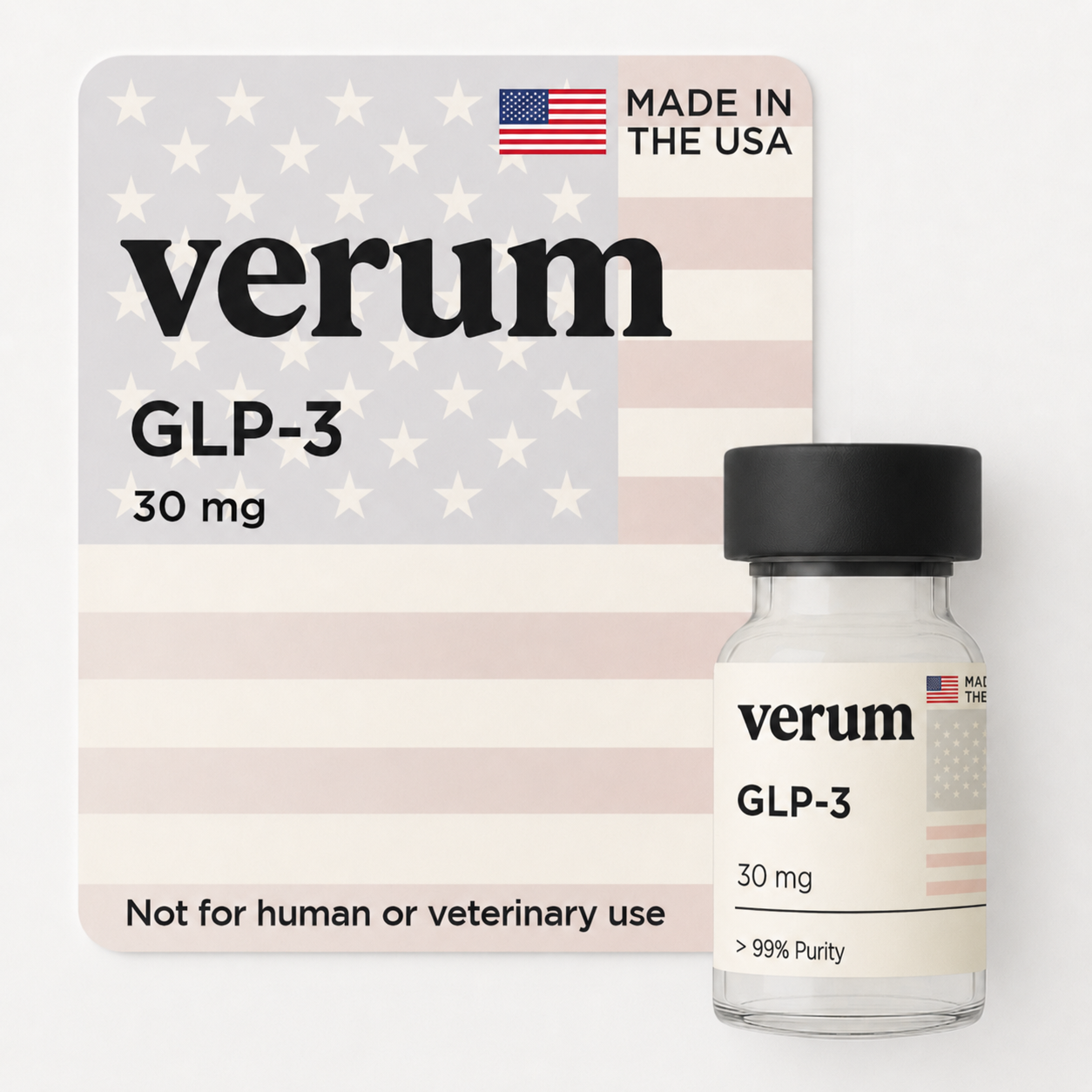
GLP-3
From $99
In stock · same-day dispatch, 2-day US shipping
- ✓ Third-party HPLC + MS tested
- ✓ NFC-verified COA on the vial
- ✓ Made in the USA
- ✓ Plain, discreet packaging
Research use only. Not for human or veterinary use, or for diagnostic or therapeutic procedures.
Live certificate of analysis
This is the same live record the NFC tag on the vial opens. Match the lot number on the certificate against the one printed on your vial.
This compound is unfinished, and that is the most important fact about it
Most compounds in this catalogue fall into one of two groups. Either they were never developed as medicines at all, or they are approved products with a completed regulatory file behind them. GLP-3 is in neither. It is an active clinical candidate whose late-stage programme is still running, which means the body of evidence that would establish its safety profile is being generated at this moment and does not yet exist.
That is a different kind of unknown from the ones attached to the older compounds here. With a peptide from the 1970s the uncertainty is that nobody ever looked properly. With this one, people are looking properly right now and have not finished. Anyone working with it is ahead of the evidence rather than beyond it, and the honest framing is that the answers are coming and are not here.
02
Three receptors, and the potencies are not close
GLP-3 engages the GIP receptor, the GLP-1 receptor and the glucagon receptor. Described that way it sounds like an even three-way split, and it is not. Published potency values put it roughly an order of magnitude apart at each step: strongest at the GIP receptor, around tenfold weaker at GLP-1, and around tenfold weaker again at glucagon. Across the full range that is close to a hundredfold spread between the tightest and loosest interaction.
That gradient is the single most useful thing to know before designing anything with this compound. At a given concentration the three receptors are not equally occupied, so the composition of the response shifts with concentration rather than scaling uniformly. Work run at one concentration and work run at ten times that concentration are not measuring the same mixture of activities, and any comparison against a single-receptor or dual-receptor agonist has to account for that rather than treating the compound as one input.
03
Four modifications on a thirty-nine residue chain
Thirty-nine residues is demanding before any modification is considered. This molecule carries alpha-aminoisobutyric acid at two separate positions, an alpha-methylated leucine at a third, and a C20 fatty diacid attached to a lysine through a glutamate spacer and an ethylene glycol linker. Each non-coded residue is a coupling step with its own failure mode, and each failure produces a species with a mass close enough to the target that a coarse method will not separate it. This is why the analytical package matters more than the number at the top of it.
04
Identification
| Molecule class | Acylated peptide; agonist at the GIP, GLP-1 and glucagon receptors |
| Development code | LY3437943 |
| Length | 39 amino acids, C-terminal amide |
| Backbone origin | Modified glucose-dependent insulinotropic polypeptide sequence |
| Non-coded residues | Alpha-aminoisobutyric acid at positions 2 and 20; alpha-methyl-leucine at position 13 |
| Acyl chain | C20 diacid on Lys17 via a gamma-glutamate spacer and an ethylene glycol linker |
| Molecular weight | Approximately 4731 g/mol |
| Expected ions | [M+3H]3+ near 1578; [M+4H]4+ near 1184 |
| CAS number | 2381089-83-2 |
| Relative potency | GIP receptor > GLP-1 receptor > glucagon receptor, roughly an order of magnitude between each |
| Physical form | White to off-white lyophilized cake, free of visible particulates |
| Fill sizes | 10, 15, 24, 30, 48 and 60 mg nominal per unit |
| Regulatory status | Investigational; not approved in any jurisdiction |
| Country of manufacture | United States |
05
How to check identity yourself, in ten seconds
This compound has a molecular weight close to 4731. On a peptide that size electrospray produces a series of multiply charged ions rather than a single peak, and the arithmetic is simple enough to do in your head. The triply protonated species lands near 1578 and the quadruply protonated near 1184. Multiply either by its charge, subtract the protons, and you should arrive back near 4731.
That check is worth doing rather than trusting a name printed in a field. It confirms the molecular weight of the material in front of the instrument, it takes seconds, and a deletion sequence or an unacylated species will not satisfy it. Some traces also show a potassium adduct sitting alongside the quadruply charged ion, which is expected rather than an impurity. The mass confirmation is printed on the certificates below.
06
Certificates of analysis - current lots
Each size is tested and released separately and carries its own certificate. All six are set out below: the interactive verification record, the certificate document, and the same information reproduced as text on this page.
Read this before comparing the six
Two independent laboratories test this catalogue and they report different quantities. One reports net peptide content: how much of the powder in a sampled unit is the peptide itself, with counterion and residual moisture excluded. The other reports fill weight conformance: individual units weighed against the target fill and expressed as a pass count across the batch.
Both are legitimate and they answer different questions. A net peptide figure tells you what is in one unit. A conformance count tells you how consistent the filling operation was across many. Neither converts into the other, and the panels attached to them differ as well. Read the certificate for the size ordered rather than assuming the figures are comparable across sizes.
10 mg
Certificate of analysis - lot 3KT3H0, 10 mg
Your browser cannot display the embedded document.
Lot record - 10 mg
3KT3H0
| Testing laboratory | Freedom Diagnostics, United States. Independent third party, not owned by or affiliated with Verum. |
| Dates | Received 22 July 2026; reported 25 July 2026 |
| Accession reference | 2607220665 |
| Method | HPLC-UV coupled to mass spectrometry (LC-MS) |
| Purity, HPLC-UV | 99.91 % |
| Net peptide content | 10.42 mg per unit |
| Appearance | White lyophilized powder |
| Mass confirmation | Charge series with the triply protonated ion near 1577 and the quadruply protonated near 1184, reconstructing to approximately 4731 |
| Endotoxin | Not tested on this lot |
15 mg
Certificate of analysis - lot GR12-032026-1, 15 mg
Your browser cannot display the embedded document.
Lot record - 15 mg
GR12-032026-1
| Testing laboratory | Freedom Diagnostics, United States. Independent third party, not owned by or affiliated with Verum. |
| Dates | Received 23 March 2026; reported 24 March 2026 |
| Accession reference | 2603230128 |
| Methods | HPLC-UV coupled to mass spectrometry (LC-MS). Bacterial endotoxin by limulus amebocyte lysate assay in accordance with USP . |
| Purity, HPLC-UV | 99.801 % |
| Net peptide content | 15.75 mg per unit |
| Appearance | White lyophilized powder |
| Bacterial endotoxin | Pass, duplicate replicates |
| Mass confirmation | Triply protonated ion at m/z 1577.40 with a potassium adduct at 1192.85, reconstructing to approximately 4731 |
| Note on this certificate | The laboratory recorded the product designation as 12 mg. The measured net peptide content is 15.75 mg. Both figures are reproduced here exactly as reported; contact us with the lot number before calculating from either. |
24 mg
Certificate of analysis - lot GR24-052026-1, 24 mg
Your browser cannot display the embedded document.
Lot record - 24 mg
GR24-052026-1
| Testing laboratory | Freedom Diagnostics, United States. Independent third party, not owned by or affiliated with Verum. |
| Dates | Received 12 May 2026; reported 14 May 2026 |
| Accession reference | 2605120073 |
| Methods | HPLC-UV coupled to mass spectrometry (LC-MS). Bacterial endotoxin by limulus amebocyte lysate assay in accordance with USP . |
| Purity, HPLC-UV | 99.82 % |
| Net peptide content | 29.43 mg per unit |
| Appearance | White lyophilized powder |
| Bacterial endotoxin | Pass, duplicate replicates. Assay sensitivity ≤0.05 EU/mL |
| Mass confirmation | Triply protonated ion near 1578 with a potassium adduct near 1193, reconstructing to approximately 4731 |
30 mg
Certificate of analysis - lot Y4AWYQ, 30 mg
Your browser cannot display the embedded document.
Lot record - 30 mg
Y4AWYQ
| Testing laboratory | pH Solutions, Monrovia, California. Independent third party, not owned by or affiliated with Verum. |
| Certificate issued | 11 July 2026 |
| Manufacture and expiry | Manufactured 8 July 2026; expiry 8 July 2027 |
| Batch size | 480 units |
| Purity, HPLC at 274 nm | 99 %, against a specification of not less than 99 % |
| Fill weight conformance | 337 of 337 units within specification against a 30.00 mg target |
| Appearance | White to off-white lyophilized cake, free of visible particulates |
| Microbial analysis, qPCR | Not detected across the assayed organisms |
| Mycotoxins, LC-MS | Not detected across six assayed toxins |
| Net peptide content | Not reported by this laboratory; fill weight conformance is reported instead |
48 mg
Certificate of analysis - lot GR48-052026-1, 48 mg
Your browser cannot display the embedded document.
Lot record - 48 mg
GR48-052026-1
| Testing laboratory | Freedom Diagnostics, United States. Independent third party, not owned by or affiliated with Verum. |
| Dates | Received 12 May 2026; reported 14 May 2026 |
| Accession reference | 2605120043 |
| Methods | HPLC-UV coupled to mass spectrometry (LC-MS). Bacterial endotoxin by limulus amebocyte lysate assay in accordance with USP . |
| Purity, HPLC-UV | 99.47 % |
| Net peptide content | 51.82 mg per unit |
| Appearance | White lyophilized powder |
| Bacterial endotoxin | Pass, duplicate replicates. Assay sensitivity ≤0.05 EU/mL |
| Mass confirmation | Quadruply protonated ion near 1184 and triply protonated near 1578, reconstructing to approximately 4731 |
60 mg
Certificate of analysis - lot 2NPVBM, 60 mg
Your browser cannot display the embedded document.
Lot record - 60 mg
2NPVBM
| Testing laboratory | pH Solutions, Monrovia, California. Independent third party, not owned by or affiliated with Verum. |
| Certificate issued | 6 July 2026 |
| Manufacture and expiry | Manufactured 22 June 2026; expiry 22 June 2027 |
| Batch size | 480 units |
| Certificate reference | ATC-COA-2NPVBM |
| Purity, HPLC at 274 nm | 99 %, against a specification of not less than 99 % |
| Fill weight conformance | 94 of 94 units within specification against a 60.00 mg target |
| Appearance | White to off-white lyophilized cake, free of visible particulates |
| Water activity | Below 0.65 aw. The only lot in this listing carrying this measurement. |
| Mycotoxins, LC-MS | Not detected across six assayed toxins |
| Microbial analysis | Not reported on this lot. The 30 mg lot carries it; this one carries water activity instead. |
| Net peptide content | Not reported by this laboratory; fill weight conformance is reported instead |
All figures above are specific to the lots named and are not specifications carried across other lots. No two of these six certificates carry an identical panel. That is a fact about how the material was released rather than a claim about quality, and it is why this page reports per lot rather than offering a single figure for the product.
07
Testing scope
Panels differ between products, between sizes and between lots. The columns below cover the union of what appears across the six current lots. No single lot carries everything in the left-hand column; check the certificate for the size ordered.
|
Performed, somewhere in the range
|
Not performed on any lot
|
The first two entries in the right-hand column matter most on a molecule of this construction. A chain missing one residue, or carrying the peptide backbone without its fatty diacid, is a different compound with different behaviour and a mass close enough to the target that a coarse method may not resolve it. A purity percentage measured at a single wavelength does not settle either question. Where a parameter is material to intended laboratory work, purchasers should verify it independently or source material released against that specification.
08
Storage and laboratory handling
| Lyophilized powder, transit | Stable at ambient temperature during shipping and short-term handling. Cold-chain transport is not required. |
| Lyophilized powder, storage | −20 °C, protected from light, container tightly closed |
| Solubility | Sterile laboratory-grade water or a defined aqueous buffer appropriate to the assay |
| Solution, storage | 2 °C to 8 °C, protected from light. Materially less stable than the dry powder. |
| Acyl chain behaviour | The C20 diacid gives this molecule surfactant-like character. Expect adsorption losses in dilute working solutions and use low-binding labware rather than assuming a calculated concentration is the actual one. Avoid vigorous agitation, which drives interfacial aggregation on acylated peptides. |
| Freeze-thaw | Avoid repeated cycles. Aliquot at first preparation where the protocol allows. |
| Personal protection | Handle under standard laboratory conditions with gloves, eye protection and a laboratory coat. |
Preparation conditions are the responsibility of the receiving laboratory. Verum provides no protocol, no preparation instruction, and no guidance on use.
09
Published literature
This page carries no bibliography. The published record on this compound consists almost entirely of clinical trials conducted in human participants under an investigational protocol, using pharmaceutical-grade material manufactured to standards this product is not manufactured to. Reproducing that literature beside a research-labelled unit would misrepresent both what is being sold and what those trials examined. Researchers working on incretin receptor pharmacology know where that record lives, and the late-stage programme is not complete.
10
Regulatory status
| United States | Not approved by the FDA for any indication. Investigational only. Not on the section 503A bulk drug substances list. |
| Compounding | There is no lawful compounding route for this substance. It is not an approved drug, so the shortage-based pathway that has applied to some approved products does not apply here. |
| Other jurisdictions | No marketing authorisation is held anywhere. |
| Development status | Late-stage clinical development is ongoing and not complete. The safety profile is not established. |
| Athletic competition | Prohibited under World Anti-Doping Agency rules. |
| Status date | Accurate as of August 2026. Verify the current position independently. |
11
Purchase eligibility
By placing an order you confirm each of the following:
| ✓ | You are at least 21 years of age. |
| ✓ | You are a qualified researcher, or are purchasing on behalf of a research institution or commercial laboratory. |
| ✓ | The material will be used solely for in vitro laboratory research. |
| ✓ | The material will not be administered to humans or to animals, and will not be resold or transferred for any such purpose. |
| ✓ | You understand that this is an investigational compound whose clinical programme is not complete and whose safety profile is not established. |
| ✓ | You are responsible for compliance with all federal, state and local law governing receipt, handling, storage and use. |
Confirmation is recorded at checkout against your order. Verum reserves the right to decline or cancel any order.
12
Supply
Orders placed before the daily cutoff are dispatched the same day from our United States warehouse. Domestic orders typically arrive within two business days. A tracking reference is issued by email once the consignment leaves the facility. Each unit carries a scannable code linking to the certificate for its own lot.
Not for human or veterinary use. Not for use in diagnostic or therapeutic procedures. This product is a laboratory reagent and is an investigational compound not approved in any jurisdiction. Nothing on this page constitutes medical advice, a recommendation for personal use, or a representation that this material is safe or effective for any purpose. No statement here has been evaluated by the U.S. Food and Drug Administration.