 Verified COA
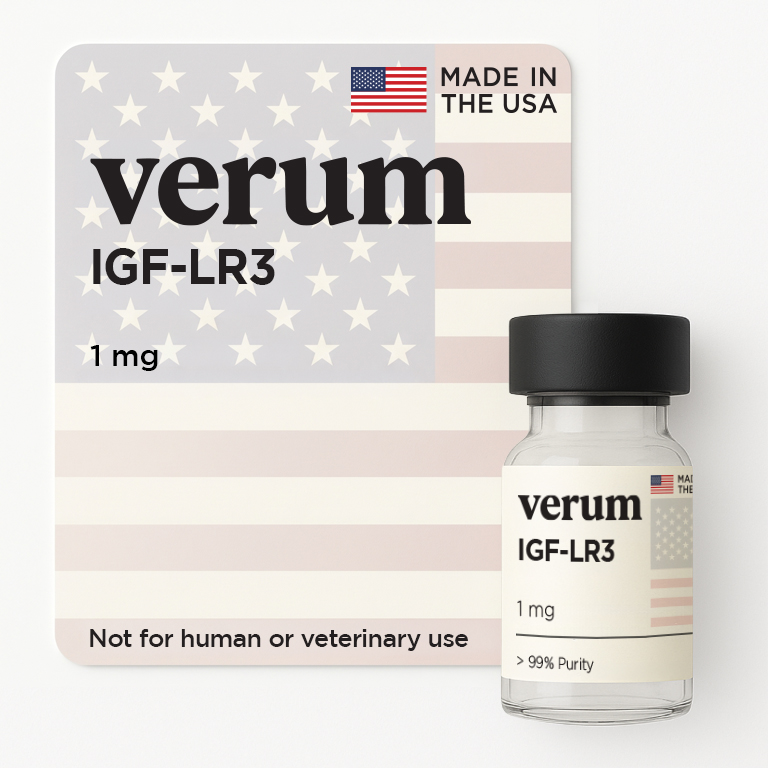 NFC-verified COA on this vial
Peptides
IGF-LR3
$105 $122
In stock · same-day dispatch, 2-day US shipping
- ✓ Third-party HPLC + MS tested
- ✓ NFC-verified COA on the vial
- ✓ Made in the USA
- ✓ Plain, discreet packaging
Research use only. Not for human or veterinary use, or for diagnostic or therapeutic procedures.
Live certificate of analysis
This is the same live record the NFC tag on the vial opens. Match the lot number on the certificate against the one printed on your vial.
Identification
| Chemical name | Recombinant Long Arg3 analogue of human insulin-like growth factor 1 |
| Common designations | IGF-1 LR3; Long R3 IGF-1; Long Arg3 IGF-1; LR3 IGF-I |
| Compound class | Recombinant protein. Not a synthetic peptide, and not manufactured by solid-phase synthesis. |
| Length | 96 residues: an 83-residue IGF-1 core with a 13-residue N-terminal extension |
| N-terminal extension | MFPAMPLSSLFVN - derived from methionyl porcine growth hormone |
| Substitution | Arginine for glutamate at position 3 of the mature sequence |
| Disulfide bonds | Three. See section 04. |
| Molecular weight | Approximately 9.1 kDa |
| CAS number | 946870-92-4 |
| Expression system | Escherichia coli |
| Physical form | White lyophilized powder |
| Quantity supplied | 1 mg nominal per unit |
| Country of manufacture | United States |
Note on the two modifications
Two changes separate this molecule from native IGF-1. An arginine replaces the glutamate at position 3, which is the source of the R3 designation, and a thirteen-residue N-terminal extension gives the Long. Together they sharply reduce affinity for the IGF binding proteins that sequester circulating IGF-1 while leaving receptor binding largely intact. That is the design rationale, and it is why this analogue became a standard reagent for serum-free mammalian cell culture rather than a therapeutic candidate.
Two corrections, because both errors appear widely on competing listings. The substitution is glutamate to arginine, not arginine to leucine. And the frequently repeated claim of a dramatically extended half-life is contested: reduced binding-protein affinity cuts both ways, since the IGFBP-3 complex also slows clearance of native IGF-1, and some animal work reports faster clearance rather than slower. No human pharmacokinetic study of this analogue has been published.
02
Certificate of analysis - current lot
The interactive verification record is shown below, followed by the same information reproduced as text on this page and the full certificate as a document. The record does not depend on the embed loading.
Certificate of analysis - lot IGFR-052026-2
Lot record
IGFR-052026-2
| Testing laboratory | Freedom Diagnostics, United States |
| Laboratory relationship | Independent third party. Not owned by, affiliated with, or operated by Verum. |
| Sample received | 5 May 2026 |
| Results reported | 7 May 2026 |
| Accession reference | 2605050307 |
| Analytical methods | HPLC-UV coupled to mass spectrometry (LC-MS). Bacterial endotoxin by limulus amebocyte lysate assay in accordance with USP . |
Results, this lot
| Identity, LC-MS | Confirmed as IGF-LR3 |
| Purity, HPLC-UV | 99.67 % |
| Net content | 1.01 mg per unit |
| Appearance | White lyophilized powder |
| Bacterial endotoxin | Pass, duplicate replicates. Assay sensitivity ≤0.05 EU/mL |
| Mass confirmation | Charge series observed from 6+ to 9+, at m/z 1013.4, 1139.7, 1302.3 and near 1520, all reconstructing to approximately 9,110 |
Purity, content and endotoxin figures above are specific to lot IGFR-052026-2 and are not specifications carried across other lots. Each lot is tested individually and reports its own results. The certificate supplied with your unit records the results for that lot.
03
Testing scope
Panels differ between products and between lots. What follows is the scope of testing performed on this lot. Nothing is claimed unless it appears on the certificate for the lot supplied.
|
Performed
|
Not performed
|
The first three entries in the right-hand column are the ones that matter on a recombinant protein; see section 04. Where a parameter is material to intended laboratory work, purchasers should verify it independently or source material released against that specification.
04
Why a purity figure establishes less on this product
This is the section that matters most here, and it is the one competing listings do not carry.
IGF-1 and its analogues carry three disulfide bonds. Recombinant expression in bacteria yields material that can include misfolded disulfide isomers with the correct sequence, the correct mass, and substantially reduced activity. A reversed-phase purity figure will not reliably separate those from correctly folded protein, and a mass confirmation will not flag them either, because the mass is identical. The specifications that speak to folding are SDS-PAGE run under both reducing and non-reducing conditions, size-exclusion chromatography for aggregates and dimers, and a cell-based potency assay reported as an ED50. None of those appears on this certificate.
Endotoxin is the second question, and on this lot it has been answered. Anything expressed in E. coli carries bacterial endotoxin unless it is specifically removed and specifically tested for, and endotoxin contamination will confound a cell-based readout regardless of how pure the protein is. This lot was tested by limulus amebocyte lysate assay under USP in duplicate, with both replicates passing at an assay sensitivity of 0.05 endotoxin units per millilitre. Panels vary between lots, so confirm it on the certificate for the unit supplied rather than assuming it carries across.
The honest summary: identity, purity, content and endotoxin are covered on this lot. Folding, aggregation and bioactivity are not. We state that rather than let a purity percentage answer questions it does not answer. Researchers whose work depends on those parameters should source material released against them.
05
Storage and laboratory handling
| Lyophilized powder, transit | Stable at ambient temperature during shipping and short-term handling. Cold-chain transport is not required. |
| Lyophilized powder, storage | −20 °C protected from light, or −80 °C for extended periods |
| Solubility | This protein aggregates in neutral aqueous buffer. It is conventionally taken into solution in dilute acetic acid, commonly 10 mM, before dilution into the working medium. Preparing directly into neutral buffer is the most common handling error with this molecule, and it costs activity without announcing itself. |
| Solution, storage | 2 °C to 8 °C, protected from light |
| Freeze-thaw | Avoid repeated cycles. Harder on a disulfide-bonded protein than on a short synthetic chain. |
| Adsorption | Carrier protein is conventionally added to dilute working solutions to limit surface losses. Use low-binding labware. |
| Scale | For reference, 1 mg supports on the order of one hundred litres of medium at a ten nanogram per millilitre working concentration. |
| Personal protection | Handle under standard laboratory conditions with gloves, eye protection and a laboratory coat. |
Preparation conditions are the responsibility of the receiving laboratory. Verum provides no protocol, no preparation instruction, and no guidance on use.
06
Published literature
The primary literature specific to this analogue is small, and most of it comes from one Australian group working in the early 1990s. That is because the molecule was designed as a reagent rather than a drug candidate, so it never accumulated the publication record a therapeutic programme would generate. Entries are indexed by the experimental system used, and each description states what the study measured rather than what it concluded. No human pharmacokinetic or clinical study of this analogue has been published. Verum has no involvement in any of this work and makes no representation as to its applicability.
|
Binding assay & culture 1992 |
Binding-protein affinity and receptor affinity across a panel of engineered IGF-1 analogues Francis GL, et al. · Journal of Molecular Endocrinology 8:213–223 Measured binding-protein affinity and receptor affinity across a series of engineered analogues by competition assay, then compared potency in culture. The paper that defines this molecule and establishes why the position 3 substitution and the N-terminal extension were selected. Everything downstream traces here. |
|
Rodent
1996 |
Relative potency of binding-protein-evading analogues against native IGF-1 across two delivery routes Tomas FM, et al. · Journal of Endocrinology 150(1):77–84 Compared analogues that bind IGF binding proteins poorly against native IGF-1 in a rodent model, measuring relative potency across two routes of delivery. Also relevant to the clearance question, since the same binding-protein evasion that raises free fraction removes the complex that slows clearance. |
|
Review
2002 |
Review of binding-protein function beyond sequestration Mohan S, Baylink DJ · Journal of Endocrinology 175(1):19–31 Reviews what the six IGF binding proteins do beyond sequestration, including receptor-independent activity. Relevant because an analogue designed to evade those proteins also evades whatever else they were contributing, which is a variable most designs using this reagent do not control for. |
One further point worth stating plainly: the industry-standard potency assay for this protein measures proliferation of a human breast cancer cell line, with an ED50 in the sub-nanogram-per-millilitre range. That is the assay by which reference-grade material is released. Work conducted in culture and in rodents does not establish an effect in any other system.
07
Regulatory status
| United States | Not approved by the FDA for any indication. Not on the section 503A bulk drug substances list. |
| Other jurisdictions | No marketing authorisation is held anywhere. This analogue was developed as a laboratory reagent rather than as a therapeutic candidate. |
| Athletic competition | Prohibited under World Anti-Doping Agency rules. |
| Status date | Accurate as of August 2026. Verify the current position independently. |
08
Purchase eligibility
By placing an order you confirm each of the following:
| ✓ | You are at least 21 years of age. |
| ✓ | You are a qualified researcher, or are purchasing on behalf of a research institution or commercial laboratory. |
| ✓ | The material will be used solely for in vitro laboratory research. |
| ✓ | The material will not be administered to humans or to animals, and will not be resold or transferred for any such purpose. |
| ✓ | You are responsible for compliance with all federal, state and local law governing receipt, handling, storage and use. |
Confirmation is recorded at checkout against your order. Verum reserves the right to decline or cancel any order.
09
Supply
Orders placed before the daily cutoff are dispatched the same day from our United States warehouse. Domestic orders typically arrive within two business days. A tracking reference is issued by email once the consignment leaves the facility. Each unit carries a scannable code linking to the certificate for its own lot.
Not for human or veterinary use. Not for use in diagnostic or therapeutic procedures. This product is a laboratory reagent. Nothing on this page constitutes medical advice, a recommendation for personal use, or a representation that this material is safe or effective for any purpose. No statement here has been evaluated by the U.S. Food and Drug Administration.