 Verified COA
 NFC-verified COA on this vial
Peptides
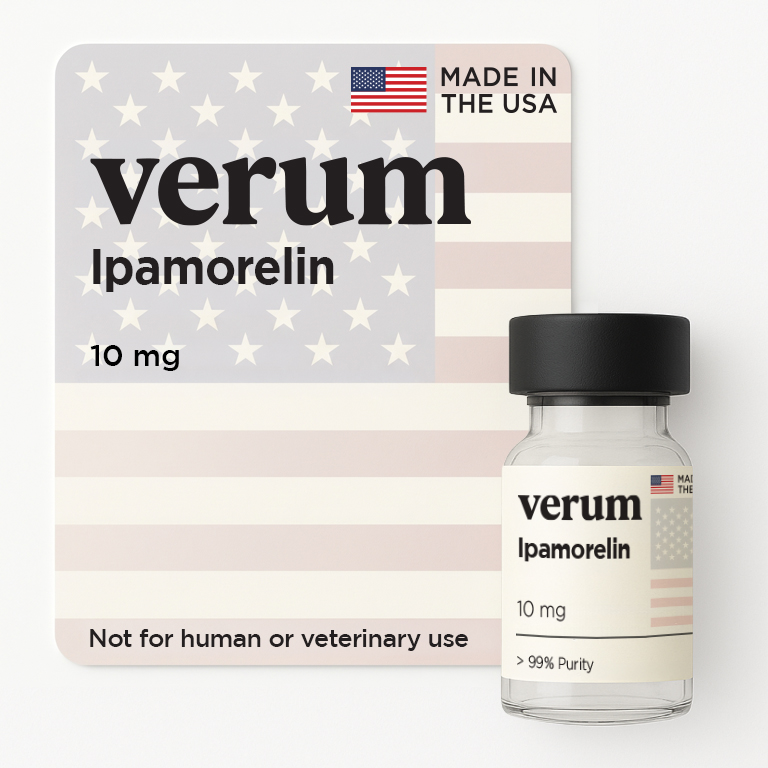
Ipamorelin
$69 $79
In stock · same-day dispatch, 2-day US shipping
- ✓ Third-party HPLC + MS tested
- ✓ NFC-verified COA on the vial
- ✓ Made in the USA
- ✓ Plain, discreet packaging
Research use only. Not for human or veterinary use, or for diagnostic or therapeutic procedures.
Live certificate of analysis
This is the same live record the NFC tag on the vial opens. Match the lot number on the certificate against the one printed on your vial.
Identification
| Chemical name | Synthetic pentapeptide amide incorporating three non-coded residues |
| Common designation | Ipamorelin |
| Sequence | Aib-His-D-2-Nal-D-Phe-Lys-NH2 |
| Length | 5 residues, C-terminal amide |
| Non-standard residues | 2-aminoisobutyric acid; D-2-naphthylalanine; D-phenylalanine |
| Molecular formula | C38H49N9O5 |
| Molecular weight | 711.9 g/mol, free base |
| CAS number | 170851-70-4 |
| Molecular target | Growth hormone secretagogue receptor (GHS-R1a), the receptor ghrelin acts on |
| Not a GHRH analogue | Binds a different receptor from sermorelin, tesamorelin and CJC-1295. See section 04. |
| Oxidation-sensitive residues | None. The sequence contains no methionine, cysteine, tryptophan or tyrosine. |
| Physical form | White lyophilized powder |
| Quantity supplied | 10 mg nominal per unit |
| Country of manufacture | United States |
02
Certificate of analysis - current lot
The interactive verification record is shown below, followed by the same information reproduced as text on this page and the full certificate as a document. The record does not depend on the embed loading.
Certificate of analysis - lot VNA7TB
Lot record
VNA7TB
| Testing laboratory | Freedom Diagnostics, United States |
| Laboratory relationship | Independent third party. Not owned by, affiliated with, or operated by Verum. |
| Sample received | 11 May 2026 |
| Results reported | 12 May 2026 |
| Accession reference | 2605110191 |
| Analytical method | High-performance liquid chromatography with ultraviolet detection coupled to mass spectrometry (HPLC-UV / LC-MS) |
Results, this lot
| Identity, LC-MS | Confirmed as ipamorelin |
| Purity, HPLC-UV | 99.90 % |
| Net peptide content | 13.12 mg per unit |
| Appearance | White lyophilized powder |
| Mass confirmation | Three species assigned: [M+H]+ at m/z 713.2, [M+2H]2+ at 356.8 and the sodium adduct [M+Na]+ at 734.2 |
Purity and content figures above are specific to lot VNA7TB and are not a specification carried across other lots. Each lot is tested individually and reports its own results. A certificate that assigns the sodium adduct rather than leaving it as an unexplained peak is one where the spectrum has been interpreted rather than glanced at.
03
Testing scope
Panels differ between products and between lots. What follows is the scope of testing performed on this lot. Nothing is claimed unless it appears on the certificate for the lot supplied.
|
Performed
|
Not performed
|
The first entry in the right-hand column is the limitation worth naming on this molecule. Three of the five residues are non-standard, including two D-amino acids, and mass spectrometry cannot distinguish a D-amino acid from its L counterpart because they weigh the same. A substitution of that kind yields identical mass, similar chromatographic behaviour and a different receptor profile. Confirming stereochemistry requires chiral analysis, which is not part of this panel or of any standard peptide panel. Where a parameter is material to intended laboratory work, purchasers should verify it independently.
04
It is not in the class it is usually filed under
Ipamorelin is routinely shelved alongside sermorelin, tesamorelin and CJC-1295, each of which binds the growth hormone-releasing hormone receptor. Ipamorelin does not. It binds the growth hormone secretagogue receptor, a separate protein with a separate endogenous ligand. The two pathways converge on the same downstream output and are otherwise unrelated.
The compound also came out of a programme searching for members of its class with less collateral endocrine activity than their predecessors, and the published characterisation reports minimal effect on cortisol and prolactin relative to those earlier compounds. That selectivity profile rather than potency is what makes the molecule useful as a research tool, and it is the property most worth verifying rather than assuming in an assay design.
05
Single unit or blend
This compound is also supplied co-lyophilized with a GHRH analogue. A blend fixes the proportion of two compounds in one powder, which makes it impossible to vary one input while holding the other constant, impossible to run a single-component control, and impossible to attribute an observation to either pathway. Separate units answer questions a combined unit cannot. Work comparing the GHRH and secretagogue routes, or establishing a concentration-response relationship for either, requires this format.
06
Storage and laboratory handling
| Lyophilized powder, transit | Stable at ambient temperature during shipping and short-term handling. Cold-chain transport is not required. |
| Lyophilized powder, storage | −20 °C, protected from light, container tightly closed |
| Solubility | Sterile laboratory-grade water or a defined aqueous buffer appropriate to the assay |
| Solution, storage | 2 °C to 8 °C, protected from light. Materially less stable than the dry powder. |
| Freeze-thaw | Avoid repeated cycles. Aliquot at first preparation where the protocol allows. |
| Sequence-specific note | The D-amino acids and the C-terminal amide make this pentapeptide unusually resistant to enzymatic degradation, and the sequence carries no oxidation-sensitive residues. Both are real advantages and both are frequently overread. Resistance to peptidases and to oxidation is not stability in aqueous storage; this peptide hydrolyses in solution like any other. |
| Personal protection | Handle under standard laboratory conditions with gloves, eye protection and a laboratory coat. |
Preparation conditions are the responsibility of the receiving laboratory. Verum provides no protocol, no preparation instruction, and no guidance on use.
07
Published literature
Rather than assemble a bibliography, this page points at one document. The FDA's briefing package prepared for the advisory committee review of ipamorelin is a systematic survey of the available evidence, written by reviewers with no commercial interest in the outcome, and it reaches a conclusion unfavourable to anyone selling this compound. That makes it more useful than a curated reading list and considerably harder to accuse of selection bias.
FDA advisory committee briefing document, ipamorelin, PDF →
08
Regulatory status
| United States | Not approved by the FDA for any indication. Not on the section 503A bulk drug substances list, and it cannot lawfully be compounded for a patient. |
| Category 2 history | Placed on Category 2 of the interim 503A list in September 2023, the designation for substances the agency considers to present significant safety risks. Removed in September 2024 after the parties who nominated it withdrew their nominations. A great deal of marketing copy stops the account there. |
| Advisory committee | The Pharmacy Compounding Advisory Committee took the substance up on 29 October 2024, with the agency's own analysis recommending against inclusion, and voted against adding it to the 503A list. The reasons on the record were insufficient human safety data, mechanistic concerns about unintended endocrine effects, and efficacy data confined to small or open-label studies. |
| In context | Several other substances received favourable committee recommendations in July 2026, and some compounds acting on the GHRH pathway have a lawful prescription route through a compounding pharmacy. This one has neither. It was reviewed, and the answer was no. |
| Other jurisdictions | No marketing authorisation is held anywhere. |
| Athletic competition | Prohibited under World Anti-Doping Agency rules. |
| Status date | Accurate as of August 2026. Verify the current position independently. |
Read the briefing document linked above rather than take anyone's characterisation of it, including this one.
09
Purchase eligibility
By placing an order you confirm each of the following:
| ✓ | You are at least 21 years of age. |
| ✓ | You are a qualified researcher, or are purchasing on behalf of a research institution or commercial laboratory. |
| ✓ | The material will be used solely for in vitro laboratory research. |
| ✓ | The material will not be administered to humans or to animals, and will not be resold or transferred for any such purpose. |
| ✓ | You are responsible for compliance with all federal, state and local law governing receipt, handling, storage and use. |
Confirmation is recorded at checkout against your order. Verum reserves the right to decline or cancel any order.
10
Supply
Orders placed before the daily cutoff are dispatched the same day from our United States warehouse. Domestic orders typically arrive within two business days. A tracking reference is issued by email once the consignment leaves the facility. Each unit carries a scannable code linking to the certificate for its own lot.
Not for human or veterinary use. Not for use in diagnostic or therapeutic procedures. This product is a laboratory reagent. Nothing on this page constitutes medical advice, a recommendation for personal use, or a representation that this material is safe or effective for any purpose. No statement here has been evaluated by the U.S. Food and Drug Administration.