 Verified COA
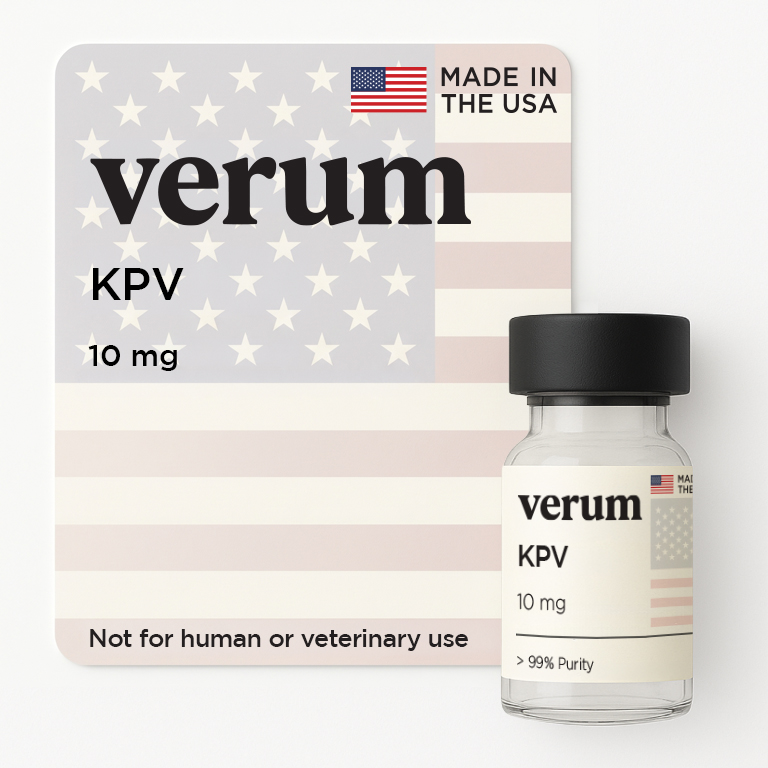 NFC-verified COA on this vial
Peptides
KPV
$49 $59
In stock · same-day dispatch, 2-day US shipping
- ✓ Third-party HPLC + MS tested
- ✓ NFC-verified COA on the vial
- ✓ Made in the USA
- ✓ Plain, discreet packaging
Research use only. Not for human or veterinary use, or for diagnostic or therapeutic procedures.
Live certificate of analysis
This is the same live record the NFC tag on the vial opens. Match the lot number on the certificate against the one printed on your vial.
Identification
| Chemical name | L-lysyl-L-prolyl-L-valine |
| Common designation | KPV |
| Sequence | Lys-Pro-Val |
| Length | 3 amino acids, linear, free termini |
| Sequence origin | C-terminal tripeptide of alpha-melanocyte-stimulating hormone, residues 11 to 13 |
| Molecular formula | C16H30N4O4 |
| Molecular weight | 342.4 g/mol |
| Expected ion | [M+H]+ near 343 |
| CAS number | 67247-12-5 |
| Oxidation-sensitive residues | None. The sequence contains no methionine, cysteine, tryptophan or tyrosine. |
| Physical form | White lyophilized powder |
| Quantity supplied | 10 mg nominal per unit |
| Also supplied in | The KLOW blend, co-lyophilized with three other compounds at a fixed proportion |
| Country of manufacture | United States |
Note on the family it is filed under
Alpha-melanocyte-stimulating hormone is a thirteen-residue peptide and this is its last three. That places the compound in the same family as two others in this catalogue while separating it from both in a way the family name obscures.
Melanotan 2 and PT-141 are cyclic analogues built around the core melanocortin recognition sequence, and both are melanocortin receptor agonists in the ordinary sense. This compound carries none of the residues that drive receptor binding in those analogues, and the literature describing it concerns activity that does not depend on the classical melanocortin receptors. Grouping it under alpha-MSH because it shares a parent is accurate genealogy and misleading pharmacology. A melanocortin receptor readout is probably the wrong instrument here, and a design assuming the same mechanism as the cyclic analogues is testing an assumption rather than a hypothesis.
02
Certificate of analysis - current lot
The interactive verification record is shown below, followed by the same information reproduced as text on this page and the full certificate as a document. The record does not depend on the embed loading.
Certificate of analysis - lot KPV1012102025-08
Lot record
KPV1012102025-08
| Testing laboratory | Freedom Diagnostics, United States. Independent third party, not owned by or affiliated with Verum. |
| Sample received | 16 December 2025 |
| Results reported | 17 December 2025 |
| Accession reference | 2512160022 |
| Analytical method | High-performance liquid chromatography with ultraviolet detection coupled to mass spectrometry (HPLC-UV / LC-MS) |
Results, this lot
| Identity, LC-MS | Confirmed as KPV |
| Purity, HPLC-UV | 99.753 % |
| Net peptide content | 11.67 mg per unit |
| Appearance | White lyophilized powder |
| Mass confirmation | Single ion observed at m/z 342.98 [M+H]+, consistent with a molecular weight of 342.4 |
| Bacterial endotoxin | Not tested on this lot |
Purity and content figures above are specific to lot KPV1012102025-08 and are not a specification carried across other lots. This certificate was issued on an earlier template carrying a narrower panel than several other listings in this catalogue. Each lot is tested individually and reports its own results.
03
Testing scope
Panels differ between products and between lots. What follows is the scope of testing performed on this lot. Nothing is claimed unless it appears on the certificate for the lot supplied.
|
Performed
|
Not performed
|
Where a parameter is material to intended laboratory work, purchasers should verify it independently or source material released against that specification.
04
What a certificate establishes on a molecule this small
Most quality arguments in this category rest on the difficulty of assembling long chains. Three residues is not difficult to assemble, so the usual reassurances carry less weight here and the failure modes are different ones. This section sets out what the document above does and does not settle.
The mass is a single point rather than a series. At roughly 342 daltons the protonated ion sits near 343, in a region of the spectrum where solvent clusters, salt adducts and small-molecule contaminants also appear. A tripeptide is too small to carry multiple charges, so there is no ladder of independent ions that must all reconstruct to the same weight. On a peptide of two thousand daltons that cross-check is the strongest part of the identity argument. Here it is unavailable.
The chromatography is crowded. A short, polar, unremarkable tripeptide elutes early on a reversed-phase column, close to the void where unretained material comes off. Separation from anything else eluting there is correspondingly harder than for a molecule with more hydrophobic character holding it on the column.
None of that makes this material suspect. It means the certificate is doing less work here than the same certificate would on a larger molecule, which is a property of the analysis rather than of the sample. Anyone requiring certainty at this size should be considering amino acid analysis or a second orthogonal method rather than treating a purity percentage as the end of the question.
05
Storage and laboratory handling
| Lyophilized powder, transit | Stable at ambient temperature during shipping and short-term handling. Cold-chain transport is not required. |
| Lyophilized powder, storage | −20 °C, protected from light, container tightly closed |
| Solubility | Freely soluble in sterile laboratory-grade water or a defined aqueous buffer appropriate to the assay |
| Solution, storage | 2 °C to 8 °C, protected from light |
| Freeze-thaw | Avoid repeated cycles. |
| Sequence-specific note | A chemically unremarkable sequence with no oxidation-sensitive residues, and about as robust as a peptide gets. It is hygroscopic, so allow the container to reach room temperature before opening or condensation will be drawn into the powder. At 10 mg of a light molecule the powder volume is small; prepare from the whole unit rather than attempting to subdivide it by weight. |
| Personal protection | Handle under standard laboratory conditions with gloves, eye protection and a laboratory coat. |
Preparation conditions are the responsibility of the receiving laboratory. Verum provides no protocol, no preparation instruction, and no guidance on use.
06
Published literature
The published record on this tripeptide is genuinely small, and most of it is cell culture and rodent work spread across a couple of decades and several disciplines. We are not assembling a curated list from it, because a short bibliography selected by the seller from a thin literature is a shaped picture rather than an informative one, and on a compound with this little published work the selection would be doing more of the argument than the studies. Researchers should search it directly. The FDA briefing package prepared for the July 2026 advisory committee review is a reasonable starting point, since it surveys the evidence base without a commercial interest in the conclusion.
07
Regulatory status
| United States | Not approved by the FDA for any indication. Not on the section 503A bulk drug substances list. |
| Advisory committee | The Pharmacy Compounding Advisory Committee reviewed this substance on 23 July 2026 and voted to recommend it for inclusion on the 503A list, by eight votes to six with one abstention, over the recommendation of the agency's own reviewers. |
| What that vote does not do | A committee recommendation is advisory and non-binding. Inclusion requires separate notice-and-comment rulemaking, which has historically taken a year or more and has not always followed a favourable vote. Glutathione cleared the same committee in June 2022 by a comparable margin and is still not on the codified list four years later. This substance is not approved, is not lawfully compoundable, and the vote does not make it a medicine. |
| Other jurisdictions | No marketing authorisation is held anywhere. |
| Status date | Accurate as of August 2026. Verify the current position independently. |
08
Purchase eligibility
By placing an order you confirm each of the following:
| ✓ | You are at least 21 years of age. |
| ✓ | You are a qualified researcher, or are purchasing on behalf of a research institution or commercial laboratory. |
| ✓ | The material will be used solely for in vitro laboratory research. |
| ✓ | The material will not be administered to humans or to animals, and will not be resold or transferred for any such purpose. |
| ✓ | You are responsible for compliance with all federal, state and local law governing receipt, handling, storage and use. |
Confirmation is recorded at checkout against your order. Verum reserves the right to decline or cancel any order.
09
Supply
Orders placed before the daily cutoff are dispatched the same day from our United States warehouse. Domestic orders typically arrive within two business days. A tracking reference is issued by email once the consignment leaves the facility. Each unit carries a scannable code linking to the certificate for its own lot.
Not for human or veterinary use. Not for use in diagnostic or therapeutic procedures. This product is a laboratory reagent. Nothing on this page constitutes medical advice, a recommendation for personal use, or a representation that this material is safe or effective for any purpose. No statement here has been evaluated by the U.S. Food and Drug Administration.