 Verified COA
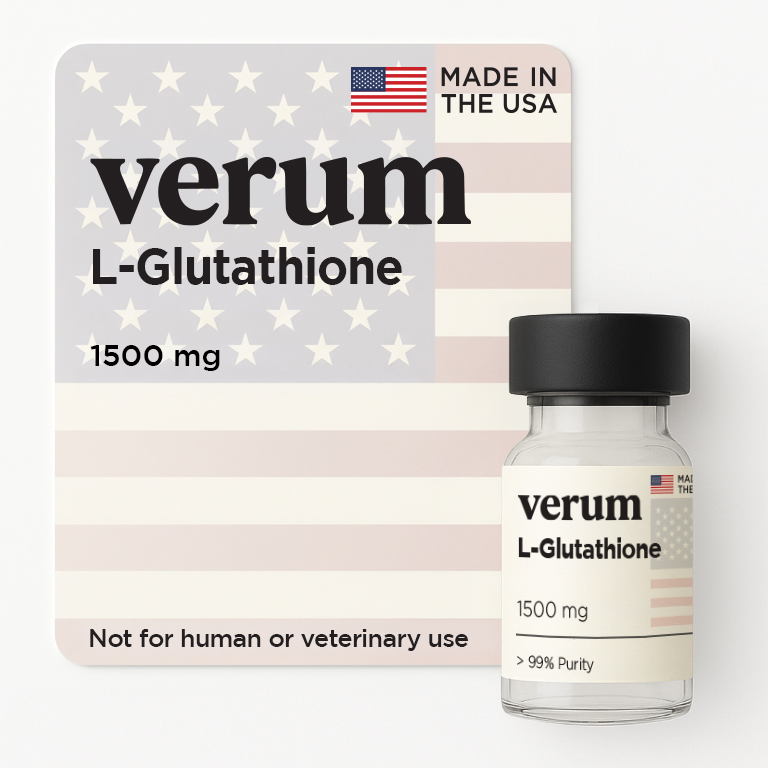 NFC-verified COA on this vial
Peptides
L-Glutathione
$79 $89
In stock · same-day dispatch, 2-day US shipping
- ✓ Third-party HPLC + MS tested
- ✓ NFC-verified COA on the vial
- ✓ Made in the USA
- ✓ Plain, discreet packaging
Research use only. Not for human or veterinary use, or for diagnostic or therapeutic procedures.
Live certificate of analysis
This is the same live record the NFC tag on the vial opens. Match the lot number on the certificate against the one printed on your vial.
Identification
| Chemical name | gamma-L-glutamyl-L-cysteinyl-glycine |
| Common designations | L-glutathione; reduced glutathione; GSH |
| Form supplied | Reduced form, free thiol |
| Molecular formula | C10H17N3O6S |
| Molecular weight | 307.3 g/mol; monoisotopic 307.08 |
| Expected ion | [M+H]+ at 308.09; a dimer adduct near 615 is expected rather than a contaminant |
| CAS number | 70-18-8 |
| Not this compound | Oxidised glutathione, GSSG. C20H32N6O12S2, approximately 612.6 g/mol, CAS 27025-41-8. A different compound with its own registry number. |
| Reactive site | Free cysteine thiol |
| Peptide linkage | Gamma bond from the glutamate side chain to cysteine, not a conventional alpha peptide bond |
| Physical form | White lyophilized powder |
| Quantity supplied | 1,500 mg nominal per unit |
| Country of manufacture | United States |
Note on the linkage
The bond between glutamate and cysteine forms from the glutamate side chain rather than its alpha carboxyl, which makes it a gamma linkage rather than a conventional peptide bond. That structural feature is why this molecule is not a substrate for the peptidases that would otherwise dismantle a tripeptide quickly, and why a dedicated enzyme, gamma-glutamyl transpeptidase, exists to cleave it. Any design assuming proteolytic behaviour typical of the peptides this molecule superficially resembles will be working from the wrong premise.
02
Certificate of analysis - current lot
The interactive verification record is shown below, followed by the same information reproduced as text on this page and the full certificate as a document. The record does not depend on the embed loading.
Certificate of analysis - lot GLUT-052026-2
Lot record
GLUT-052026-2
| Testing laboratory | Freedom Diagnostics, United States. Independent third party, not owned by or affiliated with Verum. |
| Sample received | 6 May 2026 |
| Results reported | 8 May 2026 |
| Accession reference | 2605060429 |
| Analytical methods | HPLC-UV coupled to mass spectrometry (LC-MS). Bacterial endotoxin by limulus amebocyte lysate assay in accordance with USP . |
Results, this lot
| Identity, LC-MS | Confirmed as glutathione |
| Purity, HPLC-UV | 99.73 % |
| Net content | 1,569.01 mg per unit |
| Appearance | White lyophilized powder |
| Bacterial endotoxin | Pass, duplicate replicates. Assay sensitivity ≤0.05 EU/mL |
| Mass confirmation | Principal ion observed at m/z 308.1, the reduced form. A dimer adduct appears near 615. No signal at 613 for the disulfide. |
Purity, content and endotoxin figures above are specific to lot GLUT-052026-2 and are not specifications carried across other lots. Each lot is tested individually and reports its own results.
03
Reduced or oxidised is the specification that matters
Glutathione exists in two interconvertible forms. The reduced form carries a free thiol on its cysteine residue and is the species of interest in essentially all of the literature. The oxidised form is two molecules joined through a disulfide bond: a different compound with different chemistry, roughly twice the mass, and its own registry number.
The conversion is straightforward and runs in one direction under ordinary handling. Air, alkaline pH and traces of transition metal all drive the reduced form toward the disulfide. Material stored carelessly, or a solution left standing, will contain more of the oxidised form than it started with, and a purity percentage on its own does not report the ratio.
The mass does. Reduced glutathione has a monoisotopic mass of 307.08 and appears at 308.09 as the protonated ion; the disulfide sits near 613. Those are not close together, and one look at the mass confirmation on the certificate for a given lot settles the question. On the lot above the observed ion is at 308.1, with a dimer adduct near 615 which is an expected artefact of two molecules associating in the source rather than the covalent disulfide. Check the certificate for the unit supplied rather than taking the form on trust.
04
Testing scope
Panels differ between products and between lots. What follows is the scope of testing performed on this lot. Nothing is claimed unless it appears on the certificate for the lot supplied.
|
Performed
|
Not performed
|
The first two entries in the right-hand column are the ones specific to this compound. The mass confirms which form predominates; it does not quantify how much of the other is present. Where that ratio is material to intended laboratory work, a thiol titration or a method resolving both species is the appropriate check.
05
Storage and laboratory handling
| Lyophilized powder, transit | Stable at ambient temperature during shipping and short-term handling. Cold-chain transport is not required. |
| Lyophilized powder, storage | −20 °C, protected from light, container tightly closed |
| Solubility | Soluble in sterile laboratory-grade water or a defined aqueous buffer appropriate to the assay |
| Solution, storage | 2 °C to 8 °C, protected from light. Once in solution the free thiol is exposed and conversion to the disulfide begins, so reconstituted material is materially less stable than the powder and behaves differently from a conventional peptide stock. |
| pH | Solutions at neutral or alkaline pH convert faster than slightly acidic ones. |
| Headspace | Minimise air contact and prepare working solutions close to the time of use rather than holding stock. |
| Transition metals | Keep this material away from copper. A free thiol and a redox-active transition metal together drive rapid oxidation of the thiol, and copper-containing preparations elsewhere in this catalogue are exactly that. Do not reconstitute them in the same solution, do not combine working solutions, and treat any buffer that has carried a copper complex as unsuitable for this purpose. The same caution applies to iron and to any chelator-free buffer with a metal history. |
| Freeze-thaw | Avoid repeated cycles. |
| Personal protection | Handle under standard laboratory conditions with gloves, eye protection and a laboratory coat. |
Preparation conditions are the responsibility of the receiving laboratory. Verum provides no protocol, no preparation instruction, and no guidance on use.
06
Regulatory status, and a precedent worth knowing
| United States | Not approved by the FDA for any indication. Not on the codified section 503A bulk drug substances list. |
| Advisory committee | On 8 June 2022 the Pharmacy Compounding Advisory Committee voted to recommend this substance for inclusion on the 503A list, by eight votes to five with one abstention, reaching that result over the agency's own reviewers, who had recommended against. |
| Four years later | The codified list still does not contain it. Adding a substance requires the agency to complete notice-and-comment rulemaking, and a favourable committee vote does not oblige it to start, finish or hurry that process. |
| Status date | Accurate as of August 2026. Verify the current position independently. |
That history is set out here because it is the clearest available answer to a question this market keeps getting wrong. The same committee, by almost exactly the same margin and again over its own reviewers, voted favourably on several research peptides in July 2026, and a great deal of writing since has treated those votes as though something changed. This substance is the four-year answer. A committee recommendation indicates direction, not timing, and it is not an approval of anything.
07
Published literature
Other listings in this catalogue carry an indexed bibliography. This one does not, for an unusual reason: the biochemistry of this molecule is textbook material rather than a contested literature. Its role as the principal low-molecular-weight thiol in the cell has been established for the better part of a century and appears in every general biochemistry course. There is nothing here to curate that a researcher does not already have.
The literature that is contested concerns administration to people, which is a separate question from what this compound does in a cuvette. We do not cite it, for the same reason we do not cite clinical work anywhere else in this catalogue.
08
Purchase eligibility
By placing an order you confirm each of the following:
| ✓ | You are at least 21 years of age. |
| ✓ | You are a qualified researcher, or are purchasing on behalf of a research institution or commercial laboratory. |
| ✓ | The material will be used solely for in vitro laboratory research. |
| ✓ | The material will not be administered to humans or to animals, and will not be resold or transferred for any such purpose. |
| ✓ | You are responsible for compliance with all federal, state and local law governing receipt, handling, storage and use. |
Confirmation is recorded at checkout against your order. Verum reserves the right to decline or cancel any order.
09
Supply
Orders placed before the daily cutoff are dispatched the same day from our United States warehouse. Domestic orders typically arrive within two business days. A tracking reference is issued by email once the consignment leaves the facility. Each unit carries a scannable code linking to the certificate for its own lot.
Not for human or veterinary use. Not for use in diagnostic or therapeutic procedures. This product is a laboratory reagent. Nothing on this page constitutes medical advice, a recommendation for personal use, or a representation that this material is safe or effective for any purpose. No statement here has been evaluated by the U.S. Food and Drug Administration.