 Verified COA
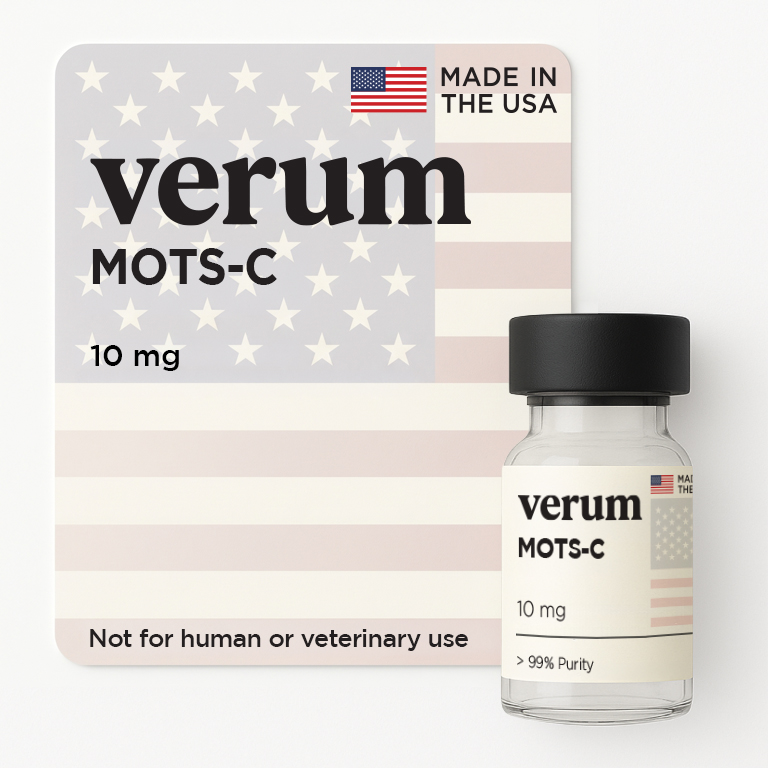 NFC-verified COA on this vial
Peptides
MOTS-C
$89 $109
In stock · same-day dispatch, 2-day US shipping
- ✓ Third-party HPLC + MS tested
- ✓ NFC-verified COA on the vial
- ✓ Made in the USA
- ✓ Plain, discreet packaging
Research use only. Not for human or veterinary use, or for diagnostic or therapeutic procedures.
Live certificate of analysis
This is the same live record the NFC tag on the vial opens. Match the lot number on the certificate against the one printed on your vial.
Identification
| Chemical name | Synthetic 16-residue polypeptide corresponding to a short open reading frame within the mitochondrial 12S ribosomal RNA gene |
| Common designation | MOTS-c |
| Sequence | Met-Arg-Trp-Gln-Glu-Met-Gly-Tyr-Ile-Phe-Tyr-Pro-Arg-Lys-Leu-Arg |
| One-letter | MRWQEMGYIFYPRKLR |
| Length | 16 amino acids |
| Genomic origin | Mitochondrial genome, not the nuclear genome. One of a small class of mitochondrial-derived peptides. |
| Molecular formula | C101H152N28O22S2 |
| Molecular weight | 2174.6 g/mol |
| Expected ions | [M+2H]2+ near 1088; [M+3H]3+ near 726; [M+4H]4+ near 545; [M+5H]5+ near 436 |
| CAS number | 1627580-64-6 |
| Oxidation-sensitive residues | Five: methionine at positions 1 and 6, tryptophan at 3, tyrosine at 8 and 11 |
| Physical form | White lyophilized powder |
| Quantity supplied | 10 mg nominal per unit |
| Country of manufacture | United States |
Note on the genomic origin
Essentially every signalling peptide a researcher works with is encoded in nuclear DNA. This one is not. Its open reading frame sits nested inside the 12S ribosomal RNA gene of the mitochondrial genome, a genome carrying only a handful of genes and long assumed to encode nothing but components of the respiratory machinery. It belongs to a small class of mitochondrial-derived peptides identified since the mid-2000s.
That origin has a practical consequence for experimental design. Published work reports movement between subcellular compartments under metabolic stress, so a peptide of this class is not fully characterised by what happens at a cell surface receptor, and assays built only around extracellular exposure may be measuring a fraction of the picture. Subcellular localisation is a variable here in a way it is not for most of this catalogue. The reference below sets out the evidence for that directly.
02
Certificate of analysis - current lot
The interactive verification record is shown below, followed by the same information reproduced as text on this page and the full certificate as a document. The record does not depend on the embed loading.
Certificate of analysis - lot MOT10-052026-4
Lot record
MOT10-052026-4
| Testing laboratory | Freedom Diagnostics, United States. Independent third party, not owned by or affiliated with Verum. |
| Sample received | 13 May 2026 |
| Results reported | 14 May 2026 |
| Accession reference | 2605130124 |
| Analytical methods | HPLC-UV coupled to mass spectrometry (LC-MS). Bacterial endotoxin by limulus amebocyte lysate assay in accordance with USP . |
Results, this lot
| Identity, LC-MS | Confirmed as MOTS-C |
| Purity, HPLC-UV | 99.76 % |
| Net peptide content | 12.07 mg per unit |
| Appearance | White lyophilized powder |
| Bacterial endotoxin | Pass, duplicate replicates. Assay sensitivity ≤0.05 EU/mL |
| Mass confirmation | Four charge states observed at m/z 435.8, 544.5, 725.3 and near 1088, all reconstructing to approximately 2175 |
The mass confirmation on this peptide is unusually informative. Four independent charge states that all reconstruct to the same molecular weight is a stronger identity argument than a single ion, because a truncated or oxidised species shifts the entire ladder rather than hiding within one peak. Take any one of the figures above, multiply by its charge, subtract the protons, and check that you arrive near 2175. Purity, content and endotoxin figures are specific to lot MOT10-052026-4 and are not specifications carried across other lots.
03
Testing scope
Panels differ between products and between lots. What follows is the scope of testing performed on this lot. Nothing is claimed unless it appears on the certificate for the lot supplied.
|
Performed
|
Not performed
|
The first two entries in the right-hand column matter more on this sequence than on most. Five of sixteen residues carry oxidation liability and each fails differently, so a sample can accumulate several modifications at once. A purity figure measured at one wavelength will not separate the resulting mixture cleanly. Where a parameter is material to intended laboratory work, purchasers should verify it independently.
04
The most oxidation-prone sequence in this catalogue
Sixteen residues, five of them vulnerable to oxidation: two methionines, a tryptophan and two tyrosines. Nothing else in this catalogue carries that concentration of liability in so short a chain, and it is the single most important handling fact about this material.
Each fails differently. Methionine oxidises to the sulfoxide, sixteen daltons heavier and frequently co-eluting with the parent. Tryptophan is vulnerable to light as well as to oxidants. Tyrosine can oxidise and cross-link.
One instruction follows for anyone buying across this catalogue: keep this peptide away from copper. GHK-Cu and the blends built around it are redox-active copper complexes, and copper plus a methionine-rich sequence is the chemistry described above, accelerated. Do not share buffers, do not combine working solutions, and treat labware that has carried a copper complex as unsuitable for this material.
05
Storage and laboratory handling
| Lyophilized powder, transit | Stable at ambient temperature during shipping and short-term handling. Cold-chain transport is not required. |
| Lyophilized powder, storage | −20 °C, protected from light, container tightly closed |
| Solubility | Sterile laboratory-grade water or a defined aqueous buffer appropriate to the assay |
| Solution, storage | 2 °C to 8 °C, in the dark rather than merely out of direct sun. Prepare close to the time of use rather than holding stock. |
| Air contact | Minimise headspace. This sequence requires stricter handling than most of the catalogue; see section 04. |
| Transition metals | Keep free transition metals, copper-containing preparations and oxidising buffer components entirely out of any solution carrying this peptide. |
| Freeze-thaw | Avoid repeated cycles. Aliquot at first preparation where the protocol allows. |
| Verification | If an assay would be affected by a sixteen dalton shift on either methionine, verify the mass on fresh material rather than assuming a stored stock is unchanged. |
| Personal protection | Handle under standard laboratory conditions with gloves, eye protection and a laboratory coat. |
Preparation conditions are the responsibility of the receiving laboratory. Verum provides no protocol, no preparation instruction, and no guidance on use.
06
Published literature
Both entries below are linked so they can be read at source. Descriptions state what each study measured, not what it concluded. No intervention study administering this peptide to human participants has been published. Verum has no involvement in either piece of work and makes no representation as to its applicability.
|
Cell culture
2018 |
Subcellular localisation and nuclear gene expression under metabolic stress Kim KH, Son JM, Benayoun BA, Lee C · Cell Metabolism 28(4):516–524 Tracked subcellular localisation over time following glucose restriction, serum deprivation and oxidative stress, then measured expression of antioxidant response element genes and the dependence of that movement on AMPK. This is the study establishing the mitochondrion-to-nucleus direction of travel, and it is the one to read before designing any assay assuming extracellular exposure is the whole mechanism. |
|
Mouse · three age groups 2021 |
Physical performance and skeletal muscle endpoints across age groups in mice Reynolds JC, Lai RW, Woodhead JST, et al. · Nature Communications 12:470 Measured physical performance in mice at two, twelve and twenty-two months of age alongside nuclear gene expression, skeletal muscle metabolism and myoblast responses to metabolic stress. A separate arm measured endogenous expression in human skeletal muscle and circulation following exercise, which is an observation about the peptide the body already makes rather than a study of administered material. Useful to anyone designing an age-stratified protocol, since responses were not uniform across age groups. |
Work conducted in cultured cells and mice does not establish an effect in any other system. Nothing above is offered as a representation about this material.
07
Regulatory status
| United States | Not approved by the FDA for any indication. Not on the section 503A bulk drug substances list. |
| Advisory committee | The Pharmacy Compounding Advisory Committee reviewed this substance on 23 July 2026 and voted to recommend it for inclusion on the 503A list, by seven votes to five with two abstentions, over the recommendation of the agency's own reviewers. That was the narrowest margin and the highest abstention count of the substances considered on that docket. |
| What that vote does not do | A committee recommendation is advisory and non-binding. Inclusion requires separate notice-and-comment rulemaking, which has historically taken a year or more and has not always followed a favourable vote. Glutathione cleared the same committee in June 2022 by a comparable margin and is still not on the codified list four years later. This substance is not approved, is not lawfully compoundable, and the vote does not make it a medicine. |
| Other jurisdictions | No marketing authorisation is held anywhere. |
| Status date | Accurate as of August 2026. Verify the current position independently. |
08
Purchase eligibility
By placing an order you confirm each of the following:
| ✓ | You are at least 21 years of age. |
| ✓ | You are a qualified researcher, or are purchasing on behalf of a research institution or commercial laboratory. |
| ✓ | The material will be used solely for in vitro laboratory research. |
| ✓ | The material will not be administered to humans or to animals, and will not be resold or transferred for any such purpose. |
| ✓ | You are responsible for compliance with all federal, state and local law governing receipt, handling, storage and use. |
Confirmation is recorded at checkout against your order. Verum reserves the right to decline or cancel any order.
09
Supply
Orders placed before the daily cutoff are dispatched the same day from our United States warehouse. Domestic orders typically arrive within two business days. A tracking reference is issued by email once the consignment leaves the facility. Each unit carries a scannable code linking to the certificate for its own lot.
Not for human or veterinary use. Not for use in diagnostic or therapeutic procedures. This product is a laboratory reagent. Nothing on this page constitutes medical advice, a recommendation for personal use, or a representation that this material is safe or effective for any purpose. No statement here has been evaluated by the U.S. Food and Drug Administration.