 Verified COA
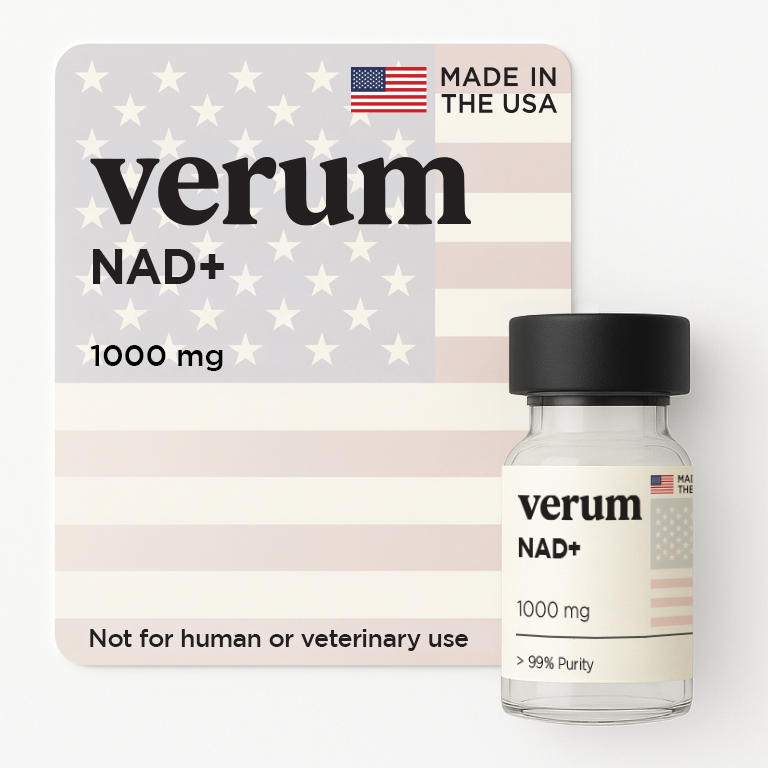 NFC-verified COA on this vial
Peptides
NAD+
From $49
In stock · same-day dispatch, 2-day US shipping
- ✓ Third-party HPLC + MS tested
- ✓ NFC-verified COA on the vial
- ✓ Made in the USA
- ✓ Plain, discreet packaging
Research use only. Not for human or veterinary use, or for diagnostic or therapeutic procedures.
Live certificate of analysis
This is the same live record the NFC tag on the vial opens. Match the lot number on the certificate against the one printed on your vial.
Identification
| Chemical name | beta-Nicotinamide adenine dinucleotide, oxidised form |
| Common designations | NAD+; NAD; beta-NAD; DPN |
| Compound class | Dinucleotide coenzyme. Not a peptide; no amino acid sequence applies. |
| Structure | Nicotinamide and adenine linked through two ribose sugars and a pyrophosphate bridge |
| Molecular formula | C21H27N7O14P2 |
| Molecular weight | 663.4 g/mol |
| Expected ions | [M+H]+ near 664; [M+2H]2+ near 333; a dimer adduct near 1327 is expected rather than a contaminant |
| CAS number | 53-84-9, free acid |
| Not this compound | NADH, the reduced form, approximately 665.4 g/mol. A different reagent; see section 03. |
| Absorbance note | The reduced form absorbs at 340 nm; the oxidised form does not |
| pH lability | Degrades under alkaline conditions; the reduced form degrades under acidic conditions |
| Physical form | White lyophilized powder, supplied in amber glass |
| Quantities supplied | 100 mg, 500 mg and 1000 mg nominal per unit |
| Country of manufacture | United States |
02
Certificates of analysis - current lots
Each size is tested and released separately and carries its own certificate. All three are set out below: the interactive verification record, the certificate document, and the same information reproduced as text on this page. The panels are not identical across the three current lots, which is why they are presented separately rather than combined.
100 mg
Certificate of analysis - lot J4Q90F, 100 mg
Your browser cannot display the embedded document.
Lot record - 100 mg
J4Q90F
| Testing laboratory | Freedom Diagnostics, United States. Independent third party, not owned by or affiliated with Verum. |
| Dates | Received 23 April 2026; reported 25 April 2026 |
| Accession reference | 2604230273 |
| Method | HPLC-UV coupled to mass spectrometry (LC-MS) |
| Identity, LC-MS | Confirmed as NAD+ |
| Purity, HPLC-UV | 99.85 % |
| Net content | 109.52 mg per unit |
| Mass confirmation | Ions at m/z 664.2 [M+H]+ and 332.5 [M+2H]2+ |
| Endotoxin and microbials | Not tested on this lot |
500 mg
Certificate of analysis - lot 8A0BSG, 500 mg
Your browser cannot display the embedded document.
Lot record - 500 mg
8A0BSG
| Testing laboratory | Freedom Diagnostics, United States. Independent third party, not owned by or affiliated with Verum. |
| Dates | Received 11 May 2026; reported 12 May 2026 |
| Accession reference | 2605110185 |
| Method | HPLC-UV coupled to mass spectrometry (LC-MS) |
| Identity, LC-MS | Confirmed as NAD+ |
| Purity, HPLC-UV | 99.94 % |
| Net content | 520.96 mg per unit |
| Mass confirmation | Ions at m/z 663.7 [M+H]+, 332.6 [M+2H]2+ and a dimer adduct near 1327 |
| Endotoxin and microbials | Not tested on this lot |
1000 mg
Certificate of analysis - lot NAD1000-052026-1, 1000 mg
Your browser cannot display the embedded document.
Lot record - 1000 mg
NAD1000-052026-1
| Testing laboratory | Freedom Diagnostics, United States. Independent third party, not owned by or affiliated with Verum. |
| Dates | Received 27 May 2026; reported 29 May 2026 |
| Accession reference | 2605270334 |
| Methods | HPLC-UV coupled to mass spectrometry (LC-MS). Bacterial endotoxin by limulus amebocyte lysate assay in accordance with USP . Microbial detection by validated PCR assay. |
| Identity, LC-MS | Confirmed as NAD+ |
| Purity, HPLC-UV | 99.94 % |
| Net content | 1,044.79 mg per unit |
| Mass confirmation | Ions at m/z 663.7 [M+H]+, 332.9 [M+2H]2+ and a dimer adduct near 1327 |
| Bacterial endotoxin | Pass, duplicate replicates. Assay sensitivity ≤0.05 EU/mL |
| Microbial analysis | No detectable microbial DNA. Pass. |
All figures above are specific to the lots named and are not specifications carried across other lots. The three current lots differ in panel scope, which is precisely why this catalogue states results per lot rather than per product. Read the certificate supplied with your unit.
03
Oxidised or reduced is the specification that matters
NAD exists as a redox pair. The oxidised form carries a positive charge on the nicotinamide ring and is the electron acceptor. The reduced form has taken on a hydride and is the electron donor. They are two different compounds with different chemistry, different absorbance behaviour and different stability, and they interconvert readily.
They also differ in mass by about two daltons, which on a molecule of 663 is roughly three parts in a thousand. A purity percentage will not distinguish them and neither will a retention time on a coarse method. The mass will: the oxidised form gives a protonated ion near 664 and a doubly protonated ion near 333. All three lots above show exactly that. The peak near 1327 is a dimer adduct of two molecules associating in the source and is expected rather than a contaminant.
There is a second reason this matters beyond identity. In a dehydrogenase assay the reduced form absorbs strongly at 340 nanometres and the oxidised form does not. That difference is the entire basis of the standard spectrophotometric readout, so starting material contaminated with the reduced form raises the baseline before the reaction begins and compresses the signal being measured. On this compound, redox state is not a purity footnote. It is the assay.
04
The two forms are unstable in opposite directions
This catches people out and is worth stating plainly. The oxidised form is labile in alkaline conditions. The reduced form is labile in acidic conditions. There is no single pH at which both are comfortable, so a buffer chosen for one is actively degrading the other, and any assay cycling between the two states is running under conditions that suit only half the reaction.
Two further liabilities apply to the material rather than the assay. This compound is hygroscopic, so a container that has not reached room temperature will draw condensation into the powder on opening. And it is light-sensitive, which is why our units are amber glass rather than clear. That is not a packaging preference; clear glass on this material is a storage decision made against the compound.
05
Testing scope
Panels differ between products, between sizes and between lots. The columns below reflect the three current lots. Nothing is claimed unless it appears on the certificate for the lot supplied.
|
Performed
|
Not performed
|
Endotoxin and microbial detection answer different questions and appear only on the 1000 mg lot. A microbial assay asks whether organisms are present; endotoxin is a bacterial membrane fragment that persists after the organism producing it is gone. Material can pass one and not the other. Where a parameter is material to intended laboratory work, purchasers should verify it independently or order the size released against it.
06
A reagent with an established bench use
Most of this catalogue consists of compounds whose research application is speculative. This one is not. It has been a standard laboratory reagent for the better part of a century and appears in dehydrogenase assays, coupled enzyme systems, sirtuin and PARP activity work, and any protocol requiring a defined electron acceptor. That is an unglamorous use, it accounts for a substantial share of who buys this compound, and it is the reason grade and redox purity matter here more than anything else on the page.
07
Selecting a size
The three units contain the same material and differ in fill. On a hygroscopic, light-sensitive, pH-labile compound the larger size is not automatically the better value: every access is an opportunity for moisture ingress, and a container that outlives the work it was opened for has spent that time degrading rather than waiting. Where small quantities are needed repeatedly, several small units usually give better material at the point of use than one large unit opened repeatedly. Note also that the three sizes are released against separate certificates with different panels, so the applicable testing scope depends on which is ordered.
08
Storage and laboratory handling
| Lyophilized powder, transit | Stable at ambient temperature during shipping and short-term handling. Cold-chain transport is not required. |
| Lyophilized powder, storage | −20 °C, protected from light, container tightly closed |
| Container | Amber glass. This compound is light-sensitive and the container is part of the specification, not the packaging. |
| Hygroscopicity | Allow the container to reach room temperature before opening. A cold container opened in humid air draws water into the powder. |
| Solubility | Soluble in sterile laboratory-grade water or a defined aqueous buffer appropriate to the assay |
| Buffer selection | Keep working solutions away from alkaline buffers, which degrade the oxidised form directly. |
| Solution, storage | 2 °C to 8 °C, protected from light. Prepare fresh rather than holding stock; the redox state you started with is not necessarily the one you will have tomorrow. |
| Freeze-thaw | Avoid repeated cycles. |
| Personal protection | Handle under standard laboratory conditions with gloves, eye protection and a laboratory coat. |
Preparation conditions are the responsibility of the receiving laboratory. Verum provides no protocol, no preparation instruction, and no guidance on use.
09
Published literature and regulatory status
This page carries no bibliography, for an unusual reason: the biochemistry of this molecule is textbook material rather than a contested literature. Its role as an electron carrier has been established since the early twentieth century and appears in every general biochemistry course. There is nothing here to curate that a researcher does not already have. The literature that is contested concerns administration to people, which is a separate question from what this compound does in a cuvette, and we do not cite it.
| United States | Not approved by the FDA for any indication. Not on the codified section 503A bulk drug substances list. |
| Other jurisdictions | No marketing authorisation is held anywhere. |
| Status date | Accurate as of August 2026. Verify the current position independently. |
10
Purchase eligibility
By placing an order you confirm each of the following:
| ✓ | You are at least 21 years of age. |
| ✓ | You are a qualified researcher, or are purchasing on behalf of a research institution or commercial laboratory. |
| ✓ | The material will be used solely for in vitro laboratory research. |
| ✓ | The material will not be administered to humans or to animals, and will not be resold or transferred for any such purpose. |
| ✓ | You are responsible for compliance with all federal, state and local law governing receipt, handling, storage and use. |
Confirmation is recorded at checkout against your order. Verum reserves the right to decline or cancel any order.
11
Supply
Orders placed before the daily cutoff are dispatched the same day from our United States warehouse. Domestic orders typically arrive within two business days. A tracking reference is issued by email once the consignment leaves the facility. Each unit carries a scannable code linking to the certificate for its own lot.
Not for human or veterinary use. Not for use in diagnostic or therapeutic procedures. This product is a laboratory reagent. Nothing on this page constitutes medical advice, a recommendation for personal use, or a representation that this material is safe or effective for any purpose. No statement here has been evaluated by the U.S. Food and Drug Administration.