 Verified COA
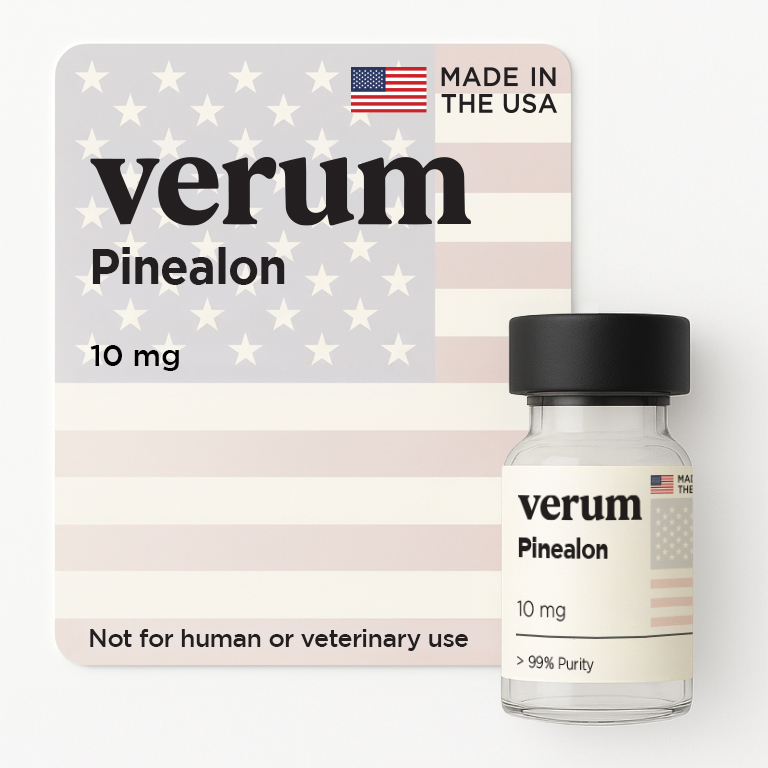 NFC-verified COA on this vial
Peptides
Pinealon
$69 $89
In stock · same-day dispatch, 2-day US shipping
- ✓ Third-party HPLC + MS tested
- ✓ NFC-verified COA on the vial
- ✓ Made in the USA
- ✓ Plain, discreet packaging
Research use only. Not for human or veterinary use, or for diagnostic or therapeutic procedures.
Live certificate of analysis
This is the same live record the NFC tag on the vial opens. Match the lot number on the certificate against the one printed on your vial.
Identification
| Chemical name | L-glutamyl-L-aspartyl-L-arginine |
| Common designations | Pinealon; EDR peptide |
| Sequence | Glu-Asp-Arg |
| One-letter | EDR |
| Length | 3 amino acids, linear, free termini |
| Molecular formula | C15H26N6O8 |
| Molecular weight | 418.4 g/mol |
| Expected ion | [M+H]+ near 419 |
| CAS number | 175175-23-2 |
| Sequence origin | Identified in a polypeptide preparation derived from brain cortex tissue. Despite the product name, the sequence is not of pineal origin; see the note below. |
| Charge profile | Two acidic residues against one basic residue |
| Oxidation-sensitive residues | None. The sequence contains no methionine, cysteine, tryptophan or tyrosine. |
| Physical form | White lyophilized powder |
| Quantity supplied | 10 mg nominal per unit; net peptide content measured per lot, see section 03 |
| Country of manufacture | United States |
Note on the name
The product name reads as a pineal gland compound and it is routinely described as one. The sequence was in fact identified in a brain cortex tissue preparation, not in pineal tissue. The name is a designation from the programme that developed it rather than a description of origin. This matters because the compound is frequently grouped by association with pineal-derived work, and Epithalon, from the same programme, genuinely does derive from a pineal extract. This one does not.
02
Certificate of analysis - current lot
The interactive verification record is shown below, followed by the same information reproduced as text on this page and the full certificate as a document. The record does not depend on the embed loading.
Certificate of analysis - lot PINE09222025-J
Lot record
PINE09222025-J
| Testing laboratory | Freedom Diagnostics, United States. Independent third party, not owned by or affiliated with Verum. |
| Sample received | 24 September 2025 |
| Results reported | 25 September 2025 |
| Accession reference | 2509240034 |
| Analytical method | High-performance liquid chromatography with ultraviolet detection coupled to mass spectrometry (HPLC-UV / LC-MS) |
Results, this lot
| Identity, LC-MS | Confirmed as Pinealon |
| Purity, HPLC-UV | 99.843 % |
| Net peptide content | 8.10 mg per unit - read section 03 before calculating from this figure |
| Appearance | White lyophilized powder |
| Mass confirmation | Ion observed at m/z 418.93 [M+H]+, consistent with a molecular weight near 418 |
| Endotoxin and microbials | Not tested on this lot |
All figures above are specific to lot PINE09222025-J and are not specifications carried across other lots. This certificate was issued on an earlier laboratory template carrying a narrower panel than several other listings in this catalogue.
03
What the net peptide content figure means
A quantity on a peptide unit can mean two different things, and almost nobody in this market explains the difference.
Gross fill weight is how much powder went into the container. Net peptide content is how much of that powder is the peptide itself. The two are never the same, because a synthesised peptide is isolated as a salt and carries a counterion, and because lyophilized material retains residual moisture. On a typical preparation the peptide accounts for somewhere in the region of seventy to ninety percent of the powder by weight, with the balance being counterion and water. A container filled honestly to its gross weight will still report a net peptide figure below that number.
Our certificates report net peptide content, which is the harder of the two figures to publish and the more useful one to receive. It is also why a certificate for this product may show a figure below the nominal while a certificate for another product shows one above it. Those are not inconsistent results; they are the same measurement applied to preparations differing in salt form and moisture.
In practice: read the net peptide figure on the certificate for the lot supplied and calculate from that, not from the nominal on the label. Where a protocol depends on a precise quantity, that is the only figure worth using, and it is on the document the code on your unit links to. A supplier who does not measure it cannot tell you either way.
04
Testing scope
Panels differ between products and between lots. What follows is the scope of testing performed on this lot. Nothing is claimed unless it appears on the certificate for the lot supplied.
|
Performed
|
Not performed
|
Identity confirmation is less discriminating on a three-residue molecule than on a longer chain. A tripeptide is too small to carry multiple charges, so there is no ladder of independent ions that must all reconstruct to the same weight, and a short polar sequence elutes early on a reversed-phase column where separation is hardest. That is a property of the analysis rather than of the sample. Where certainty at this size is material, amino acid analysis or a second orthogonal method is the appropriate check.
05
Storage and laboratory handling
| Lyophilized powder, transit | Stable at ambient temperature during shipping and short-term handling. Cold-chain transport is not required. |
| Lyophilized powder, storage | −20 °C, protected from light, container tightly closed |
| Solubility | Freely soluble in sterile laboratory-grade water or a defined aqueous buffer appropriate to the assay |
| Solution, storage | 2 °C to 8 °C, protected from light. Materially less stable than the dry powder. |
| Freeze-thaw | Avoid repeated cycles. |
| Sequence-specific note | No oxidation-sensitive residues, so this sequence carries none of the liabilities that govern handling for many peptides. With two acidic residues against one basic residue it is strongly pH-sensitive in solution behaviour, so hold buffer conditions constant across an experiment rather than varying them between preparations. It is hygroscopic; allow the container to reach room temperature before opening. |
| Personal protection | Handle under standard laboratory conditions with gloves, eye protection and a laboratory coat. |
Preparation conditions are the responsibility of the receiving laboratory. Verum provides no protocol, no preparation instruction, and no guidance on use.
06
Published literature
Both entries below are linked so they can be read at source. Descriptions state what each study measured, not what it concluded, and the originating group is named so the concentration of the literature is visible rather than obscured. Verum has no involvement in either piece of work and makes no representation as to its applicability.
| HeLa cells · cell free 2011 |
Nuclear penetration of labelled short peptides in cultured cells, and binding to defined oligonucleotides in a cell-free system Fedoreyeva LI, Kireev II, Khavinson VKh, Vanyushin BF · Biochemistry (Moscow) 76(11):1210–1219 · St. Petersburg Institute of Bioregulation and Gerontology Tracked fluorescently labelled short peptides into the nucleus of cultured cells, then tested binding to defined oligonucleotides and to DNA in a cell-free system. This is the paper underpinning the peptide-DNA interaction hypothesis, so it is the one to read to evaluate that framework rather than accept it. |
| Rat · in vivo
2012 |
Biochemical and behavioural endpoints in rat offspring following a prenatal metabolic insult Arutjunyan A, Kozina L, Stvolinskiy S, et al. · International Journal of Clinical and Experimental Medicine 5(2):179–185 Measured biochemical and behavioural endpoints in rat offspring with and without the peptide, following a defined prenatal metabolic insult. One of very few in vivo studies on this compound with a stated model and comparison group. |
Nearly all published work on this tripeptide originates with one research group, working within a framework it calls peptide bioregulation, which proposes that very short tissue-derived peptides act at the level of gene expression by interacting directly with DNA. Concentration in one laboratory is not evidence of error, but it does mean the usual check of independent replication is largely absent. Epithalon, from the same programme, received an independent examination from a UK university group in 2025 and is linked on its own listing. This compound has no equivalent that we are aware of. Work in cultured cells and rodents does not establish an effect in any other system.
07
Regulatory status
| United States | Not approved by the FDA for any indication. Not on the section 503A bulk drug substances list. |
| Advisory committee | This substance has not been reviewed by the Pharmacy Compounding Advisory Committee and is not scheduled at either announced meeting. It therefore has no committee recommendation either for or against. |
| Other jurisdictions | No marketing authorisation is held anywhere. |
| Status date | Accurate as of August 2026. Verify the current position independently. |
08
Purchase eligibility
By placing an order you confirm each of the following:
| ✓ | You are at least 21 years of age. |
| ✓ | You are a qualified researcher, or are purchasing on behalf of a research institution or commercial laboratory. |
| ✓ | The material will be used solely for in vitro laboratory research. |
| ✓ | The material will not be administered to humans or to animals, and will not be resold or transferred for any such purpose. |
| ✓ | You are responsible for compliance with all federal, state and local law governing receipt, handling, storage and use. |
Confirmation is recorded at checkout against your order. Verum reserves the right to decline or cancel any order.
09
Supply
Orders placed before the daily cutoff are dispatched the same day from our United States warehouse. Domestic orders typically arrive within two business days. A tracking reference is issued by email once the consignment leaves the facility. Each unit carries a scannable code linking to the certificate for its own lot.
Not for human or veterinary use. Not for use in diagnostic or therapeutic procedures. This product is a laboratory reagent. Nothing on this page constitutes medical advice, a recommendation for personal use, or a representation that this material is safe or effective for any purpose. No statement here has been evaluated by the U.S. Food and Drug Administration.