 Verified COA
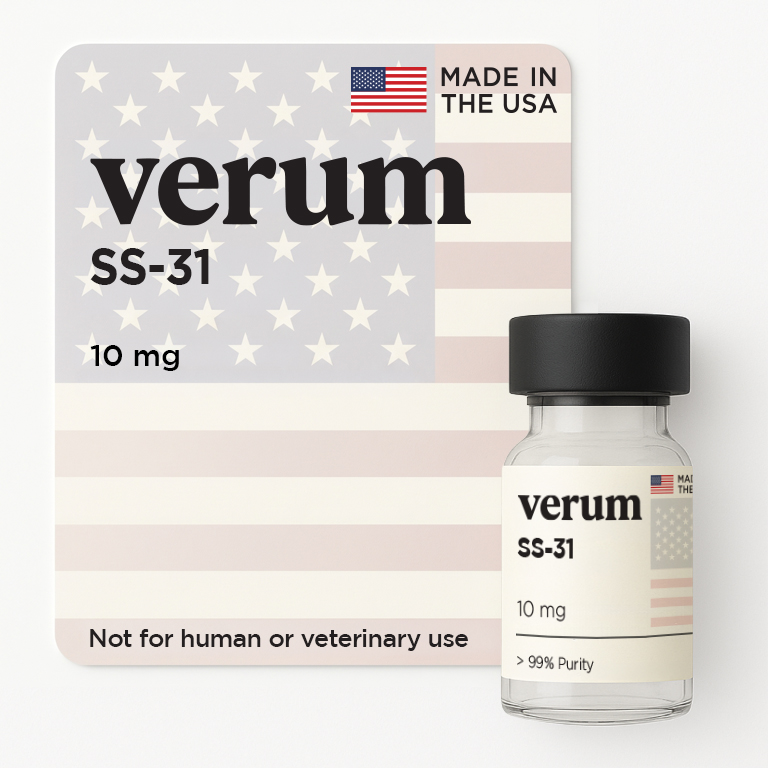 NFC-verified COA on this vial
Peptides
SS-31
$59 $72
In stock · same-day dispatch, 2-day US shipping
- ✓ Third-party HPLC + MS tested
- ✓ NFC-verified COA on the vial
- ✓ Made in the USA
- ✓ Plain, discreet packaging
Research use only. Not for human or veterinary use, or for diagnostic or therapeutic procedures.
Live certificate of analysis
This is the same live record the NFC tag on the vial opens. Match the lot number on the certificate against the one printed on your vial.
Identification
| Chemical name | D-arginyl-2,6-dimethyl-L-tyrosyl-L-lysyl-L-phenylalaninamide |
| Common designations | SS-31; MTP-131; elamipretide; Bendavia |
| Sequence | D-Arg-Dmt-Lys-Phe-NH2 |
| Length | 4 amino acids, C-terminal amide |
| Non-standard residues | D-arginine at position 1; 2,6-dimethyltyrosine at position 2. See section 03. |
| Architecture | Alternating aromatic and cationic residues, giving a net charge of +3 at physiological pH |
| Molecular formula | C32H49N9O5 |
| Molecular weight | 639.8 g/mol, free base |
| Expected ions | [M+H]+ near 641; [M+2H]2+ near 321. Not measured on this batch; see section 06. |
| CAS number | 736992-21-5 |
| Oxidation-sensitive residues | The dimethylated tyrosine. Its methyl substituents make it less reactive than an unmodified tyrosine, but it is not inert. |
| Physical form | White lyophilized powder |
| Quantity supplied | 10 mg nominal per unit; measured content stated per batch, see section 05 |
| Country of manufacture | United States |
Note on the name
The certificate below records the analyte as MTP 131 rather than SS-31. That is a synonym rather than a discrepancy. This molecule has carried at least four designations across its history: an academic laboratory code, a development code, an international non-proprietary name, and a former commercial name. All refer to the same tetrapeptide. Where a certificate names one and a label names another, check the compound rather than assuming a mismatch.
02
Certificate of analysis - current batch
The interactive verification record is shown below, followed by the same information reproduced as text on this page and the full certificate as a document. The record does not depend on the embed loading.
Certificate of analysis - batch V0124N
Batch record
V0124N
| Testing laboratory | Accurate Test Labs, Fort Lauderdale, Florida. Independent third party, not owned by or affiliated with Verum. |
| Sample received | 30 July 2026 |
| Analysis completed | 31 July 2026 |
| Sample and laboratory reference | 2607AFL1258.4387 · ATL-38162 |
| Method | TM-13, document COA-12 Peptides Rev. 1 |
Results, this batch
| Analyte as recorded | MTP 131 - a synonym for this compound; see the note above |
| Purity | 99.794 %, reported as a total purity of 99.79 % |
| Content | 7.88 mg per unit - read section 05 before calculating from this figure |
| Mass confirmation | Not reported by this laboratory. See section 06. |
| Bacterial endotoxin | Not tested on this batch |
| Microbial analysis | Not tested on this batch |
Figures above are specific to batch V0124N and are not specifications carried across other batches. Each batch is tested individually and reports its own results.
03
Four residues, three of them non-standard in some way
This is a very short molecule carrying an unusual amount of engineering. The first residue is D-arginine rather than the L form. The second is a tyrosine bearing two methyl groups on its aromatic ring. The C-terminus is amidated rather than a free acid. Only the lysine and phenylalanine are ordinary.
The arrangement is deliberate: aromatic and cationic residues alternate along the chain, giving a net charge of +3 at physiological pH combined with substantial aromatic character. That combination is what distinguishes the molecule from an ordinary short peptide, and it is the reason the compound partitions into anionic membrane environments rather than distributing as a simple soluble peptide would.
Two practical consequences. First, the D-arginine and the amidated terminus make the molecule resistant to the exopeptidases that would dismantle an all-L tetrapeptide quickly, which is a genuine advantage and is frequently overread as stability in storage. It is not the same thing. Second, a cationic amphipathic molecule behaves differently in an assay from a neutral soluble one: expect partitioning behaviour, expect interaction with anionic surfaces and membranes, and do not assume a calculated bulk concentration describes what is available in the aqueous phase.
04
This compound became an approved medicine in 2025
For most of its history this was an investigational compound with a long and mixed clinical record, including trials that did not meet their primary endpoints. In September 2025 that changed: it received accelerated approval from the FDA as a prescription medicine for a rare mitochondrial condition.
Two things follow, and they pull in opposite directions.
It is no longer an unapproved substance. A regulator has reviewed a dossier and granted a marketing authorisation, which is more than can be said for most of this catalogue. Accelerated approval is a conditional pathway that rests on a surrogate endpoint and carries an obligation to confirm benefit in further study, so it is a narrower statement than a full approval, but it is a real one.
And it is now a prescription medicine, which changes what this page is. The approved product is manufactured to pharmaceutical standards, released against a regulatory specification, and dispensed under the supervision of a licensed prescriber for a defined indication. The material on this page is none of those things. It is a laboratory reagent sold for in vitro work. Anyone whose interest is in the approved medicine should be talking to a prescriber, and this is not a route to it.
05
What the measured content figure means
The certificate above reports 7.88 mg per unit against a 10 mg nominal. That figure is printed here rather than summarised away, and it deserves an explanation rather than a shrug.
A quantity on a peptide unit can mean two different things. Gross fill weight is how much powder went into the container. Peptide content is how much of that powder is the peptide itself. The two are never identical, because a synthesised peptide is isolated as a salt carrying a counterion and because lyophilized material retains residual moisture. This molecule carries a net charge of +3, which means proportionally more counterion by weight than a less charged peptide of similar size, and the gap between gross weight and peptide content is correspondingly wider here than on many products.
In practice: calculate from the measured figure on the certificate for the batch supplied, not from the nominal on the label. Where a protocol depends on a precise quantity that is the only number worth using. A supplier who does not measure content cannot tell you either way, which is the more common situation in this category.
06
This certificate carries no mass spectrometry
Several certificates in this catalogue publish a mass confirmation alongside the purity figure. This one does not. The laboratory releasing this batch reports purity and content per unit, and does not print a mass spectrum on the face of the document.
On this molecule that gap has a specific shape. Two of the four residues are non-standard, and the most consequential of them is a stereochemical one. Mass spectrometry cannot distinguish D-arginine from L-arginine, because they weigh the same, so even a published mass would not settle that question; chiral analysis is required and is not part of any standard peptide panel. What a mass measurement would settle is whether the dimethylation on the tyrosine is present and whether the C-terminal amide is intact, since both shift the molecular weight.
A purity figure describes how much of what eluted was one peak. It does not establish the molecular weight of that peak or the stereochemistry within it. We state this rather than let a high percentage stand in for confirmations it does not provide. For reference, the intact tetrapeptide gives a protonated ion near 641.
07
Testing scope
Panels differ between products and between batches. What follows is the scope of testing performed on this batch. Nothing is claimed unless it appears on the certificate for the batch supplied.
|
Performed
|
Not performed
|
The second and fourth entries in the right-hand column are the ones specific to this molecule. Stereochemistry cannot be settled by mass, and a +3 peptide carries proportionally more counterion by weight than most, which is directly relevant to the content figure in section 05. Where a parameter is material to intended laboratory work, purchasers should verify it independently or source material released against that specification.
08
Storage and laboratory handling
| Lyophilized powder, transit | Stable at ambient temperature during shipping and short-term handling. Cold-chain transport is not required. |
| Lyophilized powder, storage | −20 °C, protected from light, container tightly closed |
| Solubility | Readily soluble in sterile laboratory-grade water or a defined aqueous buffer appropriate to the assay |
| Solution, storage | 2 °C to 8 °C, protected from light. Materially less stable than the dry powder. |
| Cationic behaviour | A net charge of +3 makes this molecule prone to adsorption onto anionic surfaces. Expect losses in dilute working solutions, use low-binding labware, and treat a calculated concentration as an upper bound rather than a measurement. |
| Buffer components | Anionic buffer species and detergents will interact with a molecule of this charge. Hold buffer composition constant across an experiment rather than varying it between preparations. |
| Freeze-thaw | Avoid repeated cycles. |
| Personal protection | Handle under standard laboratory conditions with gloves, eye protection and a laboratory coat. |
Preparation conditions are the responsibility of the receiving laboratory. Verum provides no protocol, no preparation instruction, and no guidance on use.
09
Published literature
This page carries no bibliography. The published record on this compound consists substantially of clinical trials conducted in human participants, using pharmaceutical-grade product manufactured to standards this material is not manufactured to, and that record now includes the dossier supporting a marketing authorisation. Reproducing it beside a research-labelled unit would misrepresent both what is being sold and what those trials examined. Researchers working on mitochondrial membrane biology know where that record lives.
10
Regulatory status
| United States | Holds accelerated approval as a prescription medicine, granted in September 2025 for a rare mitochondrial condition. Dispensed under the supervision of a licensed prescriber. |
| What accelerated approval means | A conditional pathway resting on a surrogate endpoint, carrying an obligation to confirm clinical benefit in further study. It is a narrower statement than a full approval and can be withdrawn if confirmatory evidence does not follow. |
| This material | Not the approved product. Supplied as a laboratory reagent, not manufactured to pharmaceutical standards, and not a substitute for a prescribed preparation. |
| Compounding | Not on the section 503A bulk drug substances list. |
| Status date | Accurate as of August 2026. This position changed in 2025 and may change again; verify the current position independently. |
11
Purchase eligibility
By placing an order you confirm each of the following:
| ✓ | You are at least 21 years of age. |
| ✓ | You are a qualified researcher, or are purchasing on behalf of a research institution or commercial laboratory. |
| ✓ | The material will be used solely for in vitro laboratory research. |
| ✓ | The material will not be administered to humans or to animals, and will not be resold or transferred for any such purpose. |
| ✓ | You have read section 04 and understand that this compound is an approved prescription medicine and that this material is not it. |
| ✓ | You are responsible for compliance with all federal, state and local law governing receipt, handling, storage and use. |
Confirmation is recorded at checkout against your order. Verum reserves the right to decline or cancel any order.
This compound is available in the United States as an approved prescription medicine for a defined indication. If that is what you are looking for, a licensed prescriber is the correct route and this is not a substitute for it.
12
Supply
Orders placed before the daily cutoff are dispatched the same day from our United States warehouse. Domestic orders typically arrive within two business days. A tracking reference is issued by email once the consignment leaves the facility. Each unit carries a scannable code linking to the certificate for its own batch.
Not for human or veterinary use. Not for use in diagnostic or therapeutic procedures. This product is a laboratory reagent. Nothing on this page constitutes medical advice, a recommendation for personal use, or a representation that this material is safe or effective for any purpose. No statement here has been evaluated by the U.S. Food and Drug Administration.