 Verified COA
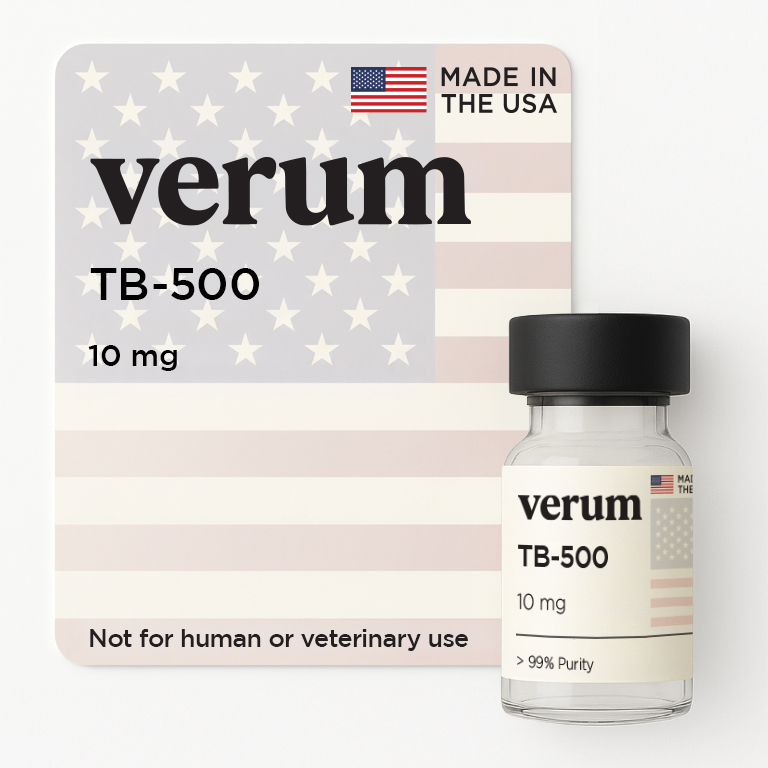 NFC-verified COA on this vial
Peptides
TB-500
$69 $89
In stock · same-day dispatch, 2-day US shipping
- ✓ Third-party HPLC + MS tested
- ✓ NFC-verified COA on the vial
- ✓ Made in the USA
- ✓ Plain, discreet packaging
Research use only. Not for human or veterinary use, or for diagnostic or therapeutic procedures.
Live certificate of analysis
This is the same live record the NFC tag on the vial opens. Match the lot number on the certificate against the one printed on your vial.
One name, two molecules. This is the smaller one.
This is the single most important thing to understand before buying anything sold under this name, and almost nobody in this market states it.
TB-500 is a trade designation, not a chemical name, and it is applied to two chemically distinct materials. One is an acetylated seven-residue fragment of approximately 888.5 daltons. The other is the full-length 43-residue protein thymosin beta-4, of approximately 4,963 daltons. They differ in mass by more than fivefold. They are not interchangeable and results obtained with one should not be compared against the other.
| This listing | The acetylated seven-residue fragment. Approximately 888.5 g/mol. Confirmed by mass on the current lot; see section 02. |
| Our GLOW and KLOW blends | The full-length 43-residue protein. Approximately 4,963 g/mol, named as thymosin beta-4 on those certificates. A different molecule from the one on this page. |
We sell both and we say which is which. The distinction is settled by the mass confirmation printed on each certificate rather than by the name on the label, which is why we publish it. If you are comparing suppliers, ask which molecule you are being offered and ask to see the ion that proves it.
02
Certificate of analysis - current lot
The interactive verification record is shown below, followed by the same information reproduced as text on this page and the full certificate as a document. The record does not depend on the embed loading.
Certificate of analysis - lot PQ7MWD
Lot record
PQ7MWD
| Testing laboratory | Freedom Diagnostics, United States. Independent third party, not owned by or affiliated with Verum. |
| Sample received | 27 May 2026 |
| Results reported | 29 May 2026 |
| Accession reference | 2605270305 |
| Analytical method | High-performance liquid chromatography with ultraviolet detection coupled to mass spectrometry (HPLC-UV / LC-MS) |
Results, this lot
| Identity, LC-MS | Confirmed as TB-500 |
| Purity, HPLC-UV | 99.58 % |
| Net peptide content | 12.16 mg per unit |
| Appearance | White lyophilized powder |
| Mass confirmation | Ion at m/z 445.3 [M+2H]2+ and a further ion near 889 [M+H]+. Both reconstruct to approximately 888.5, identifying this material as the seven-residue fragment rather than the full-length protein. |
| Bacterial endotoxin | Not tested on this lot |
Purity and content figures above are specific to lot PQ7MWD and are not a specification carried across other lots. The mass confirmation is the part worth reading twice: two independent ions agreeing on 888.5 settles which of the two molecules sold under this name is in the container, and that is a question a purity percentage cannot answer.
03
Identification
| Chemical description | Acetylated seven-residue peptide corresponding to the actin-binding region of thymosin beta-4 |
| Common designations | TB-500; TB500. The same designations are applied commercially to the full-length protein; see section 01. |
| Sequence | Ac-Leu-Lys-Lys-Thr-Glu-Thr-Gln |
| Length | 7 amino acids, N-terminally acetylated |
| Relationship to the protein | Corresponds to a short internal region of the 43-residue sequence. A fragment of that protein, not a shortened version with equivalent behaviour. |
| Molecular weight | Approximately 888.5 g/mol |
| Expected ions | [M+H]+ near 889; [M+2H]2+ near 445 |
| Oxidation-sensitive residues | None. No methionine, cysteine, tryptophan or tyrosine. See section 04. |
| Physical form | White lyophilized powder |
| Quantity supplied | 10 mg nominal per unit |
| Country of manufacture | United States |
04
A handling difference that follows from which molecule this is
The two molecules sold under this name do not handle the same way, and the difference runs in this product's favour.
The full-length 43-residue protein carries a methionine near its N-terminus. Methionine is the classic target for metal-catalysed oxidation, and the sulfoxide product has the correct sequence, a mass sixteen daltons higher, and altered behaviour that a coarse chromatographic method will not separate from the parent. That is why our blue blends, which contain the full-length protein alongside a redox-active copper complex, carry a specific warning about that pairing.
This fragment carries no methionine, and no cysteine, tryptophan or tyrosine either. None of that chemistry applies here. It is a comparatively forgiving molecule to store and to work with, and it can share a buffer with a copper-containing preparation without the concern that governs the full-length protein. Where a design calls for the short fragment specifically rather than the protein, this is that material.
05
Testing scope
Panels differ between products and between lots. What follows is the scope of testing performed on this lot. Nothing is claimed unless it appears on the certificate for the lot supplied.
|
Performed
|
Not performed
|
The first entry in the right-hand column is worth naming. An unacetylated version of this sequence would be about forty-two daltons lighter, which the observed mass distinguishes clearly, but acetylation is not reported as a separate parameter on the certificate. Where a parameter is material to intended laboratory work, purchasers should verify it independently or source material released against that specification.
06
Storage and laboratory handling
| Lyophilized powder, transit | Stable at ambient temperature during shipping and short-term handling. Cold-chain transport is not required. |
| Lyophilized powder, storage | −20 °C, protected from light, container tightly closed |
| Solubility | Freely soluble in sterile laboratory-grade water or a defined aqueous buffer appropriate to the assay |
| Solution, storage | 2 °C to 8 °C, protected from light. Materially less stable than the dry powder. |
| Sequence-specific note | No oxidation-sensitive residues, and the N-terminal acetylation removes the free amine that would otherwise be a site for aminopeptidase attack. Both are genuine advantages and both are frequently overread: resistance to oxidation and to exopeptidases is not stability in aqueous storage, and this peptide hydrolyses in solution like any other. |
| Metal compatibility | Unlike the full-length protein, this fragment carries no residue vulnerable to metal-catalysed oxidation. The copper caution that applies elsewhere in this catalogue does not apply to this material. |
| Freeze-thaw | Avoid repeated cycles. |
| Personal protection | Handle under standard laboratory conditions with gloves, eye protection and a laboratory coat. |
Preparation conditions are the responsibility of the receiving laboratory. Verum provides no protocol, no preparation instruction, and no guidance on use.