 Verified COA
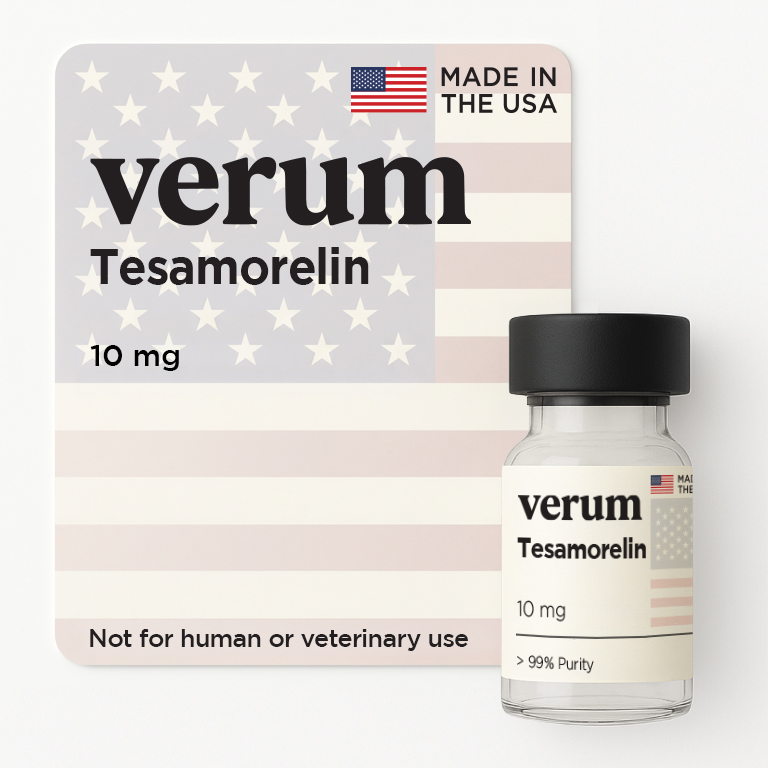 NFC-verified COA on this vial
Peptides
Tesamorelin
$129 $149
In stock · same-day dispatch, 2-day US shipping
- ✓ Third-party HPLC + MS tested
- ✓ NFC-verified COA on the vial
- ✓ Made in the USA
- ✓ Plain, discreet packaging
Research use only. Not for human or veterinary use, or for diagnostic or therapeutic procedures.
Live certificate of analysis
This is the same live record the NFC tag on the vial opens. Match the lot number on the certificate against the one printed on your vial.
The most complete certificate in this catalogue
We say elsewhere on this site that panels differ between products and that a purchaser should read the certificate rather than the marketing. This is the product where that instruction pays off best, and the reason is worth setting out before the document itself.
The endotoxin result is a number. Most certificates in this category, including most in this catalogue, report endotoxin as a bare pass. A pass tells you the laboratory applied a threshold and the sample was under it, without telling you the threshold or how far under. This certificate reports 0.50 endotoxin units per milligram against a limit of 35.00, so the margin is visible rather than implied. That is a materially more useful statement and it is the exception rather than the rule here.
Heavy metals are named individually. Arsenic, cadmium, lead and mercury are each listed with a limit of detection, a limit of quantitation, a specification and a result. All four were not detected. A single line reading "heavy metals: pass" would convey almost nothing by comparison.
And the section that was not run is printed anyway. The residual solvents page appears in full with its column headings and the words "Not Tested" against it. A laboratory that prints an empty section rather than deleting it is telling you what it did not do, which is the harder disclosure and the more informative document.
02
Certificate of analysis - current batch
The interactive verification record is shown below, followed by the same information reproduced as text on this page and the full three-page certificate as a document. The record does not depend on the embed loading.
Certificate of analysis - batch FXBM9F, three pages
Batch record
FXBM9F
| Testing laboratory | Accurate Test Labs, Fort Lauderdale, Florida. Independent third party, not owned by or affiliated with Verum. |
| Sample received | 8 July 2026 |
| Analysis completed | 20 July 2026, across three test dates |
| Sample and laboratory reference | 2607AFL1089.3871 · ATL-37657 |
| Methods | TM-13 peptides · TM-9 heavy metals · endotoxin |
Peptide, batch FXBM9F
| Purity | 99.335 %, reported as a total purity of 99.33 % |
| Content | 8.56 mg per unit - read section 04 before calculating from this figure |
| Mass confirmation | Not reported by this laboratory |
Bacterial endotoxin
| Limit | Result | Status | |
| Endotoxin, EU/mg | 35.00 | 0.50 | Pass |
Heavy metals, parts per billion
| Limit | Result | Status | |
| Arsenic | 1500 | Not detected | Pass |
| Cadmium | 500 | Not detected | Pass |
| Lead | 500 | Not detected | Pass |
| Mercury | 3000 | Not detected | Pass |
Limit of detection 16.3 ppb; limit of quantitation 48.9 ppb, for all four analytes.
Residual solvents
Not tested. The laboratory prints this section on the certificate with its headings intact rather than omitting it.
All figures above are specific to batch FXBM9F and are not specifications carried across other batches. Each batch is tested individually and reports its own results.
03
Identification
| Chemical name | N-trans-3-hexenoyl growth hormone-releasing factor (1-44) amide |
| Common designation | Tesamorelin |
| Length | 44 amino acids, C-terminal amide. The full sequence, not the 29-residue fragment. |
| Modification | A six-carbon unsaturated acyl group on the N-terminal tyrosine. See section 05. |
| Molecular formula | C221H366N72O67S |
| Molecular weight | 5135.9 g/mol |
| CAS number | 218949-48-5 |
| Molecular target | Growth hormone-releasing hormone receptor, anterior pituitary somatotrophs |
| Oxidation-sensitive residues | One methionine and multiple tyrosines. Keep free transition metals and copper-containing preparations out of any solution carrying this peptide. |
| Physical form | White lyophilized powder |
| Quantity supplied | 10 mg nominal per unit; measured content stated per batch, see section 04 |
| Country of manufacture | United States |
04
What the measured content figure means
The certificate above reports 8.56 mg per unit against a 10 mg nominal. That figure is printed here rather than summarised away, and it deserves an explanation rather than a shrug.
A quantity on a peptide unit can mean two different things. Gross fill weight is how much powder went into the container. Peptide content is how much of that powder is the peptide itself. The two are never identical, because a synthesised peptide is isolated as a salt carrying a counterion and because lyophilized material retains residual moisture. On a typical preparation the peptide accounts for roughly seventy to ninety percent of the powder by weight. A container filled honestly to its gross target will still measure below that target when the peptide alone is quantified.
In practice: calculate from the measured figure on the certificate for the batch supplied, not from the nominal on the label. Where a protocol depends on a precise quantity that is the only number worth using. A supplier who does not measure content cannot tell you either way, which is the more common situation in this category.
05
The full sequence, not the fragment
Several compounds in this catalogue act at the same receptor and are usually presented as interchangeable options. They are better understood as one family, and this entry sits apart from the rest of it in a way that is easy to miss.
| Sermorelin | The native 29-residue fragment, unmodified. |
| Modified GRF (1-29) | The same 29-residue backbone with four substitutions. Sold as CJC-1295 without DAC. |
| CJC-1295 | Those four substitutions plus a linker that binds covalently to albumin. |
| Tesamorelin | The complete 44-residue sequence with a hexenoyl group on the N-terminal tyrosine. Fifteen residues longer than every other entry above. |
The others are all built on the 29-residue fragment, which is the portion of the hormone sufficient for receptor activation. This one retains the full endogenous sequence and adds a small unsaturated acyl group at the N-terminus rather than substituting residues within the chain.
Two consequences for study design. A fifteen-residue difference is not a detail: the additional C-terminal region is absent from every other compound in the family, so any contribution it makes is present here and nowhere else. And the modification strategy differs in kind. Substituting residues within a chain and acylating a terminus are different interventions, and material behaviour, aggregation tendency and analytical profile do not transfer between them.
06
Testing scope
Panels differ between products and between batches. What follows is the scope of testing performed on this batch. Nothing is claimed unless it appears on the certificate for the batch supplied.
|
Performed
|
Not performed
|
The absence of a mass confirmation is the one real gap here, and it matters more on a 44-residue chain than on a short peptide. A deletion sequence missing one residue, or material carrying the backbone without its acyl group, differs in mass but may not separate cleanly on a coarse chromatographic method. Where that is material to your work, request a mass spectrum before ordering. Everything else on this certificate is unusually well covered.
07
Storage and laboratory handling
| Lyophilized powder, transit | Stable at ambient temperature during shipping and short-term handling. Cold-chain transport is not required. |
| Lyophilized powder, storage | −20 °C, protected from light, container tightly closed |
| Solubility | Sterile laboratory-grade water or a defined aqueous buffer appropriate to the assay |
| Solution, storage | 2 °C to 8 °C, protected from light. Prepare close to the time of use rather than holding stock. |
| Oxidation | A methionine and several tyrosines make this sequence less forgiving than the short peptides in this catalogue. Minimise headspace and air contact, and keep free transition metals and copper-containing preparations out of any solution carrying this peptide. |
| Acyl group | The N-terminal hexenoyl group gives the molecule more surface character than an unmodified peptide of similar size. Expect some adsorption in dilute working solutions, use low-binding labware, and avoid vigorous agitation. |
| Freeze-thaw | Avoid repeated cycles. Aliquot at first preparation where the protocol allows. |
| Personal protection | Handle under standard laboratory conditions with gloves, eye protection and a laboratory coat. |
Preparation conditions are the responsibility of the receiving laboratory. Verum provides no protocol, no preparation instruction, and no guidance on use.
08
Published literature
This page carries no bibliography. The published record on this compound consists overwhelmingly of registration and post-approval trials conducted in human participants, using pharmaceutical-grade product manufactured to standards this material is not manufactured to. Reproducing that literature beside a research-labelled unit would misrepresent both what is being sold and what those trials examined. Researchers working on growth hormone-releasing hormone receptor pharmacology know where that record lives.
09
Regulatory status
| United States | An approved prescription drug, dispensed under the supervision of a licensed prescriber for a defined indication. The material supplied here is not that product. |
| Compounding | Not on the section 503A bulk drug substances list. |
| By comparison | Of the compounds acting at this receptor, this is the only one holding a current marketing authorisation. Sermorelin held one until 2008 and now has a compounding route. CJC-1295 and ipamorelin were both reviewed by the Pharmacy Compounding Advisory Committee in late 2024 and rejected. Four compounds, four different positions. |
| This material | Supplied as a laboratory reagent. Not manufactured to pharmaceutical standards and not a substitute for a prescribed preparation. |
| Athletic competition | Prohibited under World Anti-Doping Agency rules. |
| Status date | Accurate as of August 2026. Verify the current position independently. |
That comparison is set out because these four compounds are routinely presented as interchangeable options and their legal positions are not remotely equivalent.
10
Purchase eligibility
By placing an order you confirm each of the following:
| ✓ | You are at least 21 years of age. |
| ✓ | You are a qualified researcher, or are purchasing on behalf of a research institution or commercial laboratory. |
| ✓ | The material will be used solely for in vitro laboratory research. |
| ✓ | The material will not be administered to humans or to animals, and will not be resold or transferred for any such purpose. |
| ✓ | You are responsible for compliance with all federal, state and local law governing receipt, handling, storage and use. |
Confirmation is recorded at checkout against your order. Verum reserves the right to decline or cancel any order.
Tesamorelin is available in the United States as an approved prescription medicine. If that is what you are looking for, a licensed prescriber is the correct route and this is not a substitute for it.
11
Supply
Orders placed before the daily cutoff are dispatched the same day from our United States warehouse. Domestic orders typically arrive within two business days. A tracking reference is issued by email once the consignment leaves the facility. Each unit carries a scannable code linking to the certificate for its own batch.
Not for human or veterinary use. Not for use in diagnostic or therapeutic procedures. This product is a laboratory reagent. Nothing on this page constitutes medical advice, a recommendation for personal use, or a representation that this material is safe or effective for any purpose. No statement here has been evaluated by the U.S. Food and Drug Administration.