 Verified COA
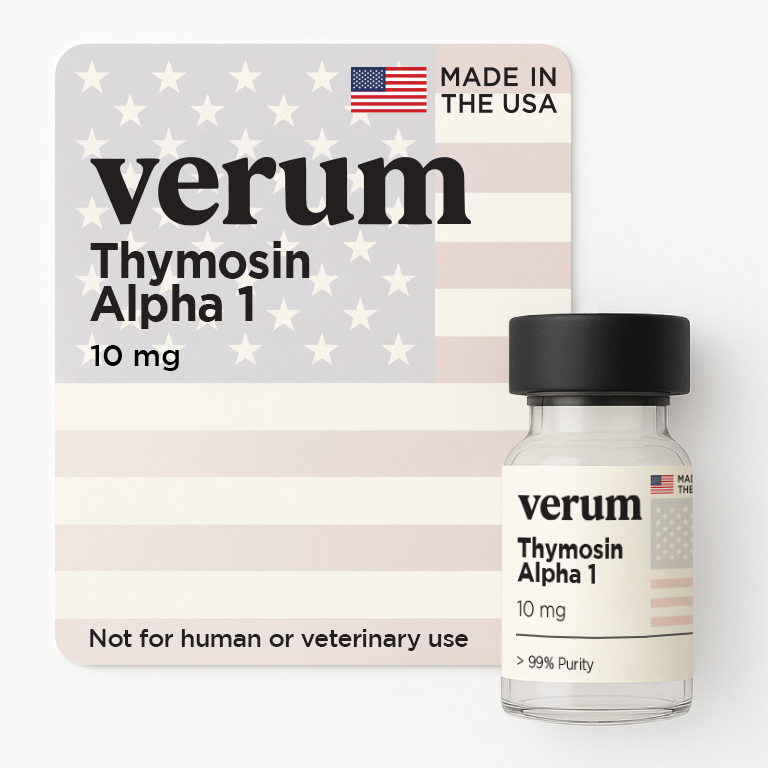 NFC-verified COA on this vial
Peptides
Thymosin Alpha 1
$99 $139
In stock · same-day dispatch, 2-day US shipping
- ✓ Third-party HPLC + MS tested
- ✓ NFC-verified COA on the vial
- ✓ Made in the USA
- ✓ Plain, discreet packaging
Research use only. Not for human or veterinary use, or for diagnostic or therapeutic procedures.
Live certificate of analysis
This is the same live record the NFC tag on the vial opens. Match the lot number on the certificate against the one printed on your vial.
Identification
| Chemical name | N-acetylated 28-residue peptide corresponding to the N-terminal region of prothymosin alpha |
| Common designations | Thymosin alpha 1; Tα1; thymalfasin |
| Sequence | Ac-Ser-Asp-Ala-Ala-Val-Asp-Thr-Ser-Ser-Glu-Ile-Thr-Thr-Lys-Asp-Leu-Lys-Glu-Lys-Lys-Glu-Val-Val-Glu-Glu-Ala-Glu-Asn |
| Length | 28 amino acids, N-terminally acetylated |
| Molecular formula | C129H215N33O55 |
| Molecular weight | 3108.3 g/mol |
| Expected ions | [M+3H]3+ near 1037; [M+4H]4+ near 778 |
| CAS number | 62304-98-7 |
| Charge profile | Strongly acidic. Nine aspartate and glutamate residues against five lysines, with the N-terminal amine blocked by acetylation. |
| Oxidation-sensitive residues | None. The sequence contains no methionine, cysteine, tryptophan or tyrosine. |
| Physical form | White lyophilized powder |
| Quantity supplied | 10 mg nominal per unit |
| Country of manufacture | United States |
02
Certificate of analysis - current lot
The interactive verification record is shown below, followed by the same information reproduced as text on this page and the full certificate as a document. The record does not depend on the embed loading.
Certificate of analysis - lot THYMA10-042026-1
Lot record
THYMA10-042026-1
| Testing laboratory | Freedom Diagnostics, United States. Independent third party, not owned by or affiliated with Verum. |
| Sample received | 14 April 2026 |
| Results reported | 15 April 2026 |
| Accession reference | 2604140268 |
| Analytical methods | HPLC-UV coupled to mass spectrometry (LC-MS). Bacterial endotoxin by limulus amebocyte lysate assay in accordance with USP . |
Results, this lot
| Identity, LC-MS | Confirmed as thymosin alpha-1, named in full on the certificate |
| Purity, HPLC-UV | 99.65 % |
| Net peptide content | 11.87 mg per unit |
| Appearance | White lyophilized powder |
| Bacterial endotoxin | Pass, duplicate replicates. Assay sensitivity ≤0.05 EU/mL |
| Mass confirmation | Ions at m/z 778.0 [M+4H]4+ and 1037.0 [M+3H]3+. Reconstructed independently both give 3108, against an expected 3108.3. |
Purity, content and endotoxin figures above are specific to lot THYMA10-042026-1 and are not specifications carried across other lots. Two independent charge states landing on the same molecular weight is a stronger identity argument than a single ion, because a truncated or deacetylated species shifts both rather than hiding inside one peak.
03
The acetyl group is part of the molecule, not a detail
This peptide is acetylated at its N-terminus, and the modification is not cosmetic. It blocks the free amine that aminopeptidases would otherwise attack, and it removes a positive charge from a molecule that is already strongly acidic. A preparation of the same 28 residues without that acetyl group is a different compound with a different charge state, different stability and a molecular weight 42 daltons lower.
That is a difference the mass detects and a purity percentage does not. Forty-two daltons on a 3108 molecule is a shift of about 1.4 percent, which a competent instrument resolves cleanly and which a single retention time will not. The certificate above reports two charge states, both landing on 3108, so the acetylation is accounted for. It is worth checking on any supplier's certificate rather than assuming, because deacetylated material will still look like a clean peak.
04
Testing scope
Panels differ between products and between lots. What follows is the scope of testing performed on this lot. Nothing is claimed unless it appears on the certificate for the lot supplied.
|
Performed
|
Not performed
|
The first two entries in the right-hand column are the ones specific to this sequence. Acetylation is not reported as a separate parameter, though the observed mass accounts for it. Deamidation matters because a chain this rich in aspartate and glutamate, terminating in asparagine, has several sites at which it can occur, and each adds one dalton without changing the sequence. Where a parameter is material to intended laboratory work, purchasers should verify it independently or source material released against that specification.
05
Storage and laboratory handling
| Lyophilized powder, transit | Stable at ambient temperature during shipping and short-term handling. Cold-chain transport is not required. |
| Lyophilized powder, storage | −20 °C, protected from light, container tightly closed |
| Solubility | Readily soluble in sterile laboratory-grade water or a defined aqueous buffer appropriate to the assay |
| Solution, storage | 2 °C to 8 °C, protected from light. Materially less stable than the dry powder. |
| pH | Strongly acidic character in solution. Hold buffer conditions constant across an experiment rather than varying them between preparations, since solubility and behaviour shift with pH on a molecule carrying this many acidic residues. |
| Sequence-specific note | No oxidation-sensitive residues and a blocked N-terminus, so this sequence carries neither the oxidation liabilities nor the aminopeptidase vulnerability that govern many peptides. Both are genuine advantages and both are frequently overread: neither is stability in aqueous storage, and this peptide hydrolyses in solution like any other. |
| Freeze-thaw | Avoid repeated cycles. Aliquot at first preparation where the protocol allows. |
| Personal protection | Handle under standard laboratory conditions with gloves, eye protection and a laboratory coat. |
Preparation conditions are the responsibility of the receiving laboratory. Verum provides no protocol, no preparation instruction, and no guidance on use.