 Verified COA
 NFC-verified COA on this vial
Peptides
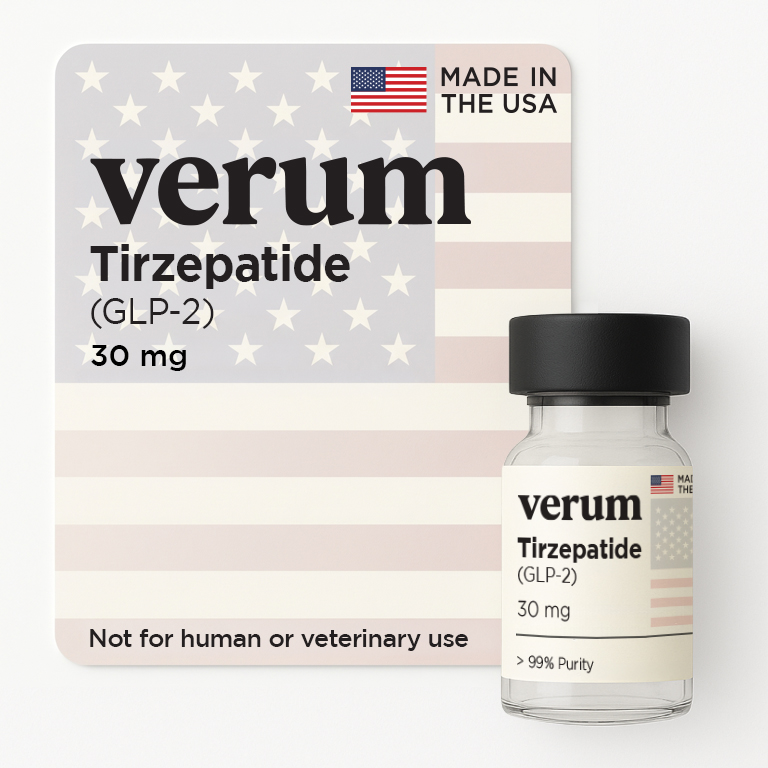
Tirzepatide
From $99
In stock · same-day dispatch, 2-day US shipping
- ✓ Third-party HPLC + MS tested
- ✓ NFC-verified COA on the vial
- ✓ Made in the USA
- ✓ Plain, discreet packaging
Research use only. Not for human or veterinary use, or for diagnostic or therapeutic procedures.
Live certificate of analysis
This is the same live record the NFC tag on the vial opens. Match the lot number on the certificate against the one printed on your vial.
The legal position, stated plainly
This compound sits in a different legal category from most of this catalogue and the distinction is worth understanding before ordering.
Most compounds here are unapproved substances with no marketing authorisation anywhere. This one is an approved medicine in the United States, held under composition-of-matter patent protection, with no approved generic. The originator has pursued an active enforcement programme against compounding pharmacies, telehealth operators and clinics supplying unlicensed versions, and courts have allowed several of those actions to proceed.
The compounding route that existed has closed. While the approved product was in shortage, compounding pharmacies could prepare copies under the exemptions that apply during a listed shortage. That shortage was declared resolved at the end of 2024 and those exemptions ended with it. There is no longer a lawful compounding pathway for this substance in the United States.
We state this because a customer who assumes the shortage-era position still holds is working from a picture more than eighteen months out of date. Material supplied on this page is a laboratory reagent, sold for in vitro research, and nothing about it constitutes a route to the approved product.
02
Identification
| Molecule class | Acylated peptide; agonist at the GIP and GLP-1 receptors |
| Development code | LY3298176 |
| Length | 39 amino acids, C-terminal amide |
| Backbone origin | Modified glucose-dependent insulinotropic polypeptide sequence |
| Non-coded residues | Alpha-aminoisobutyric acid at positions 2 and 13 |
| Acyl chain | C20 diacid on Lys20, attached through a gamma-glutamate spacer and two ethylene glycol units |
| Molecular weight | 4813.5 g/mol |
| Expected ions | [M+3H]3+ near 1605; [M+4H]4+ near 1204. Sodium and potassium adducts near 1209 and 1214 are expected rather than contaminants. |
| CAS number | 2023788-19-2 |
| Physical form | White lyophilized powder |
| Fill sizes | 10, 30, 60 and 100 mg nominal per unit |
| Country of manufacture | United States |
03
Check identity yourself, in ten seconds
This molecule has a molecular weight of 4813.5. On a peptide that size electrospray produces a series of multiply charged ions rather than one peak, and the arithmetic is simple enough to do without a calculator. Take the triply protonated ion, multiply by three, subtract three protons. Take the quadruply protonated ion, multiply by four, subtract four. Both should land near 4813.
That check is worth doing rather than trusting a name printed in a field. It confirms the molecular weight of the material the instrument actually saw, it takes seconds, and neither a deletion sequence nor an unacylated backbone will satisfy it. All four certificates below print the ions, and all four reconstruct to approximately 4813. Some traces also show sodium or potassium adducts alongside the main series, which is ordinary instrument behaviour rather than an impurity.
04
Certificates of analysis - current lots
Each size is tested and released separately and carries its own certificate. All four are set out below: the interactive verification record, the certificate document, and the same information reproduced as text on this page. The panels are not identical across the four current lots, which is why they are presented separately rather than combined.
10 mg
Certificate of analysis - lot GT10-032026-1, 10 mg
Your browser cannot display the embedded document.
Lot record - 10 mg
GT10-032026-1
| Testing laboratory | Freedom Diagnostics, United States. Independent third party, not owned by or affiliated with Verum. |
| Dates | Received 10 March 2026; reported 11 March 2026 |
| Accession reference | 2603100139 |
| Methods | HPLC-UV coupled to mass spectrometry (LC-MS). Bacterial endotoxin threshold, duplicate replicates. |
| Purity, HPLC-UV | 99.784 % |
| Net peptide content | 10.43 mg per unit |
| Appearance | White lyophilized powder |
| Bacterial endotoxin | Pass, duplicate replicates |
| Mass confirmation | Triply protonated ion at m/z 1605.35 with a potassium adduct near 1214, reconstructing to approximately 4813 |
30 mg
Certificate of analysis - lot GT30-032026-4, 30 mg
Your browser cannot display the embedded document.
Lot record - 30 mg
GT30-032026-4
| Testing laboratory | Freedom Diagnostics, United States. Independent third party, not owned by or affiliated with Verum. |
| Dates | Received 20 March 2026; reported 22 March 2026 |
| Accession reference | 2603200152 |
| Methods | HPLC-UV coupled to mass spectrometry (LC-MS). Bacterial endotoxin threshold, duplicate replicates. |
| Purity, HPLC-UV | 99.617 % |
| Net peptide content | 32.22 mg per unit |
| Appearance | White lyophilized powder |
| Bacterial endotoxin | Pass, duplicate replicates |
| Mass confirmation | Ions at m/z 1204.10 [M+4H]4+ and 1605.25 [M+3H]3+, both reconstructing to approximately 4813 |
60 mg
Certificate of analysis - lot GT60-12192025-H, 60 mg
Your browser cannot display the embedded document.
Lot record - 60 mg
GT60-12192025-H
| Testing laboratory | Freedom Diagnostics, United States. Independent third party, not owned by or affiliated with Verum. |
| Dates | Received and reported 22 December 2025 |
| Accession reference | 2512200007 |
| Method | HPLC-UV coupled to mass spectrometry (LC-MS) |
| Purity, HPLC-UV | 99.978 %, the highest figure across the four current lots |
| Net peptide content | 65.54 mg per unit |
| Appearance | White lyophilized powder |
| Mass confirmation | Triply protonated ion at m/z 1604.73 with a sodium adduct at 1209.43, reconstructing to approximately 4813 |
| Bacterial endotoxin | Not tested on this lot. The 10 mg and 30 mg lots carry it. |
100 mg
Certificate of analysis - lot 10064, 100 mg
Your browser cannot display the embedded document.
Lot record - 100 mg
10064
| Testing laboratory | Freedom Diagnostics, United States. Independent third party, not owned by or affiliated with Verum. |
| Dates | Received 29 January 2026; reported 31 January 2026 |
| Accession reference | 2601290075 |
| Method | HPLC-UV coupled to mass spectrometry (LC-MS) |
| Purity, HPLC-UV | 99.747 % |
| Net peptide content | 94.97 mg per unit - below the 100 mg nominal; see section 05 |
| Appearance | White lyophilized powder |
| Mass confirmation | Triply protonated ion at m/z 1604.53 with a sodium adduct at 1209.23, reconstructing to approximately 4813 |
| Bacterial endotoxin | Not tested on this lot. The 10 mg and 30 mg lots carry it. |
All figures above are specific to the lots named and are not specifications carried across other lots. Two of the four carry endotoxin testing and two do not, and one reports content below its nominal while three report above it. Those differences are stated rather than averaged into a single figure for the product, because the certificate that matters is the one supplied with your unit.
05
Reading the content figures across four sizes
Three of the four lots report net peptide content above their nominal and one reports below it. Set out together they look like this.
| Nominal | Measured | Endotoxin | |
| 10 mg | 10.00 | 10.43 mg | Tested |
| 30 mg | 30.00 | 32.22 mg | Tested |
| 60 mg | 60.00 | 65.54 mg | Not tested |
| 100 mg | 100.00 | 94.97 mg | Not tested |
A quantity on a peptide unit can mean two different things. Gross fill weight is how much powder went into the container. Net peptide content is how much of that powder is the peptide itself, with counterion and residual moisture excluded. The two are never identical, which is why a figure can land either side of a nominal without either result being wrong in itself.
In practice: calculate from the measured figure on the certificate for the lot supplied, not from the nominal on the label, and not from the figures above unless your unit carries one of these lot numbers. Where a protocol depends on a precise quantity that is the only number worth using.