Research guide
TB-500 vs thymosin beta-4
Updated September 24, 2026
TB-500 is a trade designation, not a chemical name, and it is sold as two different molecules. One is an acetylated seven-residue fragment, Ac-LKKTETQ, of about 888.5 g/mol. The other is full-length thymosin beta-4, a 43-residue protein of about 4,963 g/mol. They differ in mass more than fivefold and are not interchangeable. The observed mass on the certificate tells you which one you have.
The two molecules side by side
| TB-500 fragment | Thymosin beta-4 | |
|---|---|---|
| What it is | Acetylated fragment of the actin-binding region | Full-length protein |
| Length | 7 amino acids, N-terminally acetylated | 43 amino acids |
| Sequence | Ac-Leu-Lys-Lys-Thr-Glu-Thr-Gln | 43-residue sequence |
| Molecular weight | About 888.5 g/mol | About 4,963 g/mol |
| CAS number | Not listed in the product identification | 77591-33-4 |
| Oxidation-sensitive residues | None | Methionine at position 6 |
| Expected ions | [M+H]+ near 889; [M+2H]2+ near 445 | Reported on the lot certificate |
Why the difference matters in research
The fragment corresponds to a short internal region of the 43-residue protein. It is a fragment of that protein, not a shortened version with equivalent behaviour. Results obtained with one should not be compared against results obtained with the other, and a protocol written for one does not transfer to the other.
How to tell which one you have
The label will not settle it, because both are sold as TB-500. The mass confirmation on the certificate will. A certificate for the fragment shows ions consistent with about 888.5 g/mol; a certificate for the full protein shows a mass near 4,963 g/mol. If a supplier cannot show the observed mass, you cannot know which molecule you bought.
What Verum sells under each name
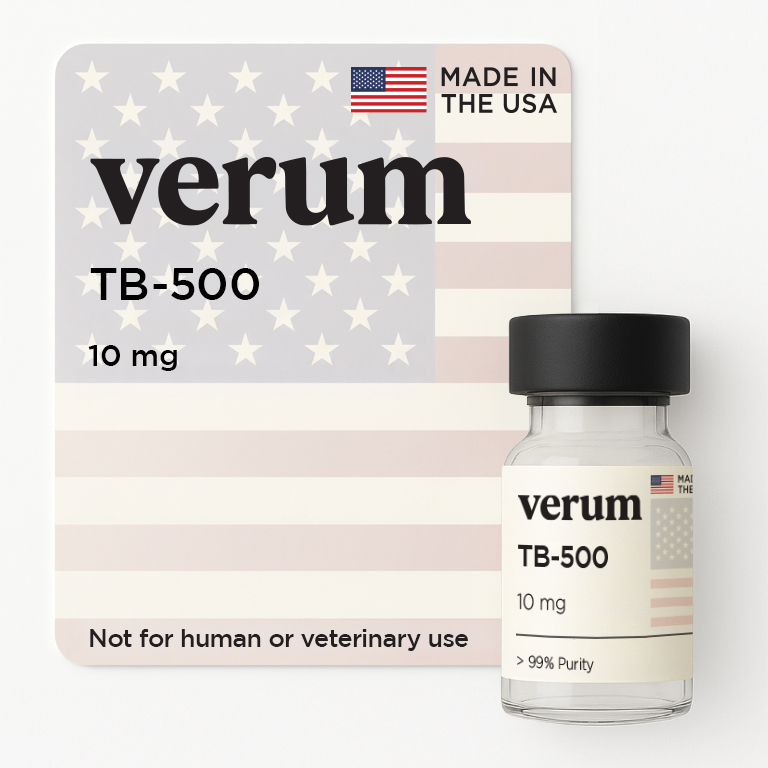
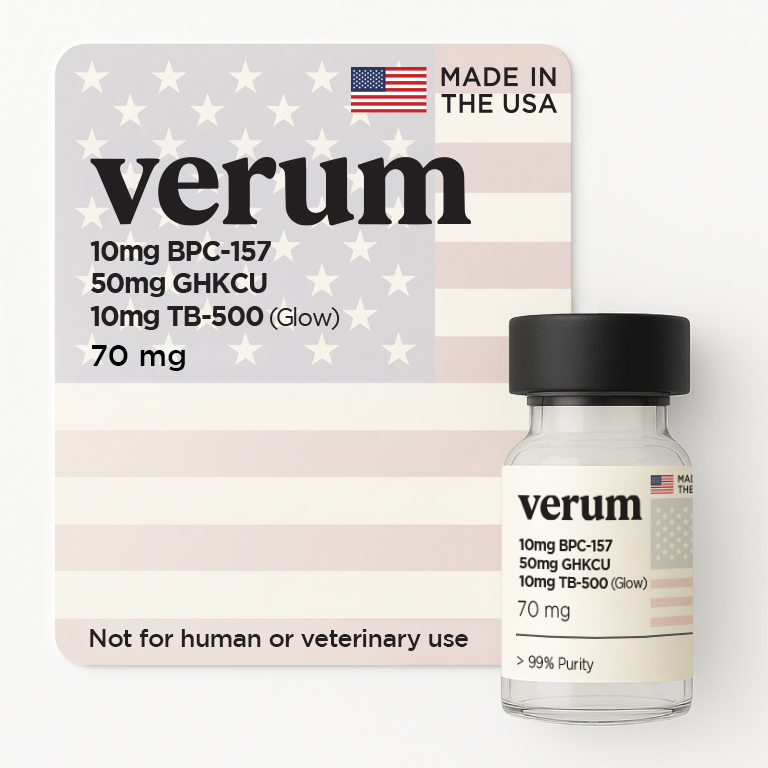
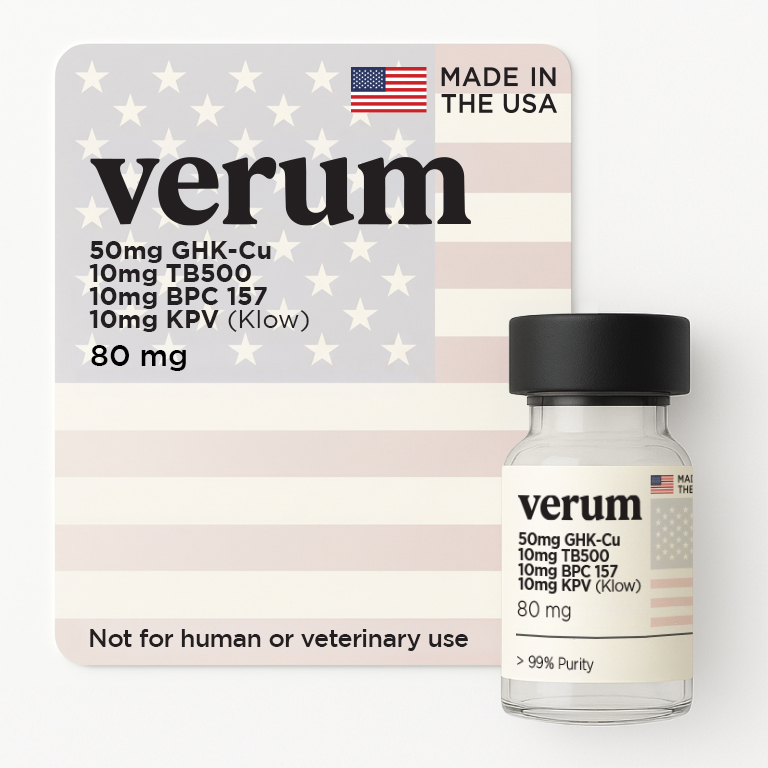
The TB-500 listing is the acetylated seven-residue fragment, confirmed by mass on the current lot. The BPC-157 + TB-500 blend, GLOW and KLOW blends contain the full-length 43-residue protein, named as thymosin beta-4 on their certificates. We sell both and state which is which.
Frequently asked questions
What is the CAS number of thymosin beta-4?
77591-33-4 for the full-length 43-residue protein. No CAS number is listed in the identification data for the seven-residue TB-500 fragment.
Is TB-500 the same as thymosin beta-4?
Not necessarily. TB-500 is a trade name used for both a 7-residue acetylated fragment (about 888.5 g/mol) and the full 43-residue thymosin beta-4 protein (about 4,963 g/mol). They are different molecules.
What is the sequence of the TB-500 fragment?
Ac-Leu-Lys-Lys-Thr-Glu-Thr-Gln (Ac-LKKTETQ), seven amino acids with an N-terminal acetyl group.
How do I know which TB-500 molecule I have?
Check the mass confirmation on the lot certificate. The fragment shows ions consistent with about 888.5 g/mol; the full protein is near 4,963 g/mol.
Research use only. All products sold by Verum are intended for laboratory and in vitro research use only. They are not for human consumption, veterinary use, diagnostic, or therapeutic applications, and have not been evaluated by the U.S. Food and Drug Administration.