Research guide
Bacteriostatic water vs sterile water
Updated September 24, 2026
Bacteriostatic water is sterile water with benzyl alcohol, a preservative that inhibits the growth of organisms introduced during repeated access. It does not sterilise a solution. Sterile water has no preservative. The preservative is cytotoxic to cultured cells, so for cell-based assays and sensitive readouts, sterile water or a defined buffer is the correct choice.
What the preservative does, and does not do
Benzyl alcohol is bacteriostatic rather than bactericidal. It does not sterilise a solution and does not reverse contamination that has already occurred. It inhibits the multiplication of organisms introduced during handling, which is why a preserved diluent tolerates being accessed more than once where an unpreserved one does not. That is the whole functional difference. It is a handling property, not a quality advantage.
When bacteriostatic water is the wrong diluent
Benzyl alcohol is cytotoxic to cultured cells at concentrations below those present in a preserved diluent. Adding it to a cell-based assay puts a second active component in every well, and any observed effect carries the preservative's contribution. The same logic applies to enzyme kinetics, binding assays with sensitive readouts, and anything downstream of mass spectrometry. For that work, sterile water or a defined buffer is correct.
When it earns its place
A preserved diluent is useful where a stock must be accessed repeatedly over time and the preservative is inert to the measurement. Compatibility with any particular compound is not guaranteed; establishing suitability is part of the experimental design and rests with the receiving laboratory.
Choosing a volume
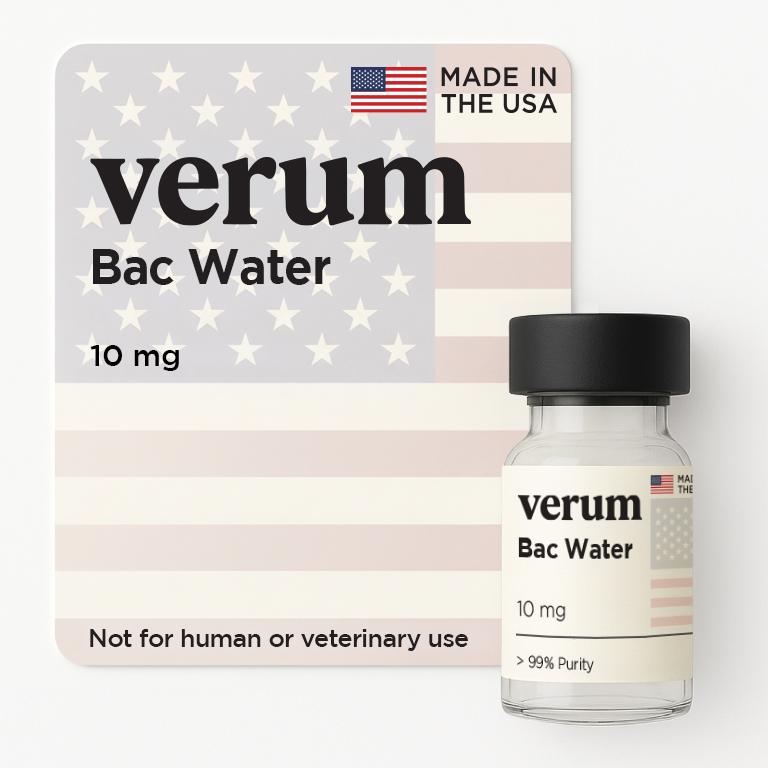
Match the volume to what will actually be used. A larger container is not automatically better value: a preserved diluent accumulates handling risk with every access. Verum supplies bacteriostatic water in 3 mL and 10 mL.
Frequently asked questions
What is the difference between bacteriostatic water and sterile water?
Bacteriostatic water contains benzyl alcohol, a preservative that inhibits growth of organisms introduced during repeated access. Sterile water has no preservative. Neither sterilises a contaminated solution.
Can bacteriostatic water be used in cell culture assays?
It is the wrong choice. Benzyl alcohol is cytotoxic to cultured cells and adds a second active component to the assay. Use sterile water or a defined buffer.
Does benzyl alcohol sterilise a solution?
No. It is bacteriostatic, not bactericidal, and does not reverse contamination that has already occurred.
Research use only. All products sold by Verum are intended for laboratory and in vitro research use only. They are not for human consumption, veterinary use, diagnostic, or therapeutic applications, and have not been evaluated by the U.S. Food and Drug Administration.