Research guide
BPC-157 vs TB-500
Updated September 24, 2026
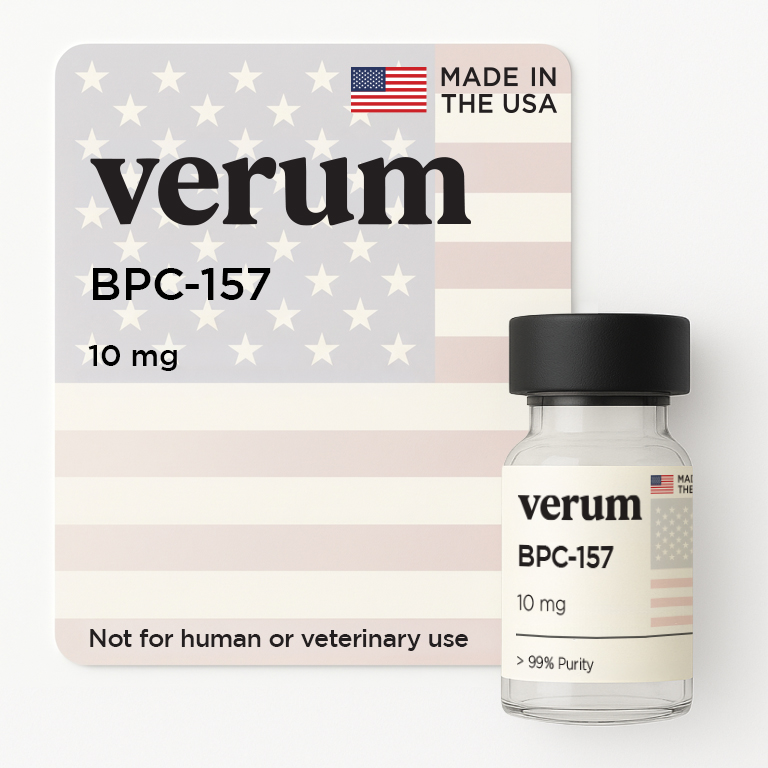
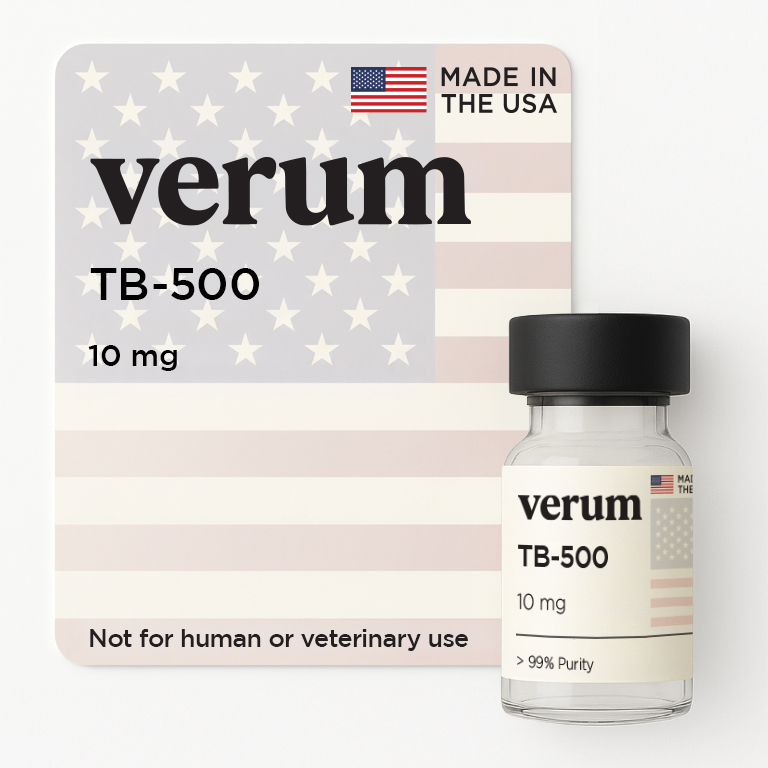
BPC-157 and TB-500 are unrelated peptides. BPC-157 is a 15-residue synthetic peptide (GEPPPGKPADDAGLV, 1419.5 g/mol, CAS 137525-51-0). TB-500, as sold by Verum, is a 7-residue acetylated fragment of thymosin beta-4 (Ac-LKKTETQ, about 888.5 g/mol). Neither sequence contains methionine, cysteine, tryptophan or tyrosine. Both are supplied as white lyophilized powder for laboratory research only.
Identity at a glance
| BPC-157 | TB-500 (fragment) | |
|---|---|---|
| Origin of sequence | Partial sequence identified in gastric juice | Actin-binding region of thymosin beta-4 |
| Sequence | Gly-Glu-Pro-Pro-Pro-Gly-Lys-Pro-Ala-Asp-Asp-Ala-Gly-Leu-Val | Ac-Leu-Lys-Lys-Thr-Glu-Thr-Gln |
| Length | 15 amino acids, linear, free termini | 7 amino acids, N-terminally acetylated |
| Molecular formula | C62H98N16O22 | See lot certificate |
| Molecular weight | 1419.5 g/mol | About 888.5 g/mol |
| CAS number | 137525-51-0 | Not listed in the product identification |
| Oxidation-sensitive residues | None | None |
| Physical form | White lyophilized powder | White lyophilized powder |
A note on the TB-500 name
TB-500 is also used for the full 43-residue thymosin beta-4 protein, a different molecule of about 4,963 g/mol. Any comparison with BPC-157 has to state which TB-500 is meant. See TB-500 vs thymosin beta-4.
Handling in the laboratory
Because neither sequence carries methionine, cysteine, tryptophan or tyrosine, neither has the oxidation liabilities that govern handling for many peptides. That is not a case for indefinite stability in solution; ordinary aqueous hydrolysis still applies. As lyophilized powder both are stable at ambient temperature in transit and are stored at -20 °C, protected from light. See lyophilized peptide storage.
The published literature
The published primary studies on both compounds were conducted in cultured cells or in animals. For BPC-157 these include rodent tendon explant culture, cultured tendon fibroblasts, chick chorioallantoic membrane and endothelial assays, and rodent and canine pharmacokinetic studies. Each Verum product page lists its references by experimental system and states what each study measured, not what it concluded. Verum has no involvement in this work and makes no representation as to its applicability.
Research combinations
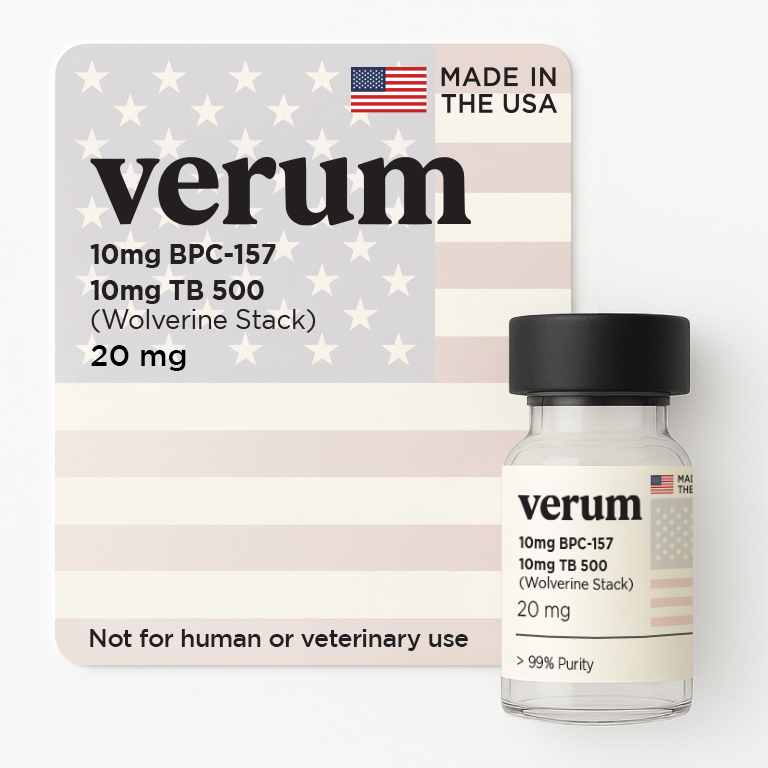
Both names appear in multi-compound research blends. In Verum's BPC-157 + TB-500 blend, and in the GLOW and KLOW blends, the TB-500 component is the full-length thymosin beta-4 protein (about 4,963 g/mol, CAS 77591-33-4, containing methionine at position 6), not the seven-residue fragment. The certificate for each blend names it.
Frequently asked questions
What is the difference between BPC-157 and TB-500?
They are unrelated molecules. BPC-157 is a 15-residue peptide of 1419.5 g/mol. TB-500, as the fragment, is a 7-residue acetylated peptide of about 888.5 g/mol derived from thymosin beta-4.
What is the CAS number of BPC-157?
137525-51-0. Its molecular formula is C62H98N16O22 and its molecular weight is 1419.5 g/mol.
Are BPC-157 and TB-500 for human use?
No. Verum supplies both strictly for laboratory and in vitro research. They are not for human or veterinary use.
Research use only. All products sold by Verum are intended for laboratory and in vitro research use only. They are not for human consumption, veterinary use, diagnostic, or therapeutic applications, and have not been evaluated by the U.S. Food and Drug Administration.